
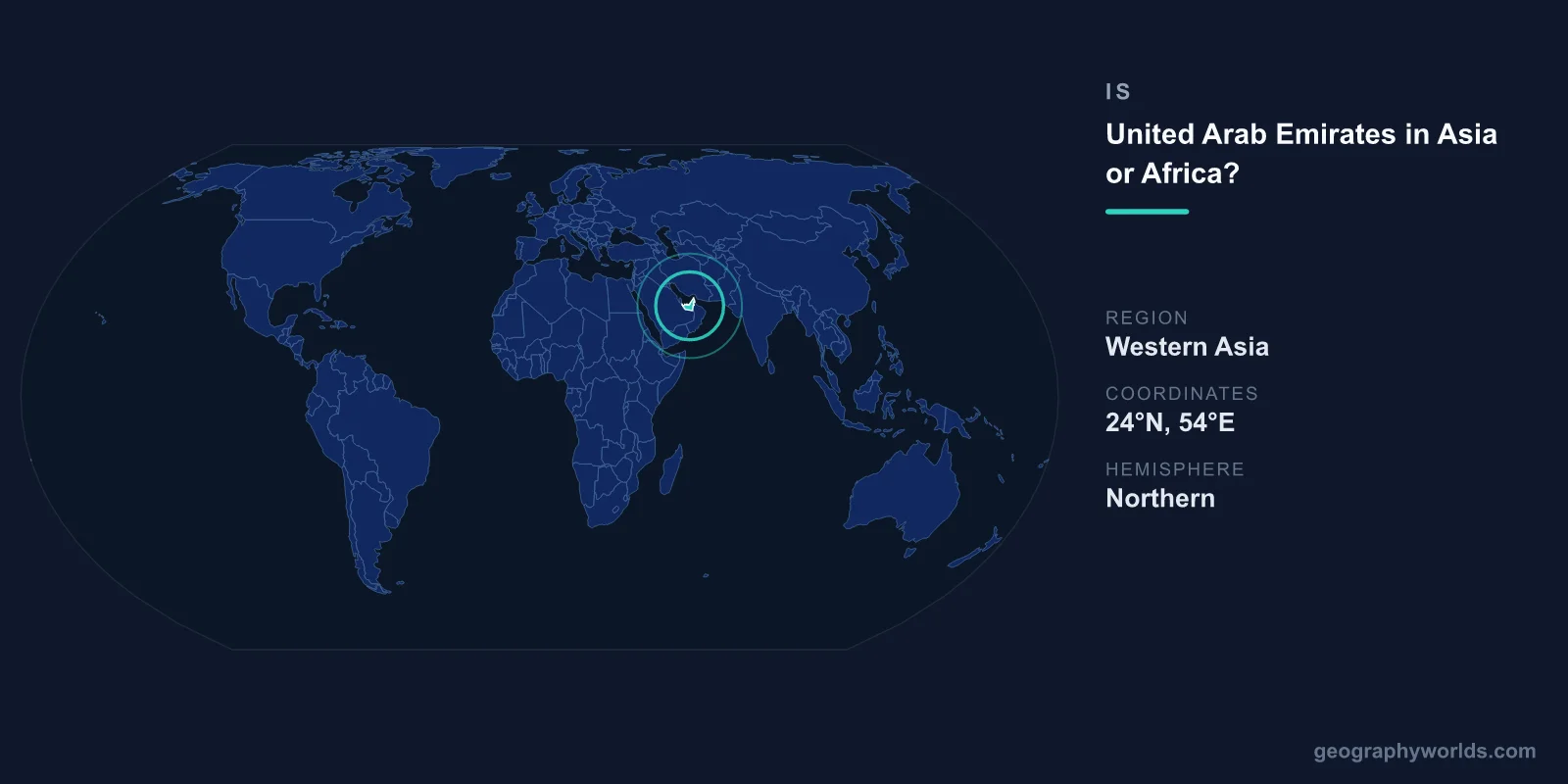
The United Arab Emirates is in Asia, not Africa. It lies on the southeastern Arabian Peninsula in the region geographers call Western Asia (or the Middle East), bordered by the Persian Gulf to the north and the Gulf of Oman to the east. While the country sits close to the African continent across the Red Sea and the Gulf of Aden, every standard geographic classification places the UAE firmly in Asia.
Why the UAE Belongs to Asia
The Arabian Peninsula, on which the UAE rests, is the southwestern extension of the Asian landmass. The UAE shares land borders with two other Asian nations: Saudi Arabia to the south and west, and Oman to the east and northeast. There is no land connection to Africa at all. The only thing separating Arabia from Africa is water, and even the narrowest gap, the Bab-el-Mandeb strait between Yemen and Djibouti, lies well over a thousand kilometres from UAE territory.
The United Arab Emirates is a federation of seven emirates: Abu Dhabi, Dubai, Sharjah, Ajman, Umm Al Quwain, Ras Al Khaimah, and Fujairah. Abu Dhabi alone accounts for roughly 87 percent of the country's total land area of about 83,600 square kilometres. The capital, Abu Dhabi city, and the United Nations both classify the country within Western Asia.
Where Exactly Is the UAE Located?
The UAE sits at approximately 24 degrees north latitude and 54 degrees east longitude. Most of the interior is flat, sandy desert that merges with the vast Rub al Khali, or Empty Quarter, the largest continuous sand desert on Earth. In the east, the Hajar Mountains rise to around 1,900 metres in Ras Al Khaimah and Fujairah, giving the country its only significant relief.
Crucially, the UAE has coastlines on two different bodies of water. Its long northern shore faces the Persian Gulf, where Dubai and Abu Dhabi are located, while the emirate of Fujairah looks out onto the Gulf of Oman, which opens to the Arabian Sea and the Indian Ocean. This dual-coast position has made the UAE a maritime crossroads for thousands of years, but both of those seas are Asian waters.
Why People Confuse the UAE With Africa
The confusion is understandable. Geologically, the Arabian Peninsula was once joined to Africa and broke away only about 30 million years ago when the Red Sea began to open, riding on the Arabian Plate as it drifted northeast. The two regions still look like puzzle pieces that once fit together.
Cultural and historical ties add to the blur. For centuries, Arab traders sailed dhows down the East African coast, and the UAE's location near the Horn of Africa fostered deep connections in commerce, language, and religion. Today, the cosmopolitan skylines of Dubai and Abu Dhabi attract residents from every continent, including large African communities, which can make the country feel hard to pin to a single region. Many people also lump "Arab countries" together without distinguishing North African nations like Egypt and Morocco from Asian ones like the UAE. Despite all of this, the geographic verdict is clear: the UAE is in Asia.
The UAE Within Asia and the Middle East
Within Asia, the UAE belongs to the subregion most commonly called the Middle East or the Gulf. It is a member of the Gulf Cooperation Council (GCC) alongside Saudi Arabia, Kuwait, Qatar, Bahrain, and Oman, all Asian states. Arabic is the official language, and the country uses the dirham as its currency.
In just over fifty years since its formation in 1971, the UAE has transformed from an economy built on pearl diving and fishing into one of the wealthiest and most globally connected nations on Earth. Today it is home to roughly 9.9 million people, though only about one in ten are Emirati citizens; the rest are expatriate workers. Dubai's Burj Khalifa, standing 828 metres tall, is the tallest building in the world, a fitting symbol of how rapidly this corner of Asia has risen. To learn more about the nation's geography, economy, and culture, see our united arab emirates country guide.
Frequently Asked Questions
Is the UAE part of the Middle East?
Yes. The UAE is part of the Middle East, a term that describes a region spanning Western Asia and parts of North Africa. The UAE specifically falls within the Asian portion of the Middle East, on the Arabian Peninsula.
Is the UAE in the Persian Gulf region?
Yes. The UAE's northern coastline runs along the Persian Gulf, and it is one of the six Gulf states in the Gulf Cooperation Council. Its eastern emirate of Fujairah also borders the Gulf of Oman.
What continent is Dubai in?
Dubai is in Asia. As the largest city of the United Arab Emirates, it sits on the Persian Gulf coast of the Arabian Peninsula, well within the Asian continent.
Does the UAE border any African country?
No. The UAE shares land borders only with Saudi Arabia and Oman, both Asian countries. It has no land border with any African nation, and the African continent lies across the sea to the west.