
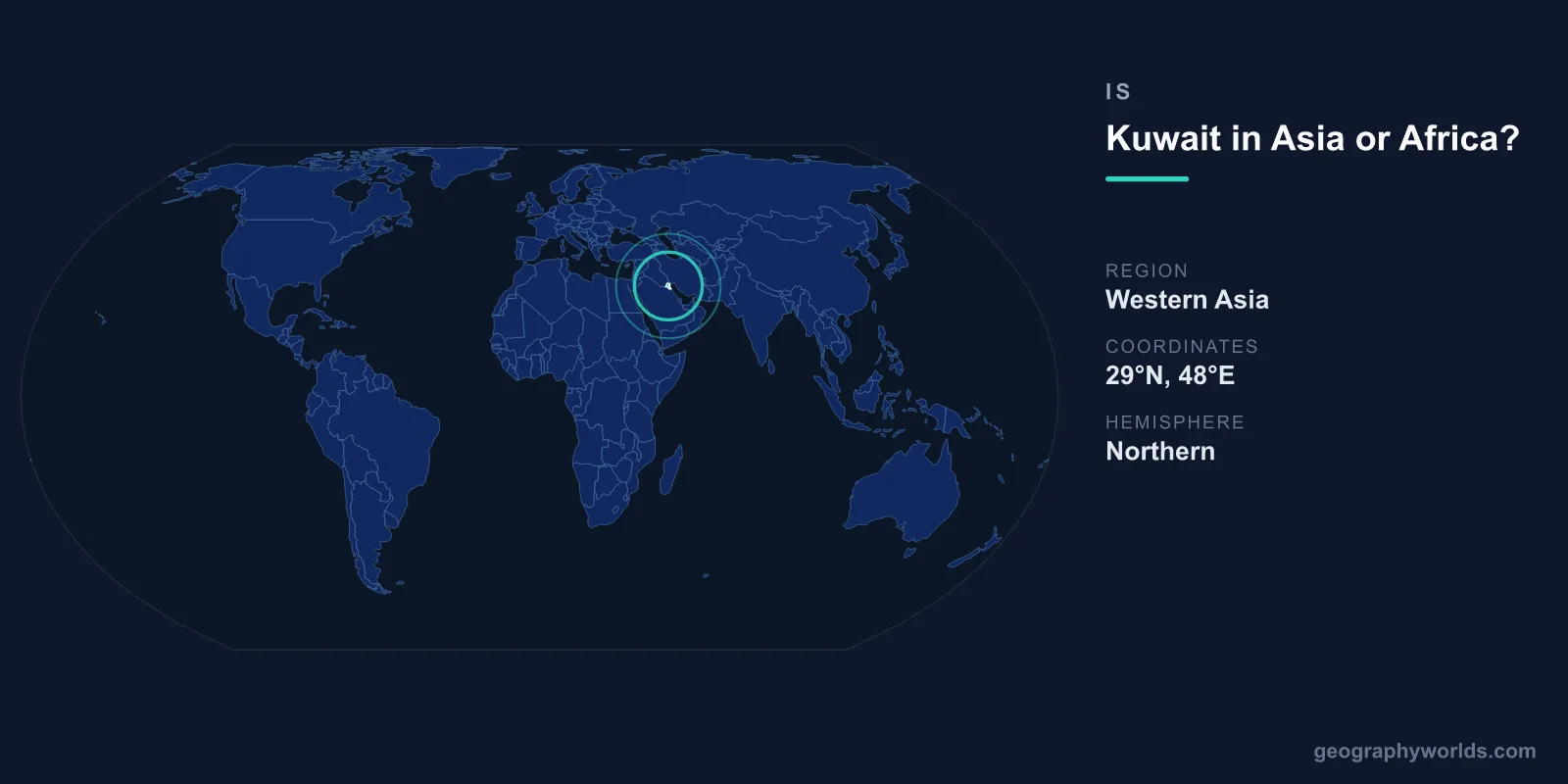
Kuwait is in Asia, not Africa. It sits in Western Asia at the northwestern corner of the Persian Gulf, sharing land borders with Iraq and Saudi Arabia. Although Kuwait is often described simply as a "Middle Eastern" country, that label is a regional and cultural term rather than a continental one. Geographically, Kuwait belongs firmly to the Asian continent.
Kuwait Is in Asia, in the Persian Gulf Region
Kuwait occupies a small wedge of land at the head of the Persian Gulf, between roughly 28 and 30 degrees north latitude and 46 to 48 degrees east longitude. Every one of its borders connects it to other Asian states: Iraq lies to the north and west, and Saudi Arabia lies to the south. Its eastern edge meets the warm waters of the Persian Gulf, which is part of the Indian Ocean system. Nowhere does Kuwait touch the African continent, and no part of its territory crosses into Africa.
The country is part of the Arabian Peninsula, the large landmass that forms the southwestern corner of Asia. The Arabian Peninsula is separated from Africa by the Red Sea, a substantial body of water that marks the clear boundary between the two continents. Kuwait sits far to the northeast of that divide, hundreds of kilometres from the nearest African shoreline.
Why People Wonder If Kuwait Is in Africa
The confusion usually comes from how the term "Middle East" is used. The Middle East is a geopolitical and cultural region that straddles the meeting point of three continents: Asia, Africa, and Europe. Because countries like Egypt sit at this junction and have land in Africa, people sometimes assume that all Middle Eastern nations might be African too. Kuwait, however, is squarely on the Asian side.
Kuwait's flat, sandy desert landscape also resembles parts of North Africa, which can reinforce the mix-up visually. Hot, arid plains and dune-dotted horizons look much the same whether they are in the Sahara or the Arabian Peninsula. But scenery does not determine which continent a country belongs to. By every standard geographic definition, Kuwait is an Asian country, specifically within the subregion known as Western Asia.
Kuwait's Landscape and Geography
Kuwait is a small nation, covering roughly 17,818 square kilometres, which makes it smaller than the U.S. state of New Jersey. Despite its modest size, its geography is distinctive. The terrain is overwhelmingly flat to gently rolling desert, with very little natural vegetation and no permanent rivers or lakes. The highest points are low ridges rather than true mountains.
The country also includes nine islands in the Persian Gulf. The largest of these is Bubiyan, a low-lying island connected to the mainland by a bridge, while Failaka Island has a long history of human settlement stretching back thousands of years. Kuwait Bay forms a natural deep-water harbour that has supported trade, pearling, and fishing for centuries, and it remains central to the country's shipping and ports today.
Kuwait's climate is one of the most extreme on Earth. Summer temperatures routinely climb above 45 degrees Celsius and have been recorded exceeding 50 degrees Celsius (122 degrees Fahrenheit), placing it among the hottest inhabited places anywhere. Rainfall is scarce and concentrated in the cooler winter months. You can learn more in our kuwait country guide.
People, Capital, and Economy
The capital is Kuwait City, which sits on the southern shore of Kuwait Bay and serves as the political, financial, and cultural heart of the country. The nation's population is roughly 4.3 million people, a large share of whom are expatriate workers from across Asia and the Arab world. Arabic is the official language, and Islam is the predominant religion.
Kuwait's economy is built on oil. The country sits atop a remarkable share of the planet's proven petroleum reserves, estimated at around 6 percent of the global total, despite its tiny footprint. Oil exports have transformed Kuwait from a modest port and pearling settlement into one of the wealthiest nations per capita in the world. The iconic Kuwait Towers, completed in the late 1970s, stand as a symbol of this rapid modernization.
How Kuwait Fits Into Asia
Asia is the largest and most populous continent on Earth, and it contains enormous diversity, from the frozen tundra of Siberia to the tropical islands of Southeast Asia. Western Asia, where Kuwait sits alongside neighbours such as Iraq, Saudi Arabia, Iran, and the United Arab Emirates, is one of its key subregions. This area is sometimes informally called the Middle East, but in continental terms it is unambiguously part of Asia. So when classifying Kuwait by continent, the answer is always Asia.
Frequently Asked Questions
Is Kuwait in the Middle East?
Yes. Kuwait is considered a Middle Eastern country. The Middle East is a regional label that includes parts of Western Asia and North Africa, and Kuwait falls within its Western Asian portion.
What continent is Kuwait on?
Kuwait is on the continent of Asia, specifically in the subregion of Western Asia on the Arabian Peninsula. It is not in Africa or Europe.
What countries border Kuwait?
Kuwait shares land borders with two countries: Iraq to the north and west, and Saudi Arabia to the south. To the east it is bordered by the Persian Gulf.
How far is Kuwait from Africa?
Kuwait is separated from Africa by the Arabian Peninsula and the Red Sea. The nearest African coastline lies well over a thousand kilometres to the southwest, so Kuwait is firmly an Asian country.