
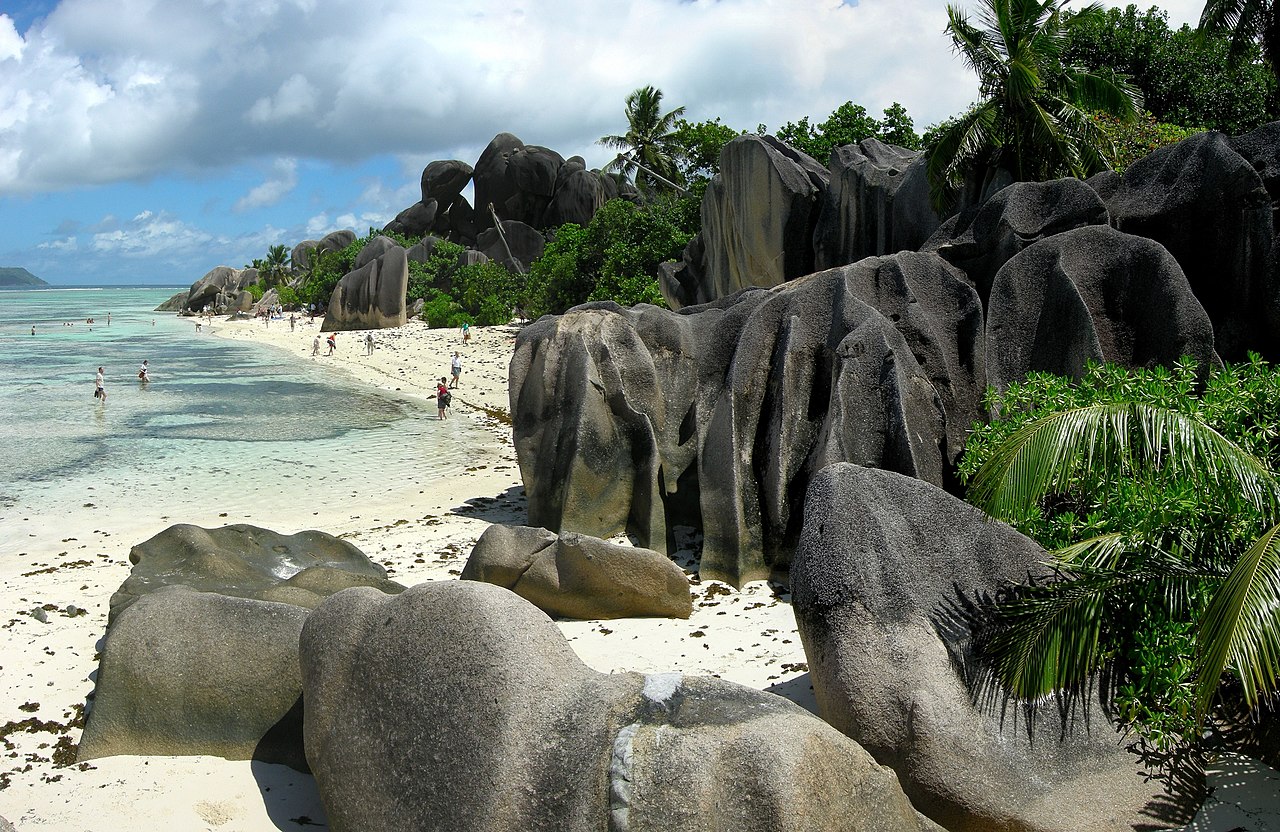
Seychelles is in Africa, not Asia. The island republic lies in the western Indian Ocean, northeast of Madagascar, with its capital Victoria about 1,500 km east of the African mainland and about 1,600 km east of Kenya. The United Nations statistical scheme places it in Eastern Africa, it has been a member of the Organisation of African Unity and then the African Union since independence on 29 June 1976, and it belongs to the Southern African Development Community. It is the smallest African country by area (457 km²) and the least populous, with an estimated 100,600 people in 2022. The Asian question arises because the granite under its main islands once lay against India, and because much of its culture arrived from across the ocean, but neither changes the classification.
Where the Africa–Asia Line Runs, and Why the Somali Sea Falls on the African Side
On land, the convention is simple. The line most geographers use to divide Africa from Asia runs through the Isthmus of Suez, the narrow neck between the Mediterranean and the Gulf of Suez now followed by the Suez Canal, and then down the Red Sea and out through the Gulf of Aden. Everything west and south of that line is Africa; the Arabian Peninsula and everything east of it is Asia. The convention leaves Egypt as a transcontinental country, with the Sinai Peninsula on the Asian side.
The open Indian Ocean has no such line, so islands are assigned by association rather than by a surveyed boundary. In practice that means nearest mainland, shared continental shelf, history and politics. The standard reference on continental boundaries notes that Comoros, Madagascar, Mauritius and Seychelles are island countries nominally associated with Africa. The same reasoning works the other way for Socotra: the archipelago sits on Africa's continental shelf off the Horn of Africa but belongs politically to Yemen, an Asian country, and is generally grouped with Asia for that reason. Further east, the Maldives, Lakshadweep and Sri Lanka are grouped with South Asia because the nearest mainland is India.
Seychelles sits in the Somali Sea, the part of the Indian Ocean off the coast of Somalia, between about 4° and 10° south of the Equator. Its nearest large neighbours are African: Madagascar to the southwest, the Comoros and the French department of Mayotte beyond Aldabra, and the Somali and Kenyan coasts to the west. India is roughly twice as far away as the African mainland. On the "nearest continent" test alone, Africa wins clearly.

Granite from Gondwana: Why Mahé Once Touched India
The strongest argument anyone could make for Asia is geological, and it is a real one. Unlike almost every other oceanic island group, the main islands of Seychelles are not volcanic and not coral. They are granite, the light-coloured rock that normally makes up continents. They sit on a submerged block of continental crust called the Seychelles microcontinent, whose granites were emplaced around 750 million years ago, in the late Precambrian.
When the supercontinent Gondwana broke apart, this block was sandwiched between Madagascar and India. Rifting between about 95 and 84 million years ago separated a combined Seychelles–India block from Madagascar. Then, about 66 million years ago, a new rift severed Seychelles from India, opening the Carlsberg Ridge. That rift jump coincided with the peak eruptions of the Deccan Traps in western India and has been linked to the arrival of the Réunion hotspot. India carried on north to collide with Asia; Seychelles stayed behind in the western Indian Ocean.
The German meteorologist Alfred Wegener cited this continental granite in the middle of an ocean as evidence for continental drift. It remains a classic piece of evidence, but it does not move the islands to Asia. The Seychelles block now rides on the Somali plate, alongside Mauritius and Réunion, while the companion fragment that stayed with the Indian plate carries Lakshadweep, the Chagos Archipelago and the Maldives. Continents in everyday geography are defined by where things are now, not where their rocks lay 66 million years ago, and today the granite of Mahé is anchored to the African side of the ocean.
Seychelles also had no indigenous population. Arab and Swahili sailors probably knew the islands through Indian Ocean trade, and the Portuguese fleet of Vasco da Gama sighted them on 15 March 1503, but nobody settled until France laid its Stone of Possession on Mahé in 1756 and landed 15 white settlers and 13 enslaved African and Indian people on Ste. Anne Island in August 1770. Britain took control after capturing Mauritius in 1810. Under the British, indentured labourers came from India, and Chinese merchants arrived too, which is why Seychellois culture blends African, French, British, Indian and Chinese influences. That mix explains the Asian intuition many people have, but it describes ancestry and cuisine, not continent.
115 Islands, 457 km² of Land and a 1.35 Million km² Ocean
The country's figures show why it can feel remote from any continent. Seychelles is usually described as 115 islands, though its constitution names 155, plus seven islands reclaimed from the sea since. The total land area is only 457 km², smaller than the city limits of many capitals. Yet its marine spatial plan, announced in its final stages in January 2023, covers an ocean area of about 1.35 million km², roughly 3,000 times its land area.
The islands fall into two very different families.
- The inner islands. Forty-four islands on the shallow Seychelles Bank, 42 of them granitic and two (Denis and Bird) coral sand cays. Together they cover 244 km², about 54% of the land area, and hold about 98% of the population. Mahé alone covers 157.3 km² and holds 86% of Seychellois; its peak, Morne Seychellois, reaches 905 m. Praslin, Silhouette and La Digue follow in size.
- The outer islands. Low coral islands and atolls scattered south and southwest: the Amirantes group of 29 coral islands, the Farquhar Group of 13, and the Aldabra Group of 67 raised coral islands, plus outliers such as Coëtivy and Platte.
The outer islands push Seychelles even further toward Africa. Aldabra lies about 1,120 km southwest of Victoria, much closer to Madagascar and the Comoros than to Mahé.

Aldabra is the second-largest coral atoll in the world after Kiritimati. Arab seafarers named it, Portuguese navigators visited in 1511, and nineteenth-century crews nearly wiped out its giant tortoises; two ships took 1,200 of them in 1842 alone. The concession holder James Spurs banned killing them in 1891. The Aldabra giant tortoise survives there today. Seychelles also has the Vallée de Mai on Praslin, a UNESCO World Heritage Site since 1983 and one of the smallest natural sites on the list, protecting the coco de mer palm, whose double nut is the largest seed of any plant.
Measured from Victoria: Madagascar, Mombasa, Malé and Mumbai
Distances settle any lingering doubt. Seychelles has no land border with anyone, but it has maritime neighbours, and the closest of them are African. The figures below are great-circle distances from Victoria on Mahé, calculated from city coordinates, so they are straight-line measures across open water rather than shipping routes.
The northern tip of Madagascar is the nearest neighbouring landmass of any size, at roughly 1,060 km. The nearest stretch of the African mainland is the Somali coast, about 1,350 km away around Mogadishu and Hobyo; Kenya's coast near Lamu is about 1,640 km. Published figures vary with the points chosen, which is why reference works round them to about 1,500 km to mainland Africa and about 1,600 km to Kenya. By contrast the nearest Asian state, the Maldives, is more than 2,200 km to the east, and the Indian mainland is over 2,800 km away even at its southern tip near Kanyakumari. Mumbai is about 3,250 km away. Seychelles is remote from everywhere, but it is roughly twice as remote from Asia as from Africa.
The same pattern holds for its nearest island neighbours. Mauritius and Réunion lie to the south, Comoros and Mayotte to the southwest, and the British-administered Chagos Archipelago is to the east. All but the Chagos are grouped with Africa, and Aldabra sits only about 420 km from the northern tip of Madagascar and a similar distance from Moroni, the capital of the Comoros.
OAU in 1976, SADC and the Indian Ocean Commission: How Institutions Group Seychelles
Where geography is ambiguous, the institutions are not. Every major classification puts Seychelles in Africa.
- United Nations geoscheme (M49). The UN Statistics Division lists Seychelles in Eastern Africa, a subregion of Sub-Saharan Africa, alongside Kenya, Tanzania, Madagascar, Mauritius and Comoros. The UN itself stresses the scheme is for statistical convenience, but it is the grouping most data sources follow.
- African Union. Seychelles joined the Organisation of African Unity on 29 June 1976, the day it became independent from the United Kingdom, and carried that membership into the African Union.
- Southern African Development Community. Seychelles is a SADC member and joined the SADC Free Trade Area after its 2008 launch.
- COMESA. It is also in the Common Market for Eastern and Southern Africa and joined its free trade area in 2009.
- Indian Ocean Commission. This body links five African Indian Ocean members: Comoros, Madagascar, Mauritius, Réunion (France) and Seychelles. It was created in Port Louis in 1982 and institutionalised by the Victoria Agreement, signed in Seychelles, in 1984. India is only an observer.
Seychelles is also a member of the Commonwealth and La Francophonie, neither of which is continental. On African league tables, Seychelles regularly appears at the top: it has the highest nominal GDP per capita and the highest Human Development Index ranking of any African country, and the 2024 V-Dem indices ranked it the leading liberal democracy on the continent. Its politics are African in the plainest sense too. In October 2025 Patrick Herminie of United Seychelles won the presidential runoff and was sworn in on 26 October as the country's sixth president.
India's role is real but sits within foreign relations rather than geography. The Indian Navy helped avert a coup attempt in 1986, India has supplied patrol vessels and a Dornier aircraft to the Seychelles Coast Guard, and the two governments signed a pact on developing Assumption Island. Those are ties between an African island state and an Asian power, much as Seychelles also has ties with France, the United Kingdom and China.
Seychelles shares the same answer as its western Indian Ocean neighbours: you can compare it with the reasoning for whether Madagascar is in Africa or Asia and where Mauritius belongs, and contrast both with the Maldives, which ends up on the Asian side because its nearest mainland is India, as explained in our post on the Maldives' continent.