
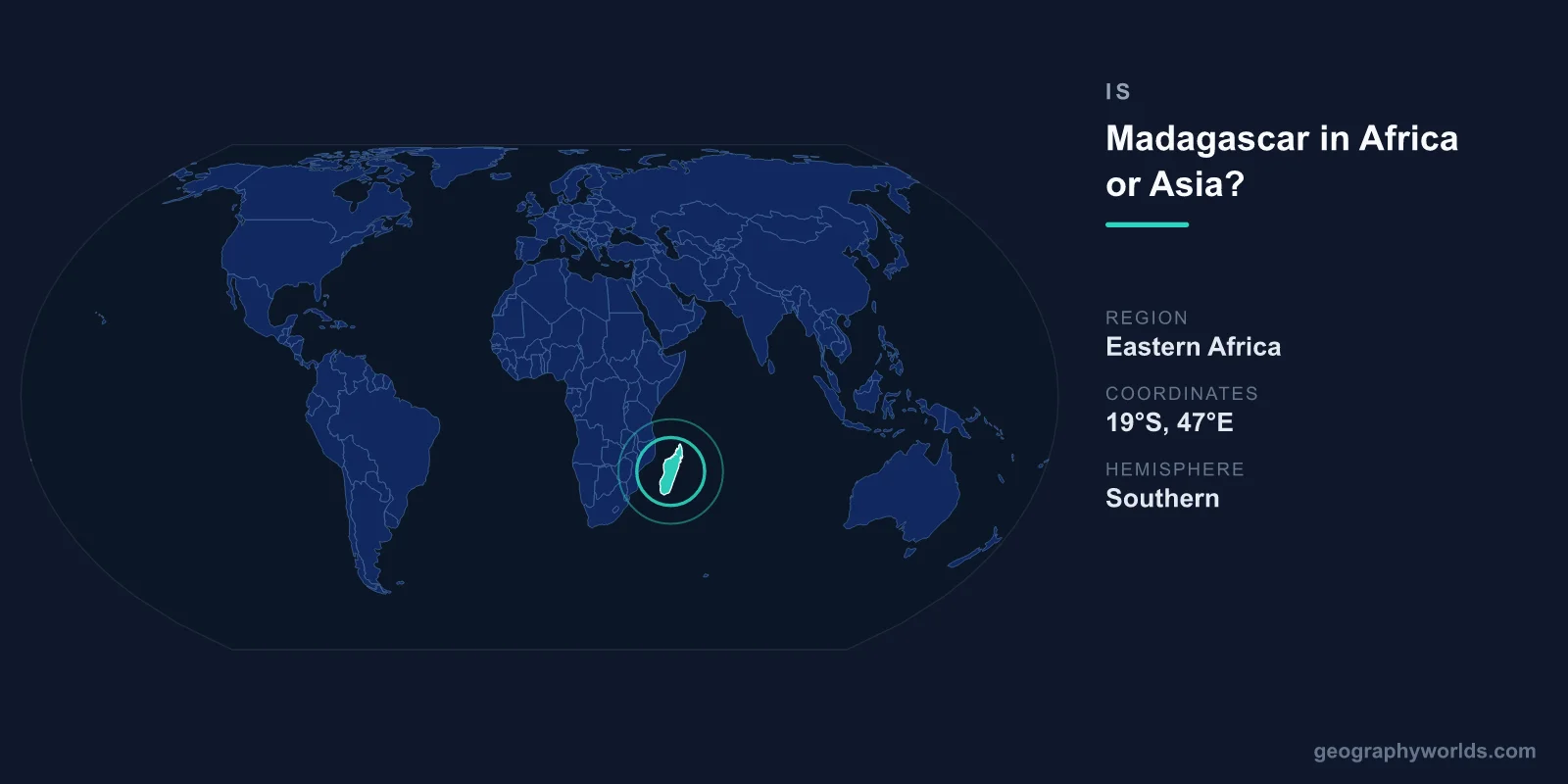
Madagascar is in Africa, not Asia. It is an island nation in the Indian Ocean, lying off the southeastern coast of the African mainland and separated from it by the Mozambique Channel. Although Madagascar's culture and wildlife carry surprising Asian threads, the country is geographically, politically, and diplomatically part of Africa, and it is a founding member of the African Union.
The Short Answer: Africa
Madagascar sits roughly 400 kilometres off the southeastern coast of Mozambique, across the Mozambique Channel. By every standard geographic and political classification, it belongs to the African continent. The United Nations groups it under Eastern Africa, the African Union counts it as a member state, and regional bodies such as the Southern African Development Community (SADC) include it among African nations. There is no recognised framework in which Madagascar is considered part of Asia.
At around 587,041 km², Madagascar is the fourth-largest island in the world, after Greenland, New Guinea, and Borneo. Its capital, Antananarivo, sits in the central highlands, and the country is home to roughly 29 million people. For more on the island nation, see our madagascar country guide.
Why People Think Madagascar Might Be in Asia
The confusion is understandable, because Madagascar genuinely has deep Asian connections that set it apart from its African neighbours. The most striking is language. Malagasy, the national tongue, is not an African language at all but an Austronesian one, closely related to Ma'anyan, spoken in southern Borneo, more than 7,000 kilometres away in Indonesia.
This reflects the island's settlement history. The first permanent inhabitants are believed to have arrived from the Indonesian archipelago around 1,500 years ago, crossing the Indian Ocean in outrigger canoes in one of humanity's most remarkable ancient sea voyages. Later, Bantu-speaking settlers from East Africa, along with Arab and other traders, added their own influence. The result is a population and culture that blend Southeast Asian and African roots, visible in everything from rice cultivation and terraced paddies to traditional music and burial customs. These Asian elements lead some people to wonder whether the island belongs to Asia, but cultural ancestry does not change its geographic location.
A Continent in Miniature: Madagascar's Geography
Madagascar stretches about 1,600 kilometres from north to south, giving it a wide range of landscapes packed into a single island. The eastern coast receives heavy rainfall and supports tropical rainforest. The central highlands, where Antananarivo lies, are cooler and more temperate, dominated by farmland and rice terraces. The west is drier, with deciduous forest and savanna, while the far south is a semi-arid zone famous for its otherworldly spiny forest of cactus-like plants.
Geologically, Madagascar has been isolated for an extraordinarily long time. It broke away from the African landmass roughly 160 million years ago and later separated from the Indian subcontinent around 88 million years ago. This long isolation is the reason for its astonishing biodiversity rather than any link to Asia.
Unique Wildlife That Sets It Apart
Because Madagascar drifted alone for tens of millions of years, an estimated 90% of its plant and animal species are found nowhere else on Earth. The most famous are the lemurs, a group of primates that exists only on Madagascar and a few nearby islands, with more than 100 recognised species and subspecies. The island is also home to two-thirds of the world's chameleon species and unique baobab trees, including those lining the celebrated Avenue of the Baobabs, where some specimens are several hundred years old and reach around 30 metres tall.
This endemism makes Madagascar one of the planet's top biodiversity hotspots. Conservationists often describe it as a "natural laboratory" of evolution, and its wildlife is a major reason the country attracts ecotourists from around the world.
Key Facts About Madagascar
- Continent: Africa (Eastern Africa)
- Ocean: Indian Ocean, across the Mozambique Channel
- Area: approximately 587,041 km², the world's fourth-largest island
- Capital: Antananarivo
- Population: roughly 29 million
- Official languages: Malagasy and French
- Membership: African Union, United Nations, SADC
Frequently Asked Questions
Is Madagascar part of Africa?
Yes. Madagascar is part of Africa and is classified within the Eastern Africa region. Despite being an island separated from the mainland by the Mozambique Channel, it is recognised as an African country and is a member of the African Union.
Why is the Malagasy language related to Asian languages?
Malagasy is an Austronesian language because Madagascar's earliest settlers arrived from the Indonesian archipelago around 1,500 years ago. Its closest relative is Ma'anyan, spoken in Borneo. This linguistic link reflects ancient migration, not Madagascar's continental placement.
How far is Madagascar from mainland Africa?
Madagascar lies about 400 kilometres off the southeastern coast of Mozambique. The Mozambique Channel separates the island from the African mainland.
What continent is closest to Madagascar?
Africa is by far the closest continent. Mainland Africa lies just across the Mozambique Channel to the west, while Asia is thousands of kilometres away to the northeast.