
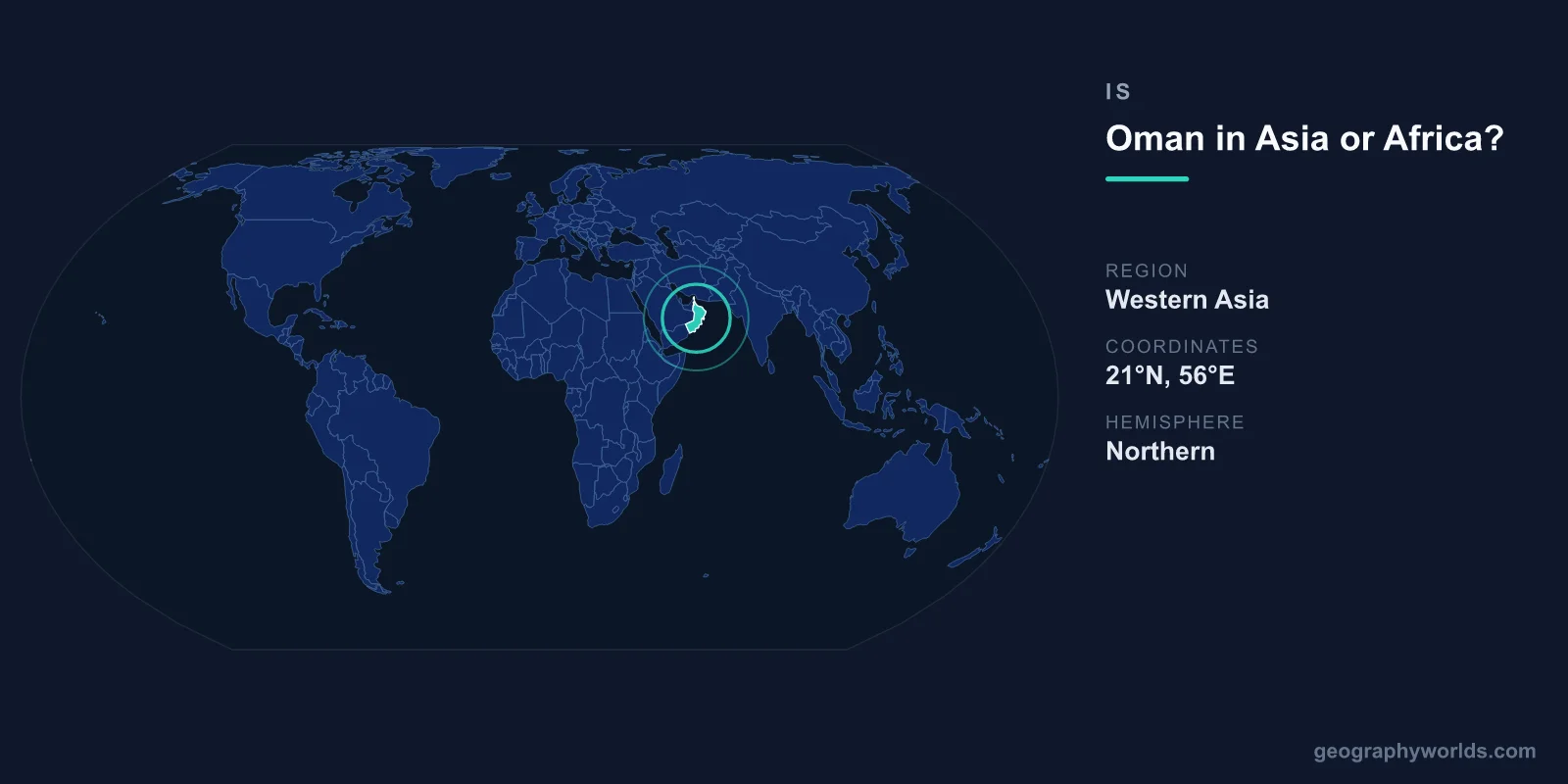
Oman is in Asia, not Africa. It sits on the southeastern coast of the Arabian Peninsula in the region known as Western Asia (or the Middle East), bordered by the Arabian Sea and the Gulf of Oman. Although the country's history is woven tightly into the Indian Ocean trading world and even reached deep into East Africa, every square kilometre of modern Oman lies firmly on the Asian continent.
Oman Is an Asian Country
Oman occupies the southeastern corner of the Arabian Peninsula, a landmass that is part of Western Asia. Its capital, Muscat, looks out over the Gulf of Oman, while the long southern shoreline meets the Arabian Sea. On land, Oman shares borders with three Asian neighbours: the United Arab Emirates to the northwest, Saudi Arabia to the west, and Yemen to the southwest. None of its frontiers touch Africa, and the nearest African coast lies hundreds of kilometres away across open water.
Politically, Oman is also unmistakably Asian. It is a founding member of the Gulf Cooperation Council (GCC) alongside Saudi Arabia, the UAE, Kuwait, Qatar and Bahrain, and it belongs to the Arab League and the broader Middle Eastern community of nations. Its identity, alliances and trade networks are anchored in the Arabian and wider Asian sphere.
Why People Confuse Oman With Africa
The mix-up is understandable, because Oman's story really did stretch across the sea into Africa. From the 17th to the 19th centuries, the Omani Empire was one of the most powerful maritime states in the Indian Ocean. At its peak it controlled Zanzibar, stretches of the Kenyan and Tanzanian coast, and parts of present-day Somalia and Mozambique.
So strong was this connection that for a time the Sultan of Oman governed his realm from Zanzibar rather than Muscat. The empire was formally split in the 1860s, and Zanzibar remained linked to the Omani royal line until 1964. Centuries of trade in spices, dates and other goods left lasting cultural exchange between the Swahili coast and Arabia. These ties explain why some people instinctively associate Oman with Africa, even though the country itself has always been part of Asia.
Oman's Place on the Arabian Peninsula
Oman is the third-largest country on the Arabian Peninsula, covering roughly 309,500 km² with a population of about 5.1 million people. Its terrain is far more varied than the flat desert many expect of Arabia:
- The Al Hajar Mountains in the north rise to over 3,000 m, with deep wadis and terraced villages.
- The vast central desert merges into Saudi Arabia's Rub' al Khali, the famous "Empty Quarter."
- The southern Dhofar region catches the seasonal monsoon, turning green and misty during the khareef season — a tropical landscape found nowhere else in Arabia.
Oman also has a coastline stretching more than 3,000 km, which helped make it a seafaring nation for thousands of years. For a deeper look at the country's regions, climate and culture, see our oman country guide.
A Strategic Asian Gateway
Oman's location gives it outsized importance in Asian and global affairs. The country's Musandam Peninsula — an exclave separated from the rest of Oman by the UAE — juts into the Strait of Hormuz, the narrow waterway connecting the Persian Gulf to the open ocean. Roughly a fifth of the world's seaborne oil passes through this strait, making Oman a key guardian of one of the planet's most vital shipping lanes.
This position has long made Oman a meeting point between Asia, Africa and beyond. Frankincense from the Dhofar mountains once travelled north into Arabia and across the Indian Ocean, and Omani dhows linked the ports of India, Persia and East Africa. Today the country balances those ancient connections with a modern, diversifying economy, but its geographic anchor remains the Arabian Peninsula of Asia.
Frequently Asked Questions
What continent is Oman in?
Oman is in Asia. More specifically, it lies in Western Asia (the Middle East), on the southeastern edge of the Arabian Peninsula. It is not part of Africa, despite its historical trading links to the East African coast.
Is Oman in the Middle East?
Yes. Oman is considered part of the Middle East, a region of Western Asia that includes the Arabian Peninsula countries. It is a member of the Gulf Cooperation Council and the Arab League.
What countries border Oman?
Oman shares land borders with three Asian nations: the United Arab Emirates, Saudi Arabia and Yemen. It also has long coastlines along the Arabian Sea and the Gulf of Oman.
Did Oman ever control parts of Africa?
Yes. During the height of the Omani Empire, Oman controlled Zanzibar and much of the East African coast, including parts of present-day Kenya, Tanzania and Somalia. Zanzibar remained tied to the Omani royal line until 1964, but Oman itself has always been located in Asia.