
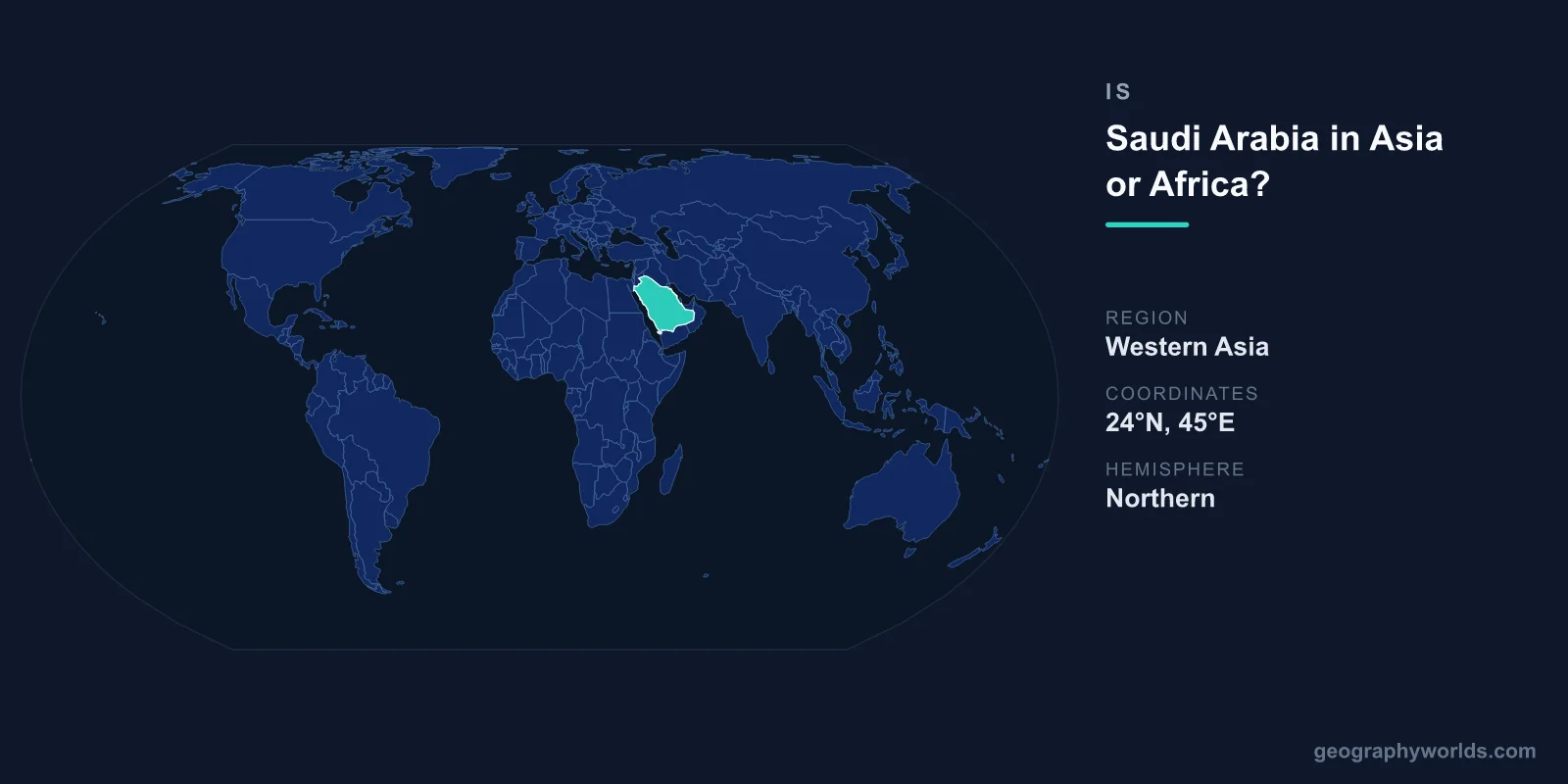
Saudi Arabia is in Asia, not Africa. It occupies roughly 80% of the Arabian Peninsula, which is the southwestern corner of the Asian continent. Although the country sits just across a narrow sea from northeast Africa, every standard geographic and political classification places Saudi Arabia firmly within Western Asia, the region more commonly known as the Middle East.
Saudi Arabia Is in Asia
Saudi Arabia is an Asian country. With a land area of about 2,149,690 km², it is by far the largest nation in the Middle East and the largest on the Arabian Peninsula. Its capital, Riyadh, lies near the center of the peninsula on a high desert plateau, while its population of roughly 36 million is concentrated in cities such as Riyadh, Jeddah, Mecca, and the eastern oil hub of Dammam.
The Arabian Peninsula is treated as part of the Asian landmass in the United Nations geoscheme, in atlases, and in every continental model used by geographers. So even though Saudi Arabia shares a coastline and a deep history with Africa, the correct answer to the question is unambiguous: it is in Asia.
Why People Confuse It With Africa
The confusion is understandable, and it comes from several directions at once. First, geography: the Red Sea, which separates Saudi Arabia from Egypt, Sudan, and Eritrea, is narrow — only about 300 km across at its widest and far less at the Bab-el-Mandeb strait in the south. On a small map, Arabia can look like an extension of the African continent.
Second, geology. The Arabian Peninsula sits on its own tectonic plate, the Arabian Plate, which was once joined to the African Plate. The two began pulling apart roughly 25 million years ago, and the Red Sea is the young, still-widening rift that opened between them. Because of this shared origin, the desert landscapes, rock formations, and even some wildlife of Arabia closely resemble those of the Horn of Africa.
Third, language and labels. The term "Middle East" describes a cultural and political region rather than a continent, and because it spans the meeting point of Asia, Africa, and Europe, some people assume it floats between continents. It does not. The Asian portion of the Middle East — including Saudi Arabia — is simply part of Asia.
Where Exactly Saudi Arabia Sits
Saudi Arabia anchors the southwestern edge of Asia. It is bordered by the Red Sea to the west and the Persian Gulf to the east, giving it coastlines on two important waterways. Its land borders connect it to a string of Asian neighbors:
- North: Jordan, Iraq, and Kuwait
- East: the United Arab Emirates, Qatar, and Bahrain (linked by a causeway)
- South: Oman and Yemen
Egypt lies just to the west across the Red Sea, but the two countries do not share a land border — the water between them is exactly the boundary that places Saudi Arabia in Asia and Egypt's mainland in Africa. For a fuller picture of the country's regions and geography, see our saudi arabia country guide.
The Landscape of Asian Arabia
Saudi Arabia's terrain is overwhelmingly desert, and it contains some of the most dramatic dry landscapes on Earth. The Rub' al Khali, or Empty Quarter, in the south is the largest contiguous sand desert in the world, a vast sea of dunes that stretches into neighboring Oman, Yemen, and the UAE. Along the western Red Sea coast rises the Hejaz mountain range, with peaks climbing well above 3,000 m, while the eastern lowlands slope toward the Persian Gulf and hold much of the country's enormous oil reserves.
Remarkably, Saudi Arabia has no permanent rivers or lakes. Fresh water comes from desalination plants along the coasts, deep groundwater aquifers, and seasonal valleys called wadis that flow only after rare rains. This makes it one of the driest large countries in Asia.
Cultural and Religious Significance
Saudi Arabia's location in Asia carries immense cultural weight. The country is home to Islam's two holiest cities, Mecca and Medina. Each year millions of Muslims travel to Mecca for the Hajj pilgrimage, one of the largest annual human gatherings anywhere on the planet, while many more visit throughout the year for the smaller Umrah pilgrimage. This religious centrality, combined with the country's vast petroleum wealth, makes Saudi Arabia one of the most influential states in both Asia and the wider Islamic world.
Frequently Asked Questions
Is Saudi Arabia part of the Middle East?
Yes. Saudi Arabia is a central country of the Middle East, a region that spans parts of Western Asia and northeastern Africa. The country itself lies entirely within the Asian portion of that region.
Is the Arabian Peninsula in Asia or Africa?
The Arabian Peninsula is part of Asia. It is connected to mainland Asia in the north and separated from Africa by the Red Sea. Saudi Arabia occupies the largest share of the peninsula, with Yemen, Oman, the UAE, Qatar, Bahrain, and Kuwait making up the rest.
How far is Saudi Arabia from Africa?
At its closest, Saudi Arabia is only a few dozen kilometers from Africa across the Bab-el-Mandeb strait near Yemen, and the Red Sea between Saudi Arabia and Egypt or Sudan is roughly 200 to 300 km wide. Despite this proximity, the two are on separate continents.
Was Saudi Arabia ever joined to Africa?
Geologically, yes. The Arabian Plate was once part of the African Plate, and the two split apart around 25 million years ago when the Red Sea rift began to open. That ancient connection explains why the landscapes of Arabia and the Horn of Africa look so alike today.