
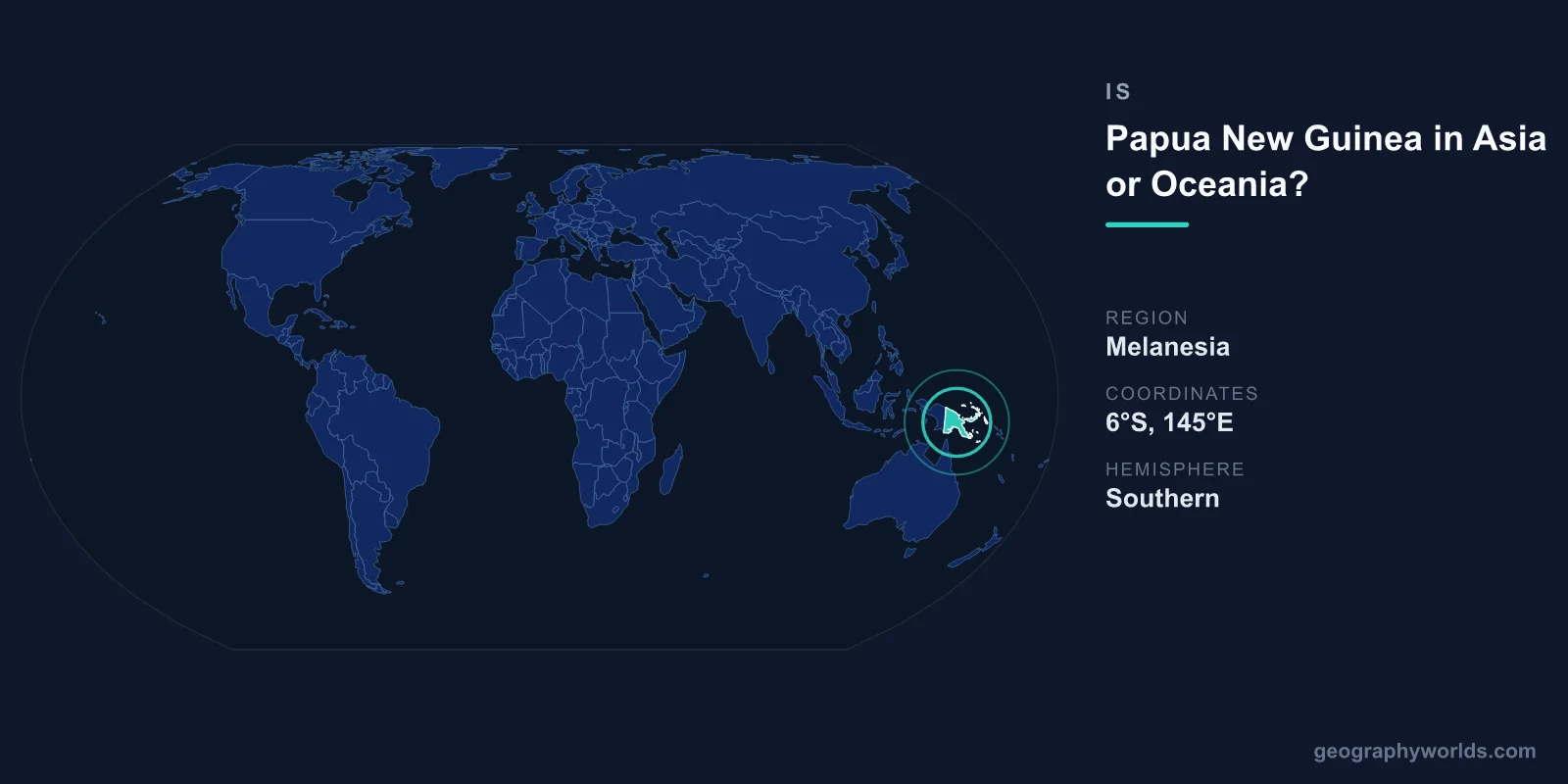
Papua New Guinea is in Oceania, not Asia — it belongs to the Melanesian subregion of the Pacific and shares the eastern half of the island of New Guinea, with its western half being part of Indonesia in Asia. The confusion is understandable, because Papua New Guinea sits almost exactly where the conventional line between Asia and Oceania is drawn, and it borders an Asian nation on land.
Oceania, Specifically Melanesia
Papua New Guinea (PNG) is classified as part of Oceania, the vast region of Pacific island groups that also includes Australia, New Zealand, and the islands of Polynesia, Micronesia, and Melanesia. Within Oceania, PNG falls into the Melanesian subregion alongside the Solomon Islands, Vanuatu, Fiji, and New Caledonia. The term "Melanesia" refers to the dark-skinned peoples and dense, tropical island chains stretching across the southwestern Pacific.
The country occupies the eastern half of New Guinea — the world's second-largest island — plus the Bismarck Archipelago, the northern Solomon Islands, and roughly 600 smaller islands. Its capital, Port Moresby, lies on the southeastern coast facing the Coral Sea, well within the Pacific world rather than the Asian mainland.
Why People Think It Might Be in Asia
The single biggest source of confusion is PNG's only land border. Papua New Guinea shares the island of New Guinea with Indonesia, whose provinces of Papua and Central Papua (formerly West Papua) make up the western half. Because Indonesia is universally classified as an Asian country, many people assume the whole island — and therefore PNG — must also be in Asia.
In reality, the island of New Guinea is one of the very few places on Earth where the conventional boundary between two continental regions runs straight through a single landmass. The western half is grouped with Asia (through Indonesia), while the eastern half is grouped with Oceania (through PNG). This makes New Guinea a textbook example of how continental "boundaries" are political and cultural conventions rather than hard geological facts.
What the Geography and Geology Say
Biogeographically, scientists place the entire island of New Guinea — both halves — within the Australasian realm, the same ecological zone as Australia. This is because New Guinea and Australia once formed a single connected landmass and share marsupials, birds of paradise, and other distinctive wildlife found nowhere in Asia. The deep-water Wallace Line and Lydekker Line, which mark the transition between Asian and Australasian species, lie well to the west of New Guinea.
Geologically, PNG sits on the Australian tectonic plate and along the Pacific Ring of Fire, giving it active volcanoes, frequent earthquakes, and dramatic mountain ranges. Peaks in the central highlands rise above 4,500 metres, with Mount Wilhelm the tallest. None of this connects PNG to the Asian continental shelf — it is firmly part of the Australasian and Pacific physical world.
A Pacific Nation in Culture and Politics
Politically and culturally, Papua New Guinea is unmistakably a Pacific country. It is a member of the Pacific Islands Forum, the Melanesian Spearhead Group, and other regional bodies that bring together Oceania's island states. Its head of state is the British monarch, represented by a governor-general, a legacy of its history under Australian administration before independence in 1975.
PNG is also one of the most culturally diverse nations on Earth. More than 800 distinct languages are spoken among its Melanesian, Papuan, and Austronesian communities — a level of linguistic diversity unmatched anywhere in the world. Some highland communities had little or no contact with the outside world until the 1930s. The official languages are English, Tok Pisin (an English-based creole), and Hiri Motu. You can learn more in our papua new guinea country guide.
Key Facts at a Glance
- Continent / region: Oceania (Melanesia)
- Capital: Port Moresby
- Area: about 462,840 km²
- Population: roughly 10 million
- Official languages: English, Tok Pisin, Hiri Motu
- Independence: 1975 (from Australian administration)
- Land border: Indonesia (an Asian country)
Frequently Asked Questions
Is Papua New Guinea part of Asia?
No. Papua New Guinea is part of Oceania, in the Melanesian subregion of the Pacific. The only reason it is sometimes linked to Asia is that it shares a land border with Indonesia, which is an Asian nation, on the island of New Guinea.
What continent is Papua New Guinea on?
Papua New Guinea is classified within Oceania. Geologically it sits on the Australian plate and within the Australasian biogeographic realm, so it is closely tied to Australia rather than the Asian mainland.
Is Papua New Guinea the same as Indonesian Papua?
No. They occupy opposite halves of the same island. Papua New Guinea is an independent country in Oceania, while the western half (the provinces of Papua and Central Papua) belongs to Indonesia and is grouped with Asia.
Is Papua New Guinea considered a Pacific Island country?
Yes. PNG is a Pacific Island nation and an active member of regional organisations such as the Pacific Islands Forum and the Melanesian Spearhead Group, confirming its place within Oceania.
