
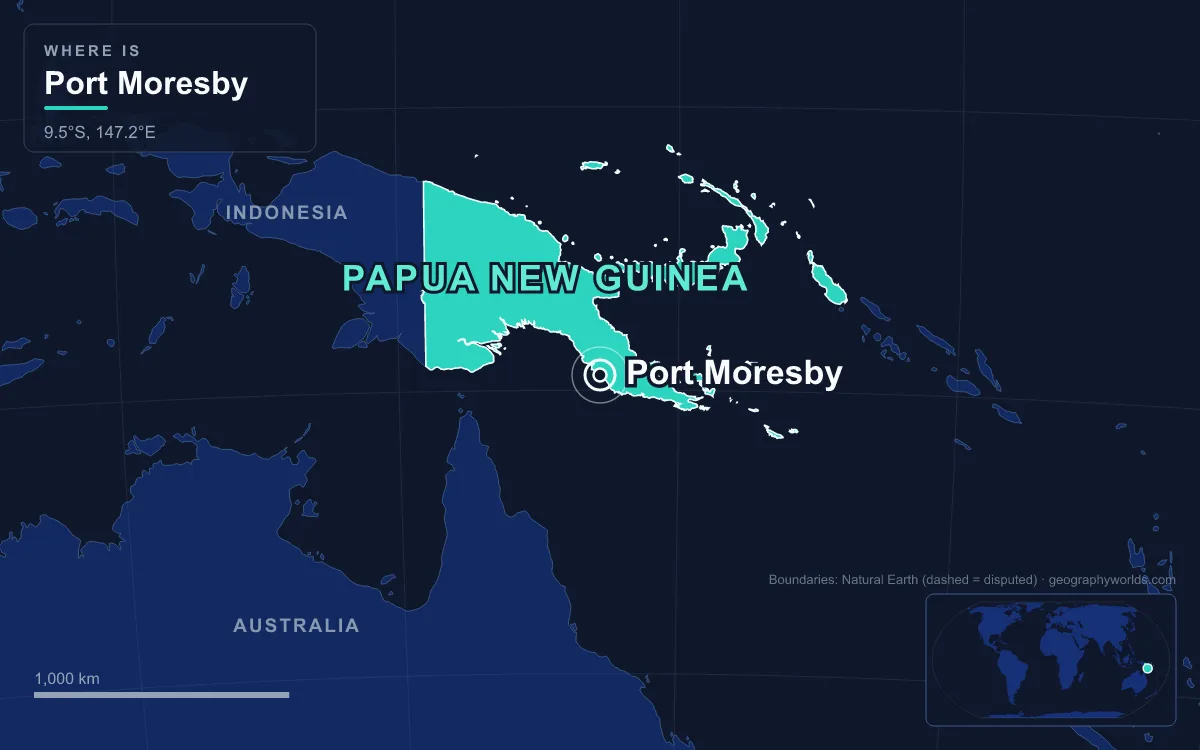
The capital of Papua New Guinea is Port Moresby, a port city on the Coral Sea coast of the Papuan Peninsula, in the south-east of the island of New Guinea. Its population more than doubled between the 2011 census (364,145) and the 2024 census (756,754), making it by far the country's largest city and one of the biggest in the south-west Pacific outside Australia and New Zealand. Although it is surrounded by Central Province and serves as that province's capital too, the city is not part of it: it forms its own National Capital District, where the traditional landowners, the Motu and Koitabu peoples, have their own representative body, the Motu Koita Assembly.
The name is British. Captain John Moresby of HMS Basilisk, surveying the southern coast in February 1873, named the harbour after his father, Admiral of the Fleet Sir Fairfax Moresby. But Europeans estimated that about 2,000 people already lived around the harbour, and the largest settlement, Hanuabada, was a cluster of five villages of Motu and Koita people. The city that grew around them is easiest to understand through four threads: who governs from it, what its people believe, how it trades, and how its residents live.
Power: From Scratchley's Bungalow to the Waigani Parliament
Port Moresby became a seat of government through a scramble between empires. In March 1883 the Premier of Queensland, Sir Thomas McIlwraith, hearing that a German warship was heading for the South Seas, ordered the Thursday Island police magistrate Henry Chester to claim New Guinea. Chester raised the Union Jack at Port Moresby on 4 April 1883, before about 200 Papuans and thirteen Europeans, but London rejected the annexation. A British protectorate followed instead, proclaimed at Port Moresby by Hugh Romilly on 23 October 1884 and again, with more ceremony, by Commodore James Erskine on 6 November; Hanuabada is remembered as the site of that declaration.
Special Commissioner Peter Scratchley arrived in August 1885 and chose the harbour as the colonial capital. Land south of Hanuabada was bought for a government bungalow, with 28 local men each paid a tomahawk, a handkerchief and half a pound of tobacco. The administration fenced off its land and began a policy of segregated residential areas that lasted until the early 1960s. In 1886 the surveyor Walter Cuthbertson laid out a grid for two townships, Granville West and Granville East, but the older name stuck. After the Papua Act took effect in 1906, the town became the capital of Australian-ruled Papua.
The Second World War made it a military headquarters. Port Moresby was a prime Japanese objective in 1942–43, and by September 1942 it was a major Allied base complex; General Douglas MacArthur kept his headquarters there from November 1942 to October 1944. The Kokoda Track, scene of the fighting that protected the town, still begins at Owers' Corner, about 50 km to the east. In 1945 Papua and the former German New Guinea were combined under one Australian administration with Port Moresby as capital. It gained city status in 1972, with Oala Oala-Rarua as its first Lord Mayor, and in September 1975 became the capital of independent Papua New Guinea.

Independence moved the centre of power inland. The House of Assembly had met from 1964 to 1975 in a former hospital downtown, but new government, cultural and intellectual buildings were built in the suburb of Waigani. The National Parliament House there, opened by Prince Charles on 8 August 1984, blends traditional design with modern construction and stands next to the Supreme Court. It seats 111 members elected for five-year terms, 89 from open electorates and 22 from provincial electorates, including one for the National Capital District; no party has ever won a majority on its own. The National Museum and National Library are also in Waigani. Not every government building has aged well: Marea Haus, known locally as the "Pineapple Building", and the Central Government Offices were abandoned after long neglect, although restoring disused offices rather than demolishing them has been common since the 2000s.
Faith: The London Missionary Society at Metoreia
Christianity reached the harbour almost as soon as Moresby's charts did. In November 1873 the Reverend Samuel Macfarlane of the London Missionary Society sent four Polynesian teachers there, and in November 1874 the Reverend William George Lawes arrived and built a mission house at Metoreia, opposite Elevala Island. The missionaries chose the place deliberately: Port Moresby was already a trading centre visited by distant groups, which they hoped would carry their message further along the coast.
A century and a half later, the country is overwhelmingly Christian. At the 2011 census, 95.6% of citizens identified as Christian, with the Catholic Church the largest denomination at 26.0%, followed by the Evangelical Lutheran Church (18.4%), the Seventh-day Adventists (12.9%), Pentecostal churches (10.4%) and the United Church (10.3%). Many people combine that faith with traditional practices. In March 2025 a constitutional amendment formally recognised Papua New Guinea as a Christian country and named the Bible as a national symbol. Fundamentalist churches have also become more common, driven partly by American prosperity theology spread through visiting preachers and televangelism, which has challenged the dominance of the older mainstream churches.
Trade: Hiri Voyages, Gold Rumours and the 2018 APEC Summit
Long before Europeans arrived, the Motu were traders by necessity. Port Moresby lies in a rain shadow and is the driest place in New Guinea, with about 899 mm of rain a year and a long dry season from June to November, so the coast could not grow enough sago. What the Motu could make were clay cooking pots, called uro. Every year around the end of September, when the south-east trade wind, the laurabada, began to blow, men sailed west to the Gulf of Papua on lakatoi, multi-hulled canoes with crab-claw sails, carrying pots made by the women. They waited there for two or three months until the north-west monsoon, the lahara, turned, rebuilt their canoes to carry bulky sago, and made the far more dangerous voyage home.
These hiri voyages continued until the late 1950s, when a storm-damaged, overloaded lakatoi foundered off Boera village with heavy loss of life and the colonial authorities banned them. Their language survived: the simplified trade Motu used on the voyages became Hiri Motu, also called Police Motu, which is still spoken around the capital, though it is losing ground to Tok Pisin and English. Since independence the voyages have been remembered in the Hiri Moale Festival, held with the September independence celebrations, which features lakatoi arrivals, canoe racing and dances.

European commerce began with gold rumours. In September 1877 traces of gold were found at the junction of the Laloki and Goldie rivers, and the next year about 100 miners arrived; most left by the end of 1878 with nothing but illness. The colonial economy grew slowly, restricted from 1921 to 1925 by the Commonwealth Navigation Act, which effectively tied Papua's trade to a single company, Burns Philp, and a single port, Sydney. Electricity arrived in 1925 and piped water only in 1941.
Today minerals, oil and gas account for about 72% of Papua New Guinea's export earnings, and the capital shows the effects. Towers, malls and apartments have risen on a redeveloped waterfront, venues were rebuilt for the 2015 Pacific Games, which Port Moresby won by a 25–22 vote over Tonga, and in November 2018 the city hosted the APEC summit. Because the national highway network is incomplete, and towns such as Lae and Madang have no direct road link to the capital, flights through Jacksons International Airport, the country's largest, where Air Niugini has its head office, are vital for reaching the rest of the country.
Daily Life: Hanuabada, Koki Market and Boroko
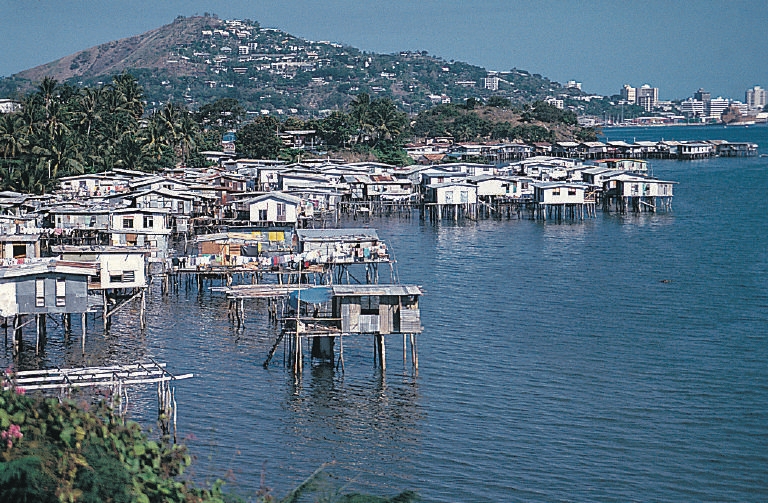
The oldest community is still the most distinctive. Hanuabada, whose name means "big village" in Motu, sits north-west of downtown and has more than 15,000 residents, many living in houses built on stilts over the water. It punches far above its size in sport: a large share of Papua New Guinea's national cricket team has come from there, and eight of the country's nine Commonwealth Games medals have been won by people from the village. The Motu Koita Assembly governs the traditional lands of ten recognised villages like it, and its chair is also Deputy Governor of the National Capital District.
Elsewhere, the city is a patchwork. "Town", the original business district on the peninsula, prospers as an office centre but has lost its restaurants and night life. Koki is known for its fresh produce market. Boroko, once the commercial heart, is now quiet, with many shop buildings empty, while the west of the city is now full of high-rises, shopping centres and affluent housing. Security shapes routines: many homes sit behind high fences and steel doors, walking is widely discouraged, and in 2021 Al Jazeera described Port Moresby as one of the most dangerous cities in the world.
Sport is the common ground. The National Football Stadium, the former Lloyd Robson Oval, has been the home of the national rugby league team since 1975 and was rebuilt for the 2015 Pacific Games, and the city also hosted the South Pacific Games in 1969 and, jointly with Lae, in 1991. For the wider picture, see how big Papua New Guinea is, how it fits into Melanesia, and the Coral Sea that Port Moresby faces.
Quick Facts About Port Moresby
- Country: Papua New Guinea
- Continent: Oceania
- Country population: approximately 10.9 million
- Capital city status: Port Moresby is the capital of Papua New Guinea, the seat of national government, and the location of foreign embassies, parliament, and the head of state's official residence.
Frequently Asked Questions
What is the capital of Papua New Guinea?
The capital of Papua New Guinea is Port Moresby. Port Moresby is the seat of national government, hosts most foreign embassies and consulates, and is typically where the head of state and parliament are located.
What continent is Port Moresby in?
Port Moresby, the capital of Papua New Guinea, is located in Oceania. As Papua New Guinea's capital, Port Moresby serves as the country's primary connection to the broader Oceanian political, economic, and cultural sphere.
Why is Port Moresby the capital of Papua New Guinea?
Port Moresby was chosen as the capital of Papua New Guinea for reasons that typically combine geography, history, and politics. Capital city selections often reflect a desire for centrality (being accessible from across the country), historical importance (being a longstanding seat of government or culture), or neutrality (being acceptable to multiple regions or ethnic groups within the country). The specific reasons for Port Moresby's designation are detailed in the city's history above.
What is Port Moresby known for?
As the capital of Papua New Guinea, Port Moresby is best known for housing the country's central government institutions — parliament, presidential or royal residences, supreme court, and key ministries. It is also typically a major cultural and economic center within Papua New Guinea, hosting national museums, embassies, and signature monuments. The introduction and history sections above provide detailed coverage of the city's specific notable institutions and landmarks.
Related Pages
- Papua New Guinea Country Guide — full geography, climate, economy, and culture overview
- Flag of Papua New Guinea — meaning, history, and design of Papua New Guinea's national flag