
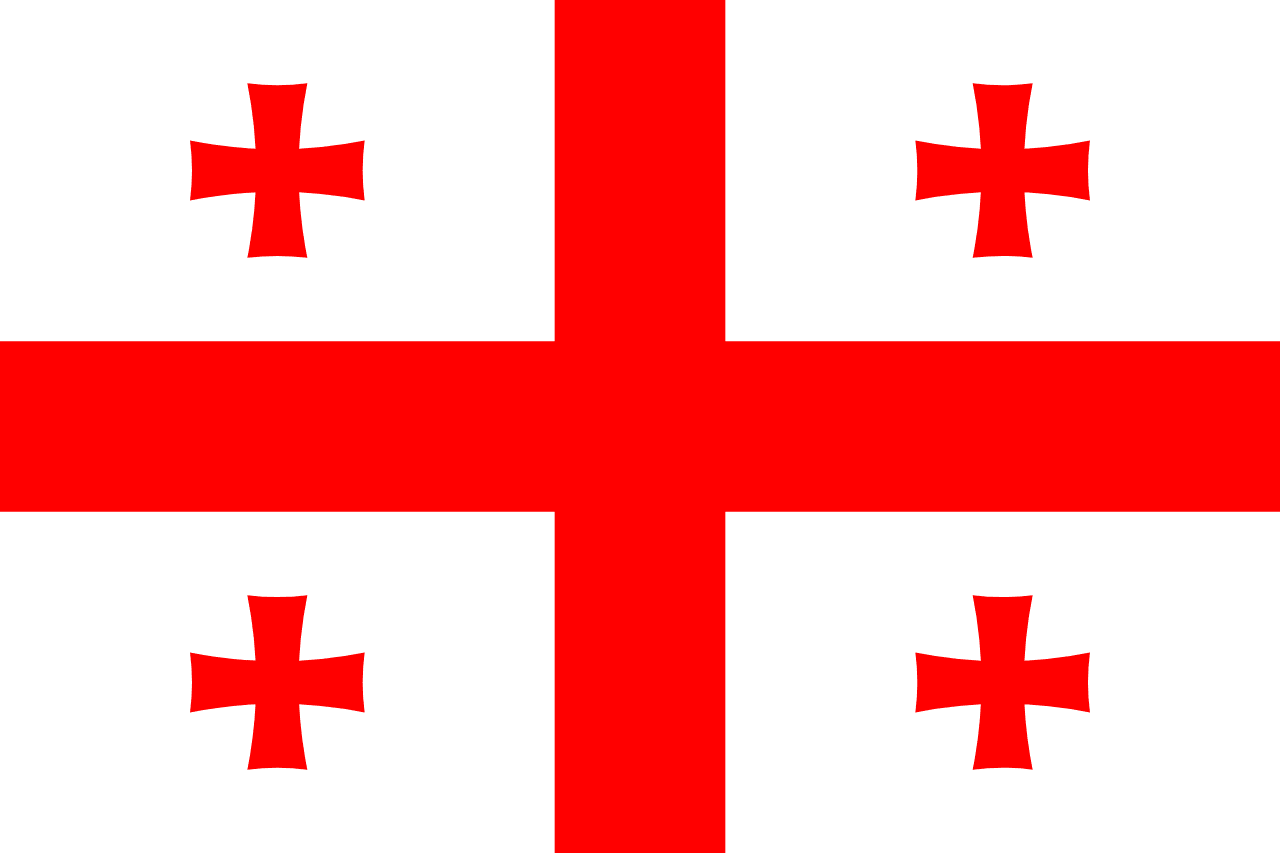
Few national flags announce their meaning as boldly as the banner of Georgia, the country nestled at the crossroads of Eastern Europe and Western Asia. A crisp white field carries a single large red cross stretching from edge to edge, and tucked into each of the four rectangles it creates sits a smaller red cross. Together these five emblems give the flag its affectionate nickname, the Five Cross Flag, and they tie modern Georgia directly to a visual identity that is many centuries old. Though the design was only officially restored in 2004, it feels far older, because that is precisely the point: this is a revival rather than an invention.
What makes the Georgian flag so striking is its economy. There are only two colors and a handful of shapes, yet the composition is instantly recognizable and impossible to confuse with the busy, multi-striped banners common elsewhere. In this article we will unpack what the white and red represent, how the crosses are arranged, where the design comes from, how it relates to other cross-bearing flags, and the role it plays in everyday Georgian life.
A Palette of White and Red
The Georgian flag uses just two colors, and that restraint is part of its power. The white field serves as the canvas for everything else, a clean background that traditionally carries associations of innocence, purity, and peace. Against it, the red crosses read as bold and unmissable, the color long linked across cultures to courage, sacrifice, and the blood of those who defended their faith and homeland.
This white-and-red combination is deliberately simple, but it is not arbitrary. The pairing echoes the heraldic tradition of crusader and Christian banners, where a red cross on a light ground signaled religious devotion and martial readiness alike. For Georgia, one of the world's oldest Christian nations, that pairing speaks to a long history in which faith and national survival were tightly intertwined. The colors are not chosen to look pleasant so much as to carry meaning that Georgians recognize immediately.
Reading the Design: One Large Cross, Four Small
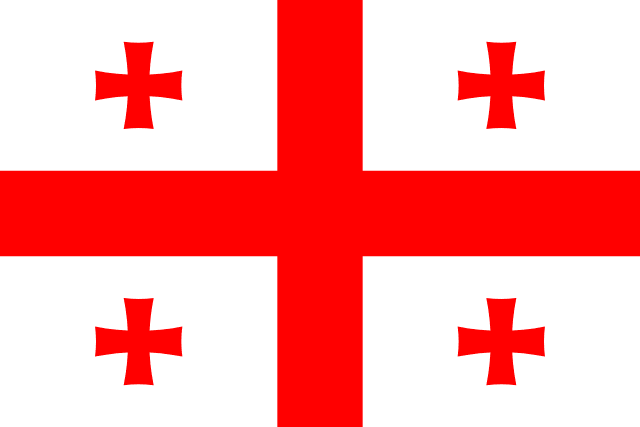
The layout follows a clear logic. A single large red cross runs vertically and horizontally across the entire white field, dividing it into four equal quarters. This central element is usually identified as the St. George's Cross, an upright cross with arms reaching all four edges of the flag. Within each of the four quarters sits a smaller red cross, and these are often described as Bolnisi-style or Jerusalem-style crosses, with short, even arms.
The result is a balanced, symmetrical arrangement: five crosses in total, one dominant and four supporting. Because the composition is built on symmetry rather than detailed illustration, it reproduces cleanly at any size, from a tiny lapel pin to a stadium-sized banner. There are no words, no intricate emblems, and no fine gradients to lose at a distance. That clarity is one reason the design has endured and travels so well across modern media.
Symbolism Rooted in Faith
The meaning behind the five crosses is explicitly religious. In the most widely cited interpretation, the large central cross represents Jesus Christ, while the four smaller crosses stand for the four evangelists, the authors of the New Testament Gospels. Arranged together, they form a compact statement of Georgia's deep and ancient Christian heritage.
Georgia adopted Christianity as a state religion remarkably early, and the church has remained central to Georgian identity through periods of foreign domination and political upheaval. A flag built entirely from crosses, therefore, is not a casual decorative choice. It situates the nation within a faith tradition that Georgians regard as inseparable from their language, culture, and sense of self. Even for citizens who are not personally devout, the crosses function as markers of national continuity stretching back across many generations.
From Medieval Banner to Modern Revival
One of the most interesting things about the Five Cross Flag is that 2004 is its adoption date, not its birth date. The design is based on a medieval Georgian flag, and its restoration was part of a broader effort to reconnect the country with symbols predating the Soviet era and other foreign rule. Rather than commissioning a brand-new emblem, Georgians reached back into their own heraldic past and brought a historic banner forward into the present.
That choice gave the modern flag instant legitimacy. It was not a committee's fresh concept but a recovered heritage, championed by political and civic movements that wanted a clear break from the immediate past and a return to deeper roots. When it was hoisted as the official national flag in 2004, the flag carried the weight of history even as it served a brand-new state navigating independence. Few countries can point to a banner that is simultaneously so old in origin and so recent in official status.
How It Compares to Other Cross Flags
Georgia's flag belongs to a wider family of cross-based banners, and comparing it with relatives helps explain what makes it distinct. The single large cross reaching to all four edges immediately recalls England's flag of St. George, a red cross on white, and indeed both share the same color scheme and the same dedication to the soldier-saint. The difference is decisive, though: where England shows one cross alone, Georgia adds the four smaller crosses in the quarters, producing a far more intricate and unmistakable composition.
The white-and-red palette also invites comparison with banners like the Swiss flag or Denmark's Dannebrog, both of which pair red and white around a cross motif. Yet none of those repeat the small-cross-in-each-quarter pattern. That fivefold structure is the Georgian flag's signature, and it traces a specific lineage to the so-called Jerusalem cross arrangement used in medieval Christian heraldry. So while a glance might group Georgia with several European cross flags, a second look reveals a design that stands firmly on its own.
The Flag in Modern Georgian Life
Today the Five Cross Flag is everywhere in Georgian public life. It flies over government buildings in Tbilisi, appears at national holidays and religious celebrations, and is waved enthusiastically by fans supporting Georgia's national sports teams, where rugby and football crowds turn the stands into seas of red and white. Because the design is so legible, it works equally well painted on a face, printed on a scarf, or projected onto a screen.
For a country that sits at the meeting point of continents and cultures, the flag also serves a quiet diplomatic role, marking Georgian embassies, delegations, and international events with a symbol that needs no translation. To learn more about the nation that flies it, you can explore our georgia country guide. The banner remains a daily reminder of a heritage that Georgians chose, deliberately, to carry into the modern era.
Interesting Facts at a Glance
- The flag is widely known as the Five Cross Flag because of its single large cross plus four smaller ones.
- It uses only two colors, white and red, with no other shades involved.
- Though officially adopted in 2004, the design is based on a medieval Georgian banner, making it old and new at once.
- The central cross is associated with St. George, the saint after whom the country is often said to be named in English.
- Georgia lies at the boundary of Europe and Asia, in the South Caucasus region.
- The four small crosses are commonly read as the four evangelists, with the large cross standing for Christ.
Frequently Asked Questions
When was the Georgian flag adopted?
The current Five Cross Flag was officially adopted in 2004. Despite that recent date, the design is a revival of a medieval Georgian banner, so it carries centuries of history even though its official status as the national flag is relatively modern.
What do the colors and crosses mean?
The flag uses a white field with red crosses. The five crosses are religious symbols: the large central cross represents Jesus Christ, while the four smaller crosses in the quarters represent the four evangelists. Together they reflect Georgia's long-standing Christian heritage.
Who designed the Georgian flag?
Rather than being the work of a single named designer, the modern flag is based on a medieval Georgian flag that was restored as the official national banner in 2004. It was brought back as a recovered historical symbol rather than created from scratch.
What continent is Georgia on, and how does its flag compare to similar ones?
Georgia sits in the South Caucasus, at the crossroads of Europe and Asia. Its flag resembles other red-and-white cross banners such as England's St. George's Cross, but it is distinguished by the four additional small crosses set in the quarters, a pattern that makes the Georgian design unmistakable.