
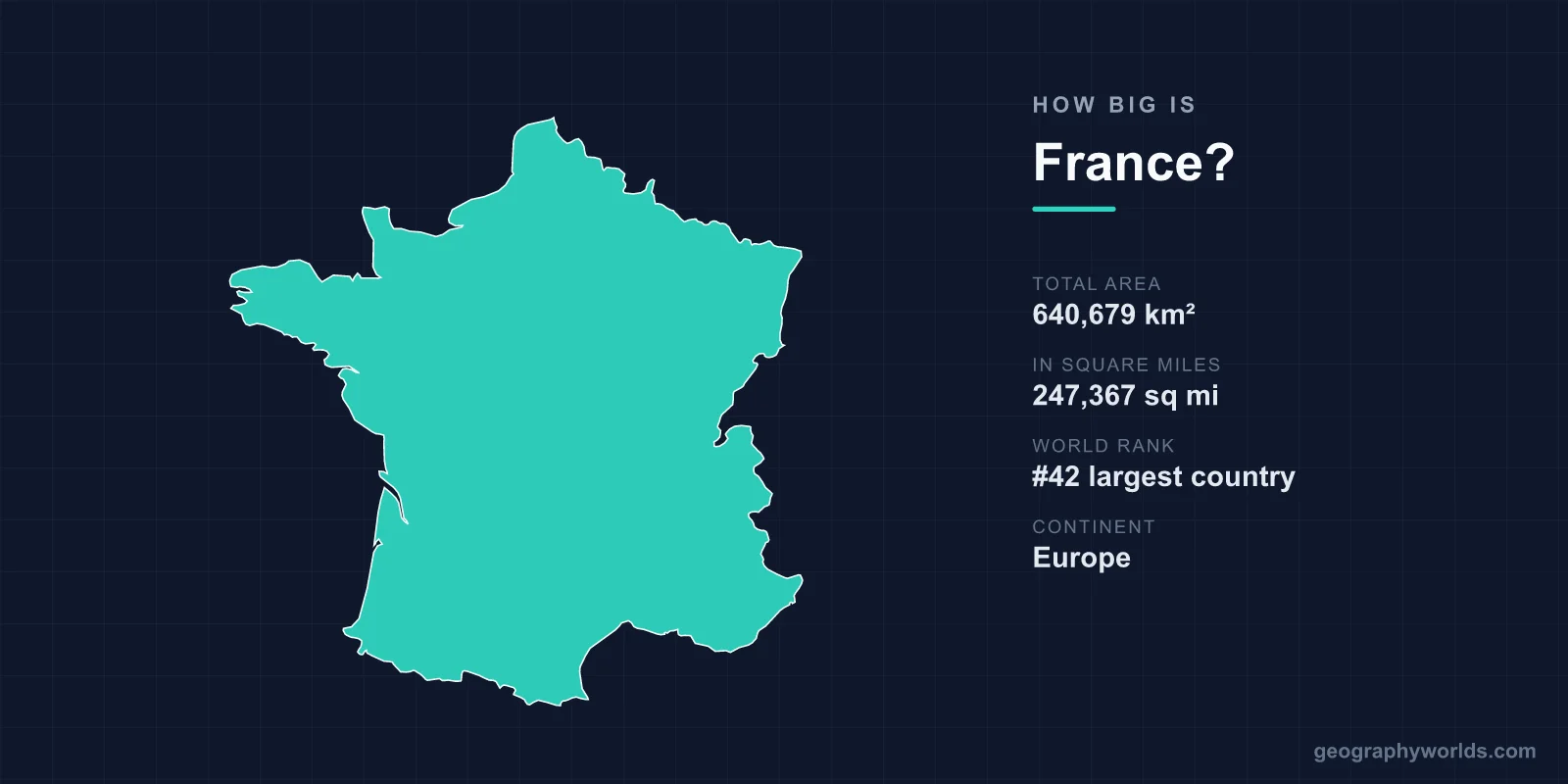
France covers a total area of 640,679 km² (247,367 sq mi) including its overseas territories, making it roughly the 42nd largest country in the world — slightly smaller than the US state of Texas. Metropolitan France, the familiar hexagonal mainland in Europe, accounts for about 551,695 km² of that total, while the remainder comes from overseas regions scattered across the globe.
France's Area in Numbers
The 640,679 km² total represents approximately 0.43% of Earth's land surface. That figure is large enough to make France the biggest country in the European Union by area, comfortably ahead of Spain and Sweden. To picture it another way, France is about 170% the size of Japan (377,975 km²) and nearly twice the area of Germany.
- Total area: 640,679 km² (247,367 sq mi)
- Metropolitan France: about 551,695 km²
- World rank: roughly 42nd largest country
- Share of world land: about 0.43%
- Capital: Paris
The gap between the two totals matters: when people say France is "smaller than Texas" (about 695,000 km²), they are usually comparing the full national area, overseas territories included.
The Shape of l'Hexagone
Mainland France is famously nicknamed l'Hexagone because its borders trace a rough six-sided figure. The country stretches roughly 960 km from north to south and about 950 km from east to west, giving it an unusually balanced, compact footprint for a nation of its size. That near-square geometry means no point on the mainland is extremely far from either the sea or a land border.
France shares land frontiers with eight European neighbours — Belgium, Luxembourg, Germany, Switzerland, Italy, Monaco, Spain and Andorra — and its coastline runs to about 3,427 km. Those shores touch the Atlantic Ocean, the English Channel, the Mediterranean Sea, and, via the island of Corsica, the Tyrrhenian Sea.
From Lowlands to Mont Blanc
For a mid-sized country, France packs in a remarkable range of terrain. The north and west are dominated by the broad, fertile lowlands of the Paris Basin and the Atlantic coastal plains. The center rises into the rugged Massif Central, an ancient upland region dotted with the extinct volcanoes of the Auvergne. Along the southeastern and southwestern frontiers, the land climbs steeply into two great mountain ranges: the Alps and the Pyrenees.
The highest point is Mont Blanc, on the French–Italian border, at 4,808 m (15,774 ft) — the tallest peak in Western Europe. Its exact height shifts slightly from year to year as the ice cap at its summit thickens or thins. Other defining landscapes include the chateau-studded Loire Valley, the sun-soaked French Riviera, the dramatic Gorges du Verdon, and the mountainous Mediterranean island of Corsica.
An Empire of Time Zones
Although metropolitan France sits in a single time zone, the country as a whole is geographically the most spread-out on Earth. Counting its overseas regions and territories — among them French Guiana in South America, Réunion and Mayotte in the Indian Ocean, Guadeloupe and Martinique in the Caribbean, and French Polynesia in the Pacific — France spans 12 time zones, more than any other nation.
This far-flung geography produces some surprising statistics. France's longest single land border is not in Europe at all, but the one French Guiana shares with Brazil. These overseas holdings are what push the national area well beyond the mainland's hexagon and give France one of the largest maritime exclusive economic zones in the world.
How France's Size Plays Out
France's combination of moderate size and varied geography helps explain its diversity of climate and culture. The west has a mild, damp maritime climate, with Brittany catching Atlantic storms; the interior is more continental, with hotter summers and colder winters; and the south enjoys a Mediterranean climate, where Provence sees well over 300 sunny days a year. That spread of conditions supports everything from Norman dairy farms to Mediterranean vineyards. For more on the country's regions, history and culture, see our france country guide.
Frequently Asked Questions
Is France bigger than Texas?
No. With a total area of about 640,679 km², France is slightly smaller than Texas, which covers roughly 695,000 km². Mainland (metropolitan) France alone, at about 551,695 km², is noticeably smaller still.
Is France the largest country in Europe?
By total area, the largest country lying entirely or partly in Europe is Russia, followed by Ukraine. Among European Union members, however, France is the largest by area, ahead of Spain.
How long does it take to drive across France?
Because the mainland measures roughly 950–960 km in each direction, a long cross-country drive — say from the Channel coast to the Mediterranean — covers around 1,000 km and typically takes nine to eleven hours, depending on the route and traffic.
What is the highest point in France?
Mont Blanc, in the Alps, at 4,808 m (15,774 ft). It is the highest mountain in Western Europe, and its summit elevation varies slightly each year with snow and ice cover.