
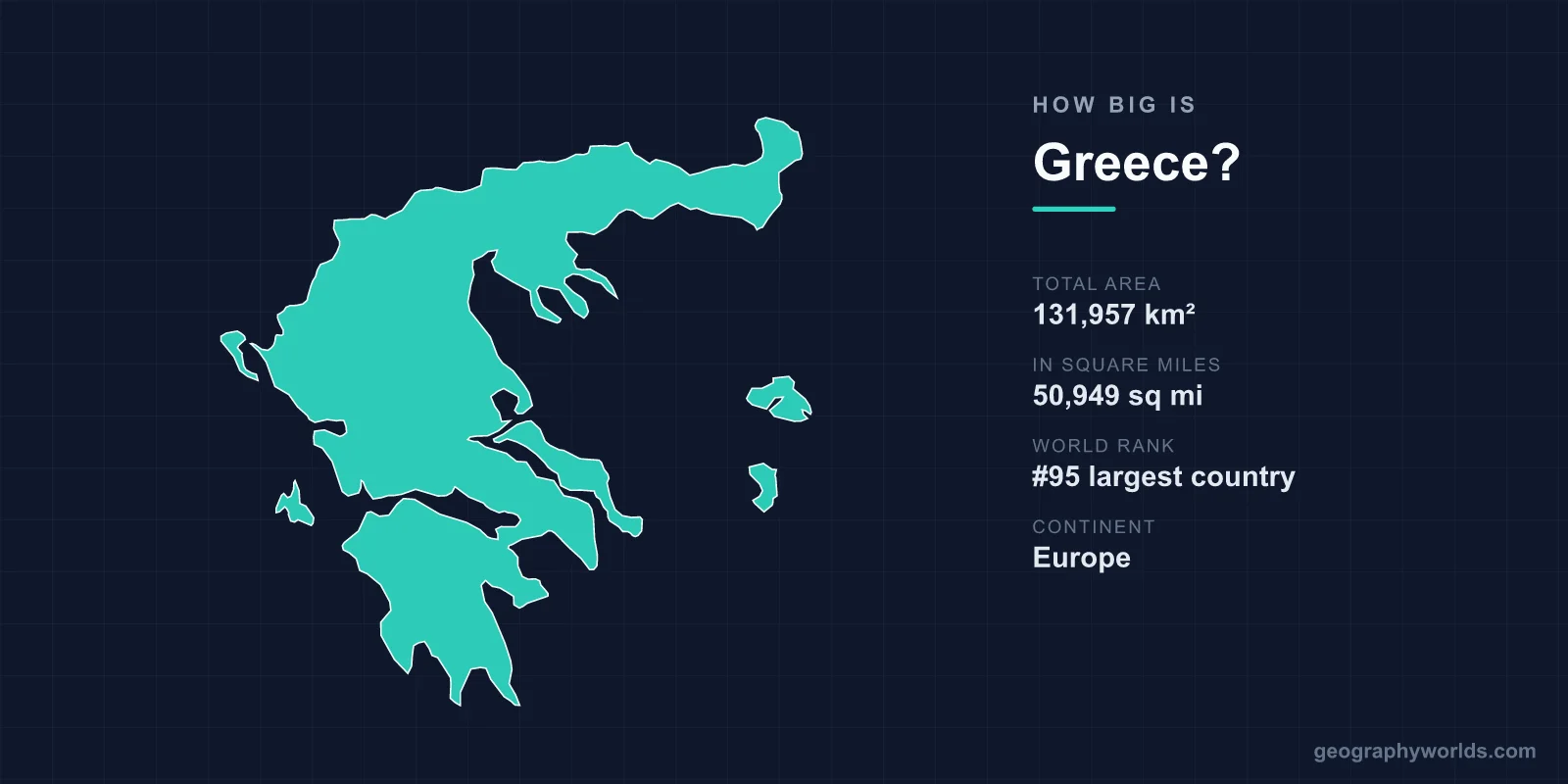
Greece covers a total area of 131,957 km² (50,949 sq mi), making it the 95th largest country in the world — roughly the size of the U.S. state of Alabama and a little over half the size of the United Kingdom. Despite ranking modestly by land area, Greece punches far above its weight geographically thanks to a vast scattering of islands and one of the longest coastlines on Earth.
Greece by the Numbers
At 131,957 km², Greece accounts for about 0.09% of the planet's total land area of roughly 149 million km². Its mainland sits at the southern tip of the Balkan Peninsula in southeastern Europe, with Athens as its capital. The country stretches approximately 800 km from north to south and around 900 km from east to west, yet its shape is so fragmented by sea that no point in Greece lies more than about 137 km from saltwater.
- Total area: 131,957 km² (50,949 sq mi)
- World rank: 95th largest country
- Coastline: 13,676 km — the 11th longest in the world
- Highest point: Mount Olympus, 2,917 m (9,570 ft)
- Continent: Europe (Balkan Peninsula)
A Land Made of Mountains and Islands
What makes Greece feel larger than its area suggests is how its land is distributed. Roughly 80% of the country is mountainous, with the Pindus range forming a rugged spine down the mainland. This makes Greece one of the most mountainous nations in Europe, and it is part of why settlements have historically clustered along valleys and coasts rather than spreading evenly across the interior.
Then there are the islands. Greece has around 6,000 islands and islets, of which only about 227 are inhabited. They are spread across the Aegean Sea to the east and the Ionian Sea to the west, including famous names such as Crete, Rhodes, Santorini, Mykonos, and Corfu. Crete alone is 8,450 km², making it the fifth-largest island in the Mediterranean. Although the islands collectively account for only about a fifth of Greek territory, they stretch the country across an enormous expanse of sea and give Greece its distinctive sprawling footprint.
How Greece Compares to Other Countries
Size comparisons help bring Greece's scale into focus. It is slightly smaller than the U.S. state of Alabama and comparable to the U.S. state of Louisiana. Against other nations, the contrasts are revealing:
- About 54% the size of the United Kingdom (243,610 km²).
- Roughly 1.3 times larger than South Korea (100,210 km²).
- Around a third the size of neighboring Turkey.
- Larger than Portugal but smaller than Italy.
Yet on coastline, Greece dwarfs far larger countries. Its 13,676 km of shoreline is longer than that of nations many times its land area, a direct result of its deeply indented coast and thousands of islands. For a deeper look at the country's regions, climate, and culture, see our greece country guide.
Climate and Terrain Across the Country
Greece's relatively compact size belies real variety in its landscapes. The climate is predominantly Mediterranean — hot, dry summers and mild, wet winters — but the experience differs sharply from place to place. The islands and southern coasts are sunny and arid, while the northern mountains can receive heavy snow and support ski resorts in winter.
Beyond Mount Olympus, the legendary home of the ancient Greek gods, the terrain includes the Peloponnese peninsula in the south, the dramatic clifftop monasteries of Meteora, and the deep Samaria Gorge on Crete, one of Europe's longest. The Parthenon atop the Acropolis of Athens remains the country's most iconic landmark, a reminder that Greece's small territory holds an outsized share of the world's archaeological heritage.
Surprising Size Facts
- No point in Greece is more than about 137 km from the sea.
- Greece has more archaeological museums than any other country.
- The Corinth Canal slices through the isthmus separating mainland Greece from the Peloponnese; at water level it is only about 6.4 m wide, yet ships still pass through.
- Santorini's caldera was carved by one of the largest volcanic eruptions in recorded history, around 1600 BCE.
Frequently Asked Questions
How big is Greece compared to the United States?
Greece is about the size of a single mid-sized U.S. state, such as Alabama or Louisiana. The entire country at 131,957 km² is roughly 1.4% of the contiguous United States, which covers more than 8 million km².
What is the largest island in Greece?
Crete is by far the largest Greek island at 8,450 km², making it the fifth-largest island in the Mediterranean. It has its own mountains, gorges, and cities, and functions almost like a small country within Greece.
How long is Greece's coastline?
Greece has about 13,676 km of coastline, the 11th longest in the world. This remarkable length comes from its heavily indented mainland coast and its roughly 6,000 islands and islets.
Why does Greece seem larger than its area suggests?
Because its territory is spread across two seas and thousands of islands, Greece occupies a wide geographic span even though its land area ranks only 95th globally. Its mountainous terrain and vast coastline also make it feel expansive and varied.