
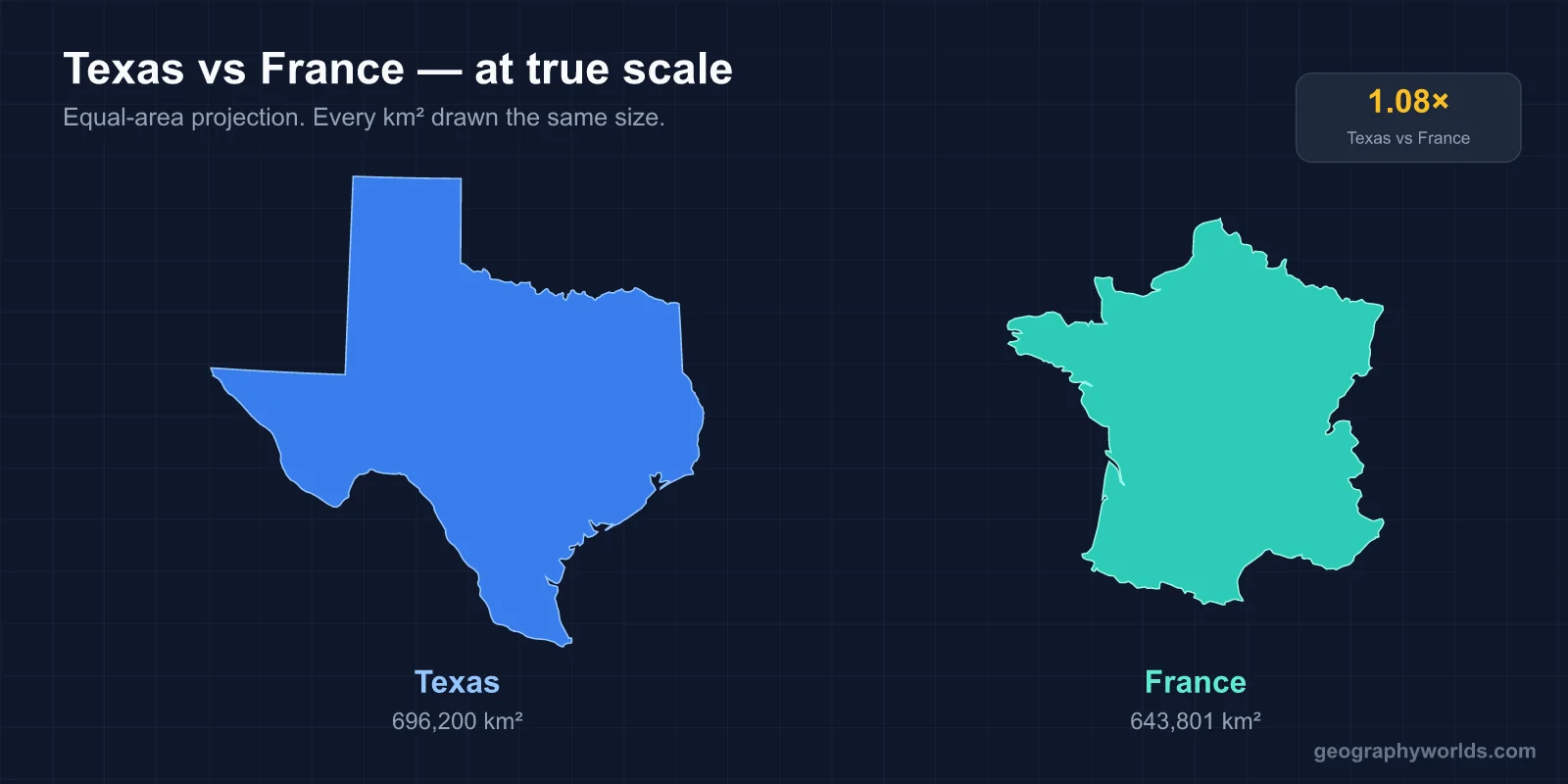
Yes. Texas is slightly larger than France. Texas covers 696,200 km² (268,597 sq mi), while metropolitan France covers 643,801 km² (248,573 sq mi). Texas is about 1.08 times the size of France — a modest 8% larger by area. But France has more than twice as many people.
The Short Answer
Texas-vs-France is one of the closest size comparisons you can find between a US state and a major European country. Texas is bigger, but not dramatically. If you laid France on top of Texas, France would cover most of the state — about 92% of it. The leftover Texas area (around 52,400 km²) is roughly the size of West Virginia or the entire country of Costa Rica.
This comparison surprises people in both directions. Americans assume Texas dwarfs European countries; Europeans assume France is much bigger than any single US state. Neither is quite right. Texas wins, but only just.

The Real Numbers
- Texas total area: 696,200 km² (268,597 sq mi)
- Metropolitan France total area: 643,801 km² (248,573 sq mi)
- Difference: 52,399 km² — roughly the size of Costa Rica
- Ratio: Texas is about 1.08× the size of France
Note: this comparison uses "metropolitan France" — the part of France in Europe. If you include France's overseas territories (French Guiana, Reunion, Martinique, Guadeloupe, Mayotte, French Polynesia, etc.), the total jumps to 643,801 + ~120,000 = roughly 763,000 km² of total French territory. That would make France slightly larger than Texas. But for most everyday comparisons, "France" means metropolitan France.
Population: France Crushes Texas
While Texas is slightly larger by area, France has more than twice as many people:
- France population: ~68,000,000
- Texas population: ~30,500,000
- France density: ~106 people per km²
- Texas density: ~44 people per km²
France has about 37 million more people than Texas, packed into 8% less land. That makes France about 2.4× more densely populated. The difference shows up in everyday life: France has compact cities, extensive rail networks (TGV high-speed trains, dense urban transit), and a much more developed countryside. Texas has sprawling cities, highway-centric infrastructure, and vast empty spaces in West Texas and the Panhandle.
Cities Comparison
Paris is by far the dominant metropolitan area in France — Île-de-France (the greater Paris region) has about 12.4 million people, nearly 18% of the country's population. Beyond Paris, France has substantial cities but no other true megalopolis: Lyon (~2.3 million), Marseille (~1.8 million), Toulouse (~1.5 million), Lille, Bordeaux, Nice, and so on.
Texas has a more multipolar structure: Dallas-Fort Worth (~7.9 million), Houston (~7.3 million), San Antonio (~2.6 million), Austin (~2.4 million). The four big Texan metros together contain about 20 million people — roughly 65% of Texas's population. Both Texas and France have most of their population in a handful of cities, but France's is more centralized in Paris than Texas's is in any one metro.
Economy: France Wins, Texas Closes
France has the 7th-largest economy in the world, with a GDP of about $3.1 trillion. Texas, if it were a country, would be the 8th-largest economy at about $2.4 trillion. So France's economy is about 30% larger than Texas's.
Per capita, the gap reverses dramatically: French GDP per capita is about $46,000, while Texan GDP per capita is about $79,000. Texas produces more economic output per person but France has more people overall. This is a common pattern when comparing US states to European countries — US states tend to have higher per-capita output, while European countries have more total population.
Climate and Geography
France has remarkable climatic diversity for its size. Northern France has a maritime climate similar to the southern UK or Belgium. The Mediterranean coast has hot dry summers. The Alps in the southeast have alpine climate with skiing. The Massif Central is highland plateau. France has Atlantic coast, Mediterranean coast, English Channel coast, and three major mountain ranges (the Alps, the Pyrenees, the Massif Central).
Texas spans humid subtropical in the east (piney woods), prairie in the north, Gulf Coast in the southeast, semi-arid hill country in central Texas, and true desert in the west. Climate range is comparable to France's in some ways but more extreme — Texas summers exceed France's by a wide margin (38°C+ in much of Texas vs ~30°C in much of France), and Texas hurricanes have no European equivalent.
History and Identity
This is where the comparison becomes most interesting. France has been a continuous political entity since at least the Treaty of Verdun in 843 — over 1,180 years of recorded statehood, with Paris as its capital for most of that time. Texas became an independent state in 1836 (after seceding from Mexico), joined the US in 1845, and has been part of the United States ever since (with a 4-year break for the Civil War). Texan statehood is less than 190 years old.
But Texas has its own strong sense of identity — the only US state that was ever an independent country, with a flag that flies as proudly as any nation's. The "Texan" identity is something genuinely unique among US states. France has 26 historical regions (now consolidated into 18) — Bretagne, Provence, Normandie, Alsace, etc. — each with deep regional cultures.
What Else Is Roughly the Size of Texas or France?
- Botswana: 581,730 km² — smaller than both
- Afghanistan: 652,230 km² — slightly larger than France, slightly smaller than Texas
- Myanmar: 676,578 km² — between France and Texas
- Ukraine: 603,550 km² — smaller than both
- Somalia: 637,657 km² — close to France
So Texas, France, Myanmar, and Afghanistan are all in roughly the same size range — between 640,000 and 700,000 km². These are mid-sized countries by world standards, large enough to be substantial but not continental-scale like the US, Russia, China, Brazil, or Australia.
Travel Distances
From Calais (northern France) to Marseille (southern France) is about 1,000 km — roughly the same as Houston to El Paso. From Brest (western France) to Strasbourg (eastern France) is about 950 km — similar to Brownsville to Texarkana. So if you're used to driving across France, you have a decent mental model for the scale of Texas. The shapes are different (France is more irregular, Texas more like a square), but the long axes are comparable.
France has the TGV high-speed rail network connecting Paris to most major cities in 2-3 hours. Texas has had high-speed rail proposals for decades but no major operating routes — most Texans drive or fly between cities. The same physical distances support completely different transportation cultures.
Wine and Agriculture
This is an unexpected place where the comparison gets fun. France is one of the world's top wine producers, with about 750,000 hectares of vineyards across regions like Bordeaux, Burgundy, Champagne, and the Rhône Valley. Texas, perhaps surprisingly, has the 5th-largest wine industry in the US — with about 5,000 hectares of vineyards, concentrated in the High Plains and Hill Country.
So France has roughly 150× more vineyard area than Texas. But Texas does produce wine — and the Hill Country wine region around Fredericksburg has become a serious destination. On agricultural land overall, both states/countries devote a substantial percentage of their land to farming, but Texas has more total acreage in pasture and cattle ranching, while France is more diversified across grain, livestock, dairy, and high-value crops like wine grapes.
Key Facts
- Texas is about 8% larger than metropolitan France.
- France has more than 2.2× more people than Texas.
- France's population density is about 2.4× higher than Texas's.
- France's GDP is about 30% larger than Texas's.
- If you include French overseas territories, France becomes slightly larger than Texas.
Fun Facts
- France has the most visited country in the world by tourists (about 90 million annually); Texas attracts about 80 million domestic visitors per year.
- Texas has 254 counties; France has 96 départements (administrative divisions).
- The French Foreign Legion has had recruits from Texas; Texas has a "French Legation" historical building in Austin from the Republic of Texas era.
- The Texas state flag is one of two US state flags with a single star (along with Alaska's, which has 8); France's tricolor is one of the most copied flags in the world.
- If Texas joined the EU, it would be the EU's most populous member after Germany and France.
The Bottom Line
Texas is bigger than France, but barely — by about 8%, which is roughly a Costa Rica's worth of extra land. The two are close enough in size that they're reasonable real-world comparisons for thinking about scale. France has 2× the people and a longer history. Texas has more sprawl, more emptiness, and a state-as-country mythology.
The next time someone says "Texas is bigger than France," they're right — but only by a margin small enough that the comparison feels meaningful rather than absurd. These are two of the most distinctive places on Earth at almost exactly the same scale.