
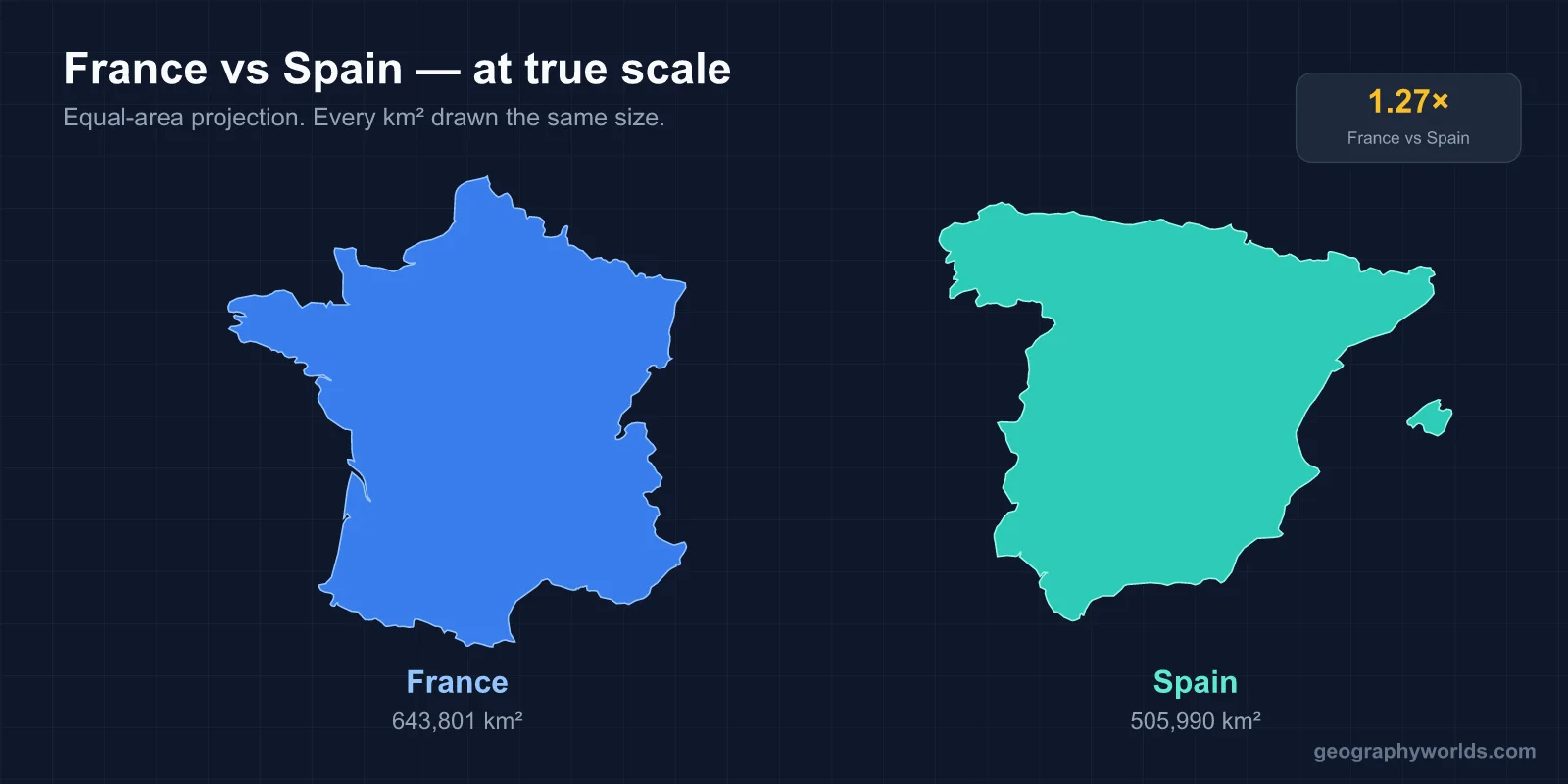
France and Spain are two of the largest countries in western Europe, sharing a long border across the Pyrenees Mountains. Both are major economic powers, major tourism destinations, and major cultural exporters. So which one is bigger?
The Short Answer
Yes, France is bigger than Spain. France covers 643,801 km² (including overseas departments and territories). Spain covers 505,990 km². France is approximately 27% larger than Spain.
Side-by-Side Numbers
- France area: 643,801 km² (248,573 sq mi) including overseas territories
- France metropolitan only: 543,940 km² (mainland Europe plus Corsica)
- Spain area: 505,990 km² (195,360 sq mi)
- Difference: France is ~138,000 km² larger
- Ratio: France is ~1.27× the size of Spain
- France population: ~68 million
- Spain population: ~48 million
France
France is the largest country entirely within the European Union and the third-largest in Europe (after Russia and Ukraine). It borders Belgium, Luxembourg, Germany, Switzerland, Italy, Monaco, Spain, and Andorra in Europe. France's overseas departments and territories — including French Guiana, Guadeloupe, Martinique, Mayotte, Réunion, and various Pacific territories — add about 100,000 km² to the total area and extend French sovereignty across multiple continents and oceans.
Metropolitan France has been shaped by geography, mountain ranges, and rivers. The Alps form the eastern border with Italy and Switzerland (with Mont Blanc, the highest peak in Western Europe at 4,809 m); the Pyrenees form the southern border with Spain; the Vosges and Jura Mountains run along the German and Swiss borders; the Massif Central dominates the central south. Major rivers include the Seine (through Paris), the Loire (the longest in France at 1,012 km), the Rhône, and the Garonne. Paris, the capital, has 12 million in its metro area.
Spain
Spain occupies most of the Iberian Peninsula in southwestern Europe, plus the Balearic Islands in the Mediterranean, the Canary Islands in the Atlantic off northwest Africa, and the small North African enclaves of Ceuta and Melilla. It borders Portugal to the west, France and Andorra to the northeast, the Mediterranean Sea, and the Atlantic Ocean. Spain is the 4th largest country in Europe and the 51st largest in the world.
Madrid is the capital and largest city (about 3.3 million in the city, 6.7 million in the metro area). Other major cities include Barcelona, Valencia, Seville, Zaragoza, and Málaga. Spain is divided into 17 autonomous communities with varying degrees of independence, including Catalonia, the Basque Country, Galicia, and others with strong regional identities. The country is famous for its diverse landscapes — from the Pyrenees in the north to the desert-like Almería in the southeast.
Population
France has about 68 million people; Spain has about 48 million. France's population is about 42% larger. Population density is similar — France is about 105 per km² (mainland), Spain about 95 per km². Both countries are aging slowly, with France having a slightly higher fertility rate (1.83 vs 1.16 in Spain). Both countries are major destinations for immigration from former colonies, the Mediterranean, and Eastern Europe.
Climate
Both countries have varied climates. France's climate ranges from oceanic in the west (Brittany, Normandy) to continental in the east (Alsace, Champagne) to Mediterranean in the south (Provence, the Côte d'Azur). Mountain climates dominate the Alps and Pyrenees. Paris has a temperate oceanic climate with mild summers and cool winters. Spain's climate is mostly Mediterranean — hot, dry summers and mild, wet winters across much of the country. Inland areas have continental influences, with Madrid experiencing hot summers and cold winters. The Atlantic coast (Galicia, Asturias, Basque Country) has an oceanic climate, while Almería in the southeast is essentially desert. The Canary Islands have subtropical climates that stay mild year-round.
Economy
France has the world's 7th largest economy at about $3 trillion GDP. Major industries include aerospace (Airbus), automotive (Renault, Peugeot), nuclear energy (France generates about 70% of its electricity from nuclear, more than any other country), luxury goods (LVMH, Hermès, Kering), tourism, agriculture (wine, dairy, grain), and pharmaceuticals. Spain has the world's 15th largest economy at about $1.6 trillion. Major industries include tourism (Spain is one of the world's top tourism destinations), automotive manufacturing, agriculture (olive oil, wine, fruit), renewable energy (Spain is a leader in solar and wind), and banking.
History
France has been one of Europe's most consequential nations for over 1,000 years. The Kingdom of France emerged from the western Frankish realm in the 10th century. Major historical moments include the Hundred Years War (1337–1453), the religious wars of the 16th century, the Sun King Louis XIV's reign (1643–1715), the French Revolution (1789–1799), the Napoleonic Wars, and the two world wars. France was a founding member of what became the European Union. Today it is a permanent UN Security Council member, a nuclear power, and one of the world's most influential cultural and political nations.
Spain has had an equally consequential history. The Iberian Peninsula was home to the Phoenicians, Greeks, Carthaginians, Romans, Visigoths, and (from 711 CE for nearly 800 years) the Muslim Moors. The Reconquista completed in 1492 with the fall of Granada — the same year Columbus reached the Americas. Spain became the world's largest empire in the 16th century under Charles V and Philip II, spanning the Americas, the Philippines, and parts of Europe and Africa. The 19th and 20th centuries brought decline, civil war (1936–1939), Franco's dictatorship (1939–1975), and finally democratic transition. Spain joined the EU in 1986.
Cuisine
Both countries have legendary cuisines. French cuisine is widely regarded as the foundation of fine dining in the Western world. Techniques developed in France (sauce-making, sautéing, classic baking) underpin culinary traditions globally. Famous dishes include coq au vin, beef bourguignon, ratatouille, foie gras, escargot, and countless regional specialties. France is a top wine producer (often #1 globally). Spanish cuisine is more regional and varied — paella (Valencia), gazpacho (Andalusia), tapas (everywhere), pintxos (Basque Country), jamón ibérico, tortilla española, churros, and patatas bravas. Spain produces excellent wine (Rioja, Ribera del Duero, Albariño) and is the world's top producer of olive oil.
Tourism
France and Spain are perennially the world's #1 and #2 most-visited countries by international tourists. France welcomes about 90 million international visitors per year; Spain about 85 million. Top destinations in France include Paris (the Eiffel Tower, the Louvre, Versailles), the French Riviera, the Loire Valley castles, Mont-Saint-Michel, Provence, the Alps, and the wine regions. Top destinations in Spain include Barcelona (the Sagrada Família, Park Güell), Madrid (the Prado, the Royal Palace), Seville, Granada (the Alhambra), the Balearic and Canary Islands, the Costa del Sol, and the Camino de Santiago pilgrimage.
Languages and Culture
French is the only official language of France, spoken by about 300 million people globally. The Académie française has tried to preserve and standardize the language for nearly 400 years. France has shaped global culture in literature, philosophy, fashion, cinema, art, and music. Spanish is the official language of Spain at the national level, but Catalan, Basque, and Galician are also official in their respective regions. Spanish is spoken by about 500 million people globally, making it one of the most widely spoken languages on Earth.
Sport
Both countries are major sporting nations. Spain has dominated football in the 21st century — winning the 2010 FIFA World Cup, the 2008 and 2012 Euros, and producing legendary players like Iniesta, Xavi, Iker Casillas, and Sergio Ramos. La Liga is one of the world's top football leagues, with Real Madrid and FC Barcelona among the most valuable clubs. Spain is also a tennis powerhouse (Rafael Nadal) and a top motorcycling and Formula 1 nation. France has won two FIFA World Cups (1998, 2018), produced legends like Zidane, Mbappé, Henry, and Platini, and dominates rugby (winning multiple Six Nations titles). France also hosts the Tour de France (cycling), Roland Garros (tennis), and Le Mans (endurance auto racing) — three of the most prestigious sporting events on Earth.
Key Facts
- France is about 27% larger than Spain by area.
- France has about 42% more people than Spain.
- Both are among the world's top tourism destinations.
- Spain has 17 autonomous communities with significant regional identity.
- France generates about 70% of its electricity from nuclear power.
Fun Facts
- France's overseas territories give it sovereign territory on every inhabited continent except Antarctica.
- Spain has the longest stable borders in continental Europe (since 1297 with Portugal).
- France produces over 7 billion bottles of wine per year.
- Spain is the world's top producer of olive oil.
- The Pyrenees Mountains form most of the France-Spain border.
The Bottom Line
France is larger than Spain — by about 27%. Both are major European powers with rich histories, world-class cuisines, and outsized cultural influence. France has slightly more people and a larger economy; Spain has more regional diversity and a slightly different food and wine tradition. Both will continue to be at the heart of European life for centuries to come.
Quiz Western Europe!
Test your knowledge of France, Spain, and great European nations.
Play Geography Games →