
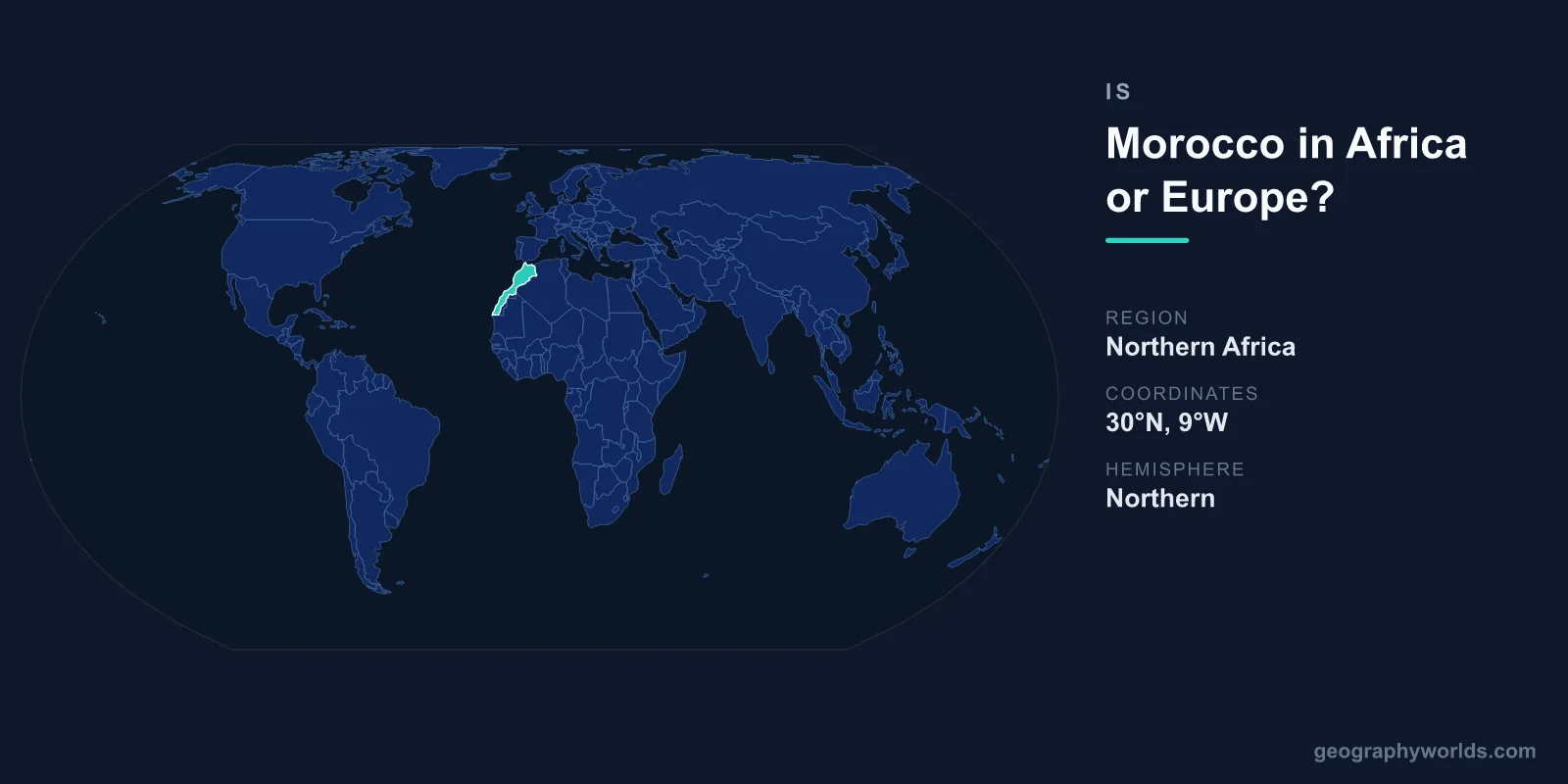
Morocco is in Africa, not Europe. It occupies the northwestern corner of the African continent, separated from mainland Europe by the narrow Strait of Gibraltar. Although Morocco sits remarkably close to Spain and shares deep cultural and economic ties with the continent across the water, every recognized geographic definition places it firmly within Africa.
Africa, Without Question
Morocco lies in the region known as the Maghreb, the western edge of North Africa. Its capital is Rabat, and its largest city is Casablanca on the Atlantic coast. The country covers about 446,550 km² and is home to roughly 37 million people, the overwhelming majority of whom are of Arab and Berber (Amazigh) descent — peoples indigenous to North Africa. Morocco is a founding-era member of the African Union family and participates in continental institutions, leaving no ambiguity about which continent it belongs to. Both Arabic and Tamazight (Berber) are official languages, a reflection of its African roots rather than any European identity.
Why People Think Morocco Might Be in Europe
The confusion is understandable. Morocco is one of the closest African countries to Europe, separated from Spain by just about 14 km of water at the Strait of Gibraltar. On a clear day you can stand on the Moroccan coast near Tangier and see the Spanish shoreline across the strait. Several other factors reinforce the European association:
- Spain governs two small enclaves — Ceuta and Melilla — that sit physically on the North African coast inside Morocco's borders, creating a literal land frontier between Morocco and EU territory.
- Morocco was a French and Spanish protectorate in the first half of the 20th century, and French remains widely spoken in business, government, and education.
- In 1987 Morocco actually applied to join the European Economic Community (the forerunner of the EU). The application was rejected, partly on the grounds that Morocco is not a European country.
- Centuries of trade, migration, and shared Mediterranean history link Morocco tightly to Spain, France, and Portugal.
None of this changes the geographic fact: the Strait of Gibraltar marks the boundary between the African and European landmasses, and Morocco sits on the African side of it.
Morocco's Geography and Borders
Morocco has two long coastlines: the Atlantic Ocean to the west and the Mediterranean Sea to the north. To the east it borders Algeria, and to the south lies the disputed territory of Western Sahara, which Morocco administers and claims. The country's landscape is strikingly varied. The Rif Mountains rise along the northern Mediterranean coast, while the much larger Atlas Mountains run diagonally across the interior from the southwest to the northeast, peaking at Toubkal at over 4,000 m — one of the highest summits in North Africa. Beyond the Atlas, the land descends into the Sahara Desert. This combination of ocean, mountain, and desert is unmistakably North African in character.
A Crossroads of Civilizations
Morocco's position at the gateway between Africa and Europe has shaped it into a cultural crossroads for thousands of years. Berber kingdoms, Phoenician and Roman traders, Arab dynasties spreading Islam, and waves of Andalusian refugees from Spain all left their mark. Moroccan architecture, music, and cuisine show strong Moorish and Andalusian influences — a legacy of the period when Muslim dynasties ruled both Morocco and southern Spain. Yet the country also looks south and inward: trans-Saharan trade routes once connected Moroccan cities like Fes and Marrakech to sub-Saharan Africa, carrying gold, salt, and ideas. This blend of Berber, Arab, sub-Saharan African, and Mediterranean European threads makes Morocco distinctly itself, but its geographic and historical anchor is the African continent.
How Close Is Europe, Really?
At its narrowest, the Strait of Gibraltar is only about 14 km wide. The Spanish city of Tarifa is the southernmost point of mainland continental Europe, and from there Morocco's mountains are clearly visible. Ferries cross the strait between Tangier and Spanish ports in roughly an hour, making Morocco one of the easiest African destinations to reach from Europe. This proximity is exactly why Morocco is sometimes mistakenly grouped with Europe — but a short ferry ride does not move a country to another continent. For more on the country's regions, climate, and travel highlights, see our morocco country guide.
Frequently Asked Questions
Is Morocco part of Africa or the Middle East?
Morocco is geographically in Africa, specifically North Africa. It is sometimes grouped culturally and politically with the Arab world and the broader Middle East and North Africa (MENA) region because of its Arabic language and Islamic heritage, but its continent is Africa.
How far is Morocco from Spain?
At the narrowest point of the Strait of Gibraltar, Morocco is only about 14 km from Spain. Ferries between Tangier and Spanish ports cross the strait in roughly an hour, and the two coastlines are visible from one another on clear days.
Why does Spain have territory inside Morocco?
Ceuta and Melilla are two Spanish autonomous cities located on the North African coast within Morocco's geographic borders. They have been under Spanish control for centuries and remain part of Spain and the European Union, though Morocco claims them.
Has Morocco ever tried to join the European Union?
Yes. In 1987 Morocco applied to join the then European Economic Community. The application was rejected, in part because Morocco is not a European country. Today Morocco maintains close partnership agreements with the EU but is not a member.