
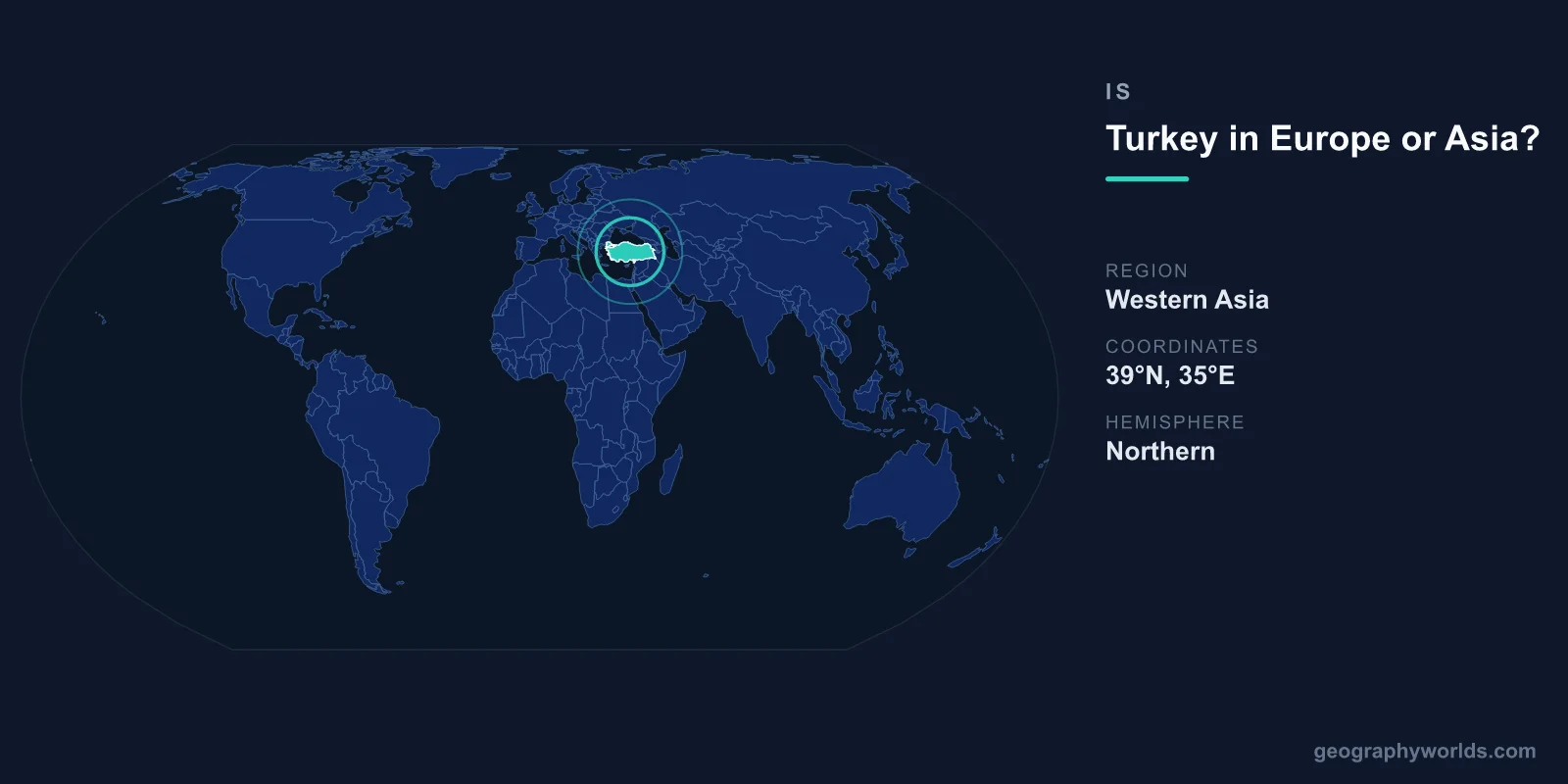
Turkey is in both Europe and Asia, making it a transcontinental country. The vast majority of its territory lies in Asia, on the peninsula of Anatolia, while a smaller portion sits in southeastern Europe in a region known as Thrace. The two parts are separated by a narrow band of water that has shaped Turkish history, trade, and identity for thousands of years.
Where Exactly Is the Dividing Line?
The boundary between Turkey's European and Asian halves is not an arbitrary line on a map but a real waterway. Three connected bodies of water do the dividing: the Bosphorus Strait in the north, the Sea of Marmara in the middle, and the Dardanelles in the south. Together they form the only sea passage between the Black Sea and the Mediterranean, and they mark the conventional border between the two continents.
West of this water lies European Turkey, the region of Thrace, which borders Greece and Bulgaria. East of it lies Asian Turkey, the enormous Anatolian peninsula that makes up the bulk of the nation. The Bosphorus itself is remarkably narrow, in places less than a kilometre wide, which means a person standing on one shore can clearly see the other continent across the water.
How Much of Turkey Is in Each Continent?
Turkey covers a total area of roughly 783,562 km², and the split between continents is heavily lopsided. About 97% of the country's land lies in Asia, while only around 3% lies in Europe. Despite that small European footprint, the Thracian region is densely populated and economically vital.
Population tells a different story than land area. European Turkey, though tiny by area, is home to many millions of people, largely because part of Istanbul, Turkey's largest city, sits on the European side. The capital, however, is firmly Asian: Ankara, located in the central Anatolian plateau, has served as the seat of government since the founding of the modern republic in 1923.
Istanbul: A City on Two Continents
No place captures Turkey's transcontinental nature better than Istanbul. It is one of the only major cities in the world to span two continents, with neighbourhoods, highways, and railways crossing the Bosphorus from Europe to Asia. Commuters routinely travel between continents on their way to work, crossing by ferry, by metro tunnel beneath the strait, or over one of the suspension bridges that link the two shores.
Historically, this position made the city the capital of two great empires, the Byzantine and the Ottoman, under the earlier names Byzantium and Constantinople. Its role as a bridge between East and West gave it control over trade routes between Europe and Asia, a strategic advantage that turned it into one of the wealthiest and most influential cities in the world for over a millennium.
Why People Disagree About Turkey's Continent
Geographically the answer is clear, yet Turkey's continental identity is often debated because culture and politics complicate the picture. Several factors blur the line:
- Political ties: Turkey is a long-standing member of NATO and has been a candidate for European Union membership for decades, anchoring it to European institutions.
- Sporting bodies: Turkish football and basketball clubs compete in European competitions such as UEFA tournaments rather than Asian ones.
- Cultural heritage: Through the Byzantine and Ottoman eras, Turkey shaped European history, while Turkic migration and Islamic civilisation link it strongly to Central Asia and the Middle East.
Because of these overlapping connections, Turkey is frequently described as a cultural bridge rather than belonging neatly to one side. For more on its history, geography, and travel highlights, see our turkey country guide.
The Geography of Anatolia and Thrace
Asian Turkey, or Anatolia, is a broad peninsula surrounded on three sides by water: the Black Sea to the north, the Mediterranean to the south, and the Aegean to the west. Its interior is dominated by the high Anatolian Plateau, ringed by the Pontic Mountains in the north and the Taurus Mountains in the south. This is where you will find famous sites such as the fairy chimneys of Cappadocia and the ancient ruins of Ephesus and Troy.
European Turkey, by contrast, is a flatter, rolling landscape of farmland and river valleys that blends into the Balkans. With coastlines on four different seas, the Black Sea, the Sea of Marmara, the Aegean, and the Mediterranean, Turkey enjoys an extraordinarily varied geography for a single country. Around 85 million people live across these two continents, the overwhelming majority on the Asian side.
Frequently Asked Questions
Is Turkey considered a European or Asian country?
Turkey is officially a transcontinental country. Geographically it is mostly Asian, with about 97% of its land in Anatolia, but politically and culturally it maintains strong European ties through NATO, EU candidacy, and European sporting leagues.
What part of Turkey is in Europe?
The European part of Turkey is the region of Thrace in the country's northwest. It borders Greece and Bulgaria and includes the European districts of Istanbul, separated from Asian Turkey by the Bosphorus Strait and the Sea of Marmara.
Is Istanbul in Europe or Asia?
Istanbul is in both. The city straddles the Bosphorus Strait, with some districts on the European side and others on the Asian side, making it one of the only major cities in the world to span two continents.
Is the capital of Turkey in Europe or Asia?
Ankara, the capital, is located in Asia, in the central Anatolian plateau. The republic moved the capital there from Istanbul in 1923, placing the seat of government firmly on the Asian side of the country.