
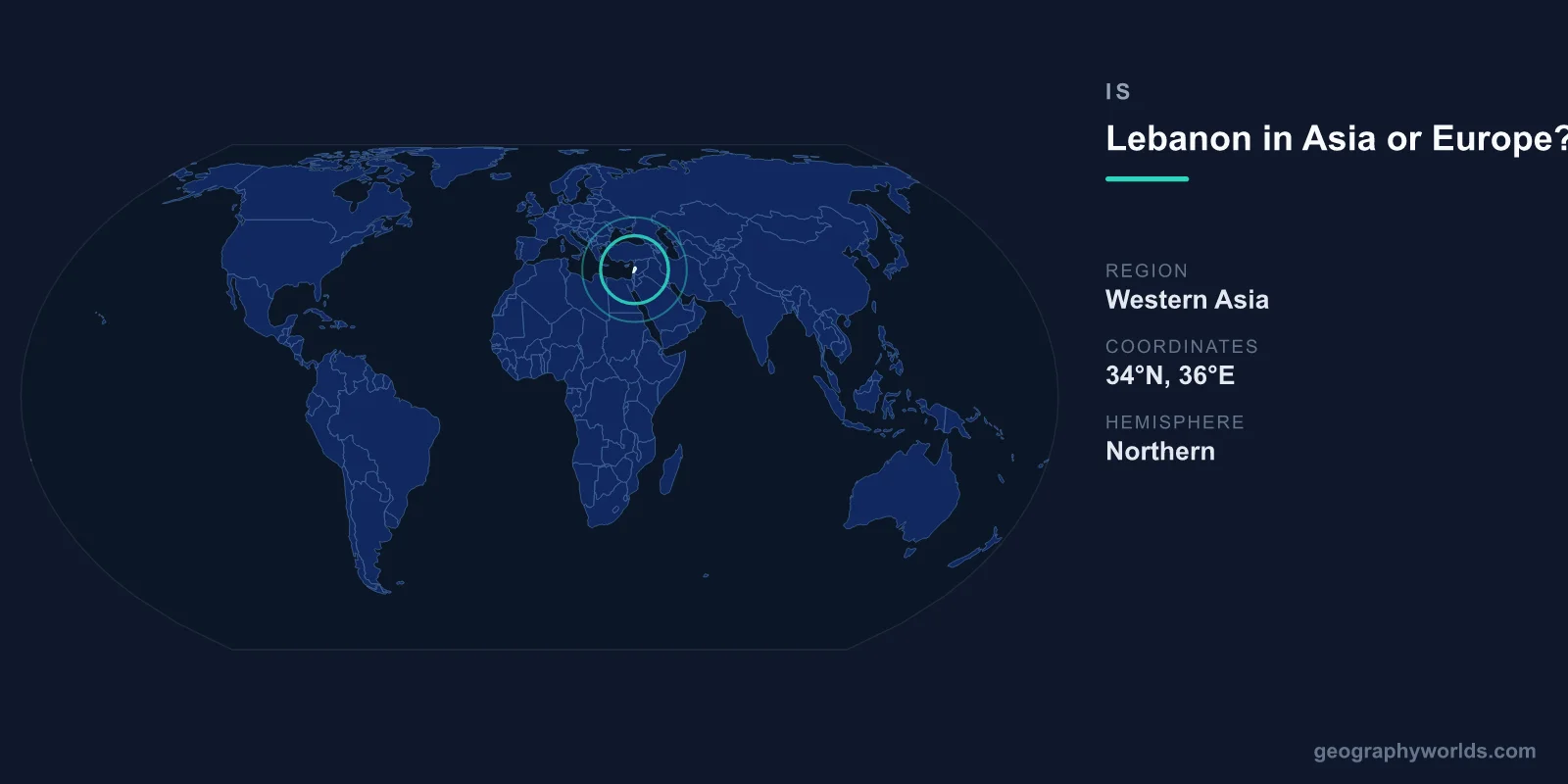
Lebanon is in Asia, not Europe. It sits in Western Asia — the region commonly called the Middle East — on the eastern shore of the Mediterranean Sea, bordered by Syria to the north and east and Israel to the south. Although its capital, Beirut, has long carried a European reputation, every standard geographic definition used by the United Nations, atlases, and cartographers places Lebanon firmly on the Asian continent.
Lebanon Is in Western Asia
Lebanon belongs to the region geographers call Western Asia, the same continental zone as Syria, Jordan, Iraq, and the Arabian Peninsula. More specifically, it lies within the Levant — the strip of land along the eastern Mediterranean that has linked Asia, Africa, and Europe for thousands of years. Covering roughly 10,452 km², Lebanon is one of the smallest countries in continental Asia, yet its position at the crossroads of three continents has shaped its history far more than its modest size would suggest.
There is no land bridge, peninsula, or natural boundary that would place Lebanon in Europe. The Mediterranean Sea separates it from the European mainland to the west and northwest. To reach Europe from Beirut by sea, you would have to sail across open water toward Cyprus, Greece, or southern Italy — a journey of hundreds of kilometres. Continents are defined by physical landmass, and Lebanon's landmass is part of the great Asian continent that stretches eastward all the way to the Pacific.
Where Exactly Is Lebanon Located?
Lebanon occupies a long, narrow rectangle of land roughly 210 kilometres from north to south and only 50 to 90 kilometres wide. It sits between approximately 33° and 35° north latitude and 35° and 37° east longitude. Its only two neighbours are both Asian countries: Syria wraps around its northern and eastern borders, while Israel lies to the south. The western edge is entirely coastline, with about 225 kilometres of frontage on the Mediterranean Sea.
This places Lebanon at one of the most strategically important junctions on Earth. For travellers and traders moving between Europe, the Arabian Peninsula, Egypt, and Mesopotamia, the Lebanese coast has always been a natural gateway — close enough to Europe to absorb its influences, but unmistakably anchored in Asia.
Why People Think Lebanon Might Be European
The confusion is understandable, because Lebanon has unusually strong cultural ties to Europe. Beirut was once nicknamed the "Paris of the Middle East," and Lebanon itself has been called the "Switzerland of the East." Several factors feed this perception:
- French heritage: Lebanon was under French mandate from 1920 to 1943. French is still widely spoken alongside Arabic, appearing on street signs, in schools, and in everyday conversation.
- Mediterranean lifestyle: The cafe culture, coastal resorts, vineyards in the Beqaa Valley, and a cosmopolitan capital give parts of Lebanon a distinctly Mediterranean-European feel.
- Cuisine and diaspora: Lebanese food such as hummus, tabbouleh, and fattoush is beloved across Europe, and a large Lebanese diaspora has spread these connections worldwide.
- Sporting and cultural bodies: Lebanon sometimes competes in or affiliates with European or pan-Mediterranean organisations, which can blur the picture for casual observers.
These influences are cultural and historical, not geographic. A country's continent is determined by its physical position on the globe, and Lebanon's position is unmistakably Asian. Cultural identity and continental geography are simply two different things.
Lebanon's Geography and Landscape
Despite its small footprint, Lebanon has dramatic and varied terrain. A narrow coastal plain runs along its Mediterranean shoreline, home to the capital Beirut and ancient port cities like Tyre, Sidon, and Byblos. Behind the coast rises the Lebanon mountain range, which peaks at Qurnat as Sawda' at about 3,088 metres. Beyond it lies the fertile Beqaa Valley, the country's agricultural heartland, and further east the Anti-Lebanon range forms a natural border with Syria.
This compact arrangement creates a famous quirk: in winter, you can ski in the mountains in the morning and swim in the Mediterranean the same afternoon, because the slopes sit just half an hour from the coast. The country's mountains also give it the cedar tree that appears at the centre of its national flag — a symbol that dates back to antiquity and gives Lebanon one of the most recognisable flags in Asia.
A Crossroads of Civilizations
Lebanon's Asian location placed it at the heart of one of the ancient world's great trading regions. The Phoenicians, a seafaring people who originated along this coast, built a maritime civilization that spread across the Mediterranean. They are credited with developing the alphabet that later influenced Greek, Latin, and Arabic scripts. Byblos, one of Lebanon's coastal cities, is among the oldest continuously inhabited settlements on Earth, with roots stretching back more than 7,000 years.
Over the centuries, the territory passed through Phoenician, Roman, Byzantine, Arab, Crusader, and Ottoman hands before becoming a modern republic in the 20th century. Each of these powers came overland or by sea through Asia and the Mediterranean, reinforcing Lebanon's role as a meeting point rather than a European outpost. Today Lebanon is home to around 5.5 million people, with Arabic as its official language and one of the most religiously diverse populations in the region. You can learn more in our Lebanon country guide.
Key Facts
- Continent: Asia (Western Asia / the Middle East)
- Region: The Levant, eastern Mediterranean coast
- Capital: Beirut
- Land neighbours: Syria (north and east), Israel (south) — both Asian countries
- Area: Roughly 10,452 km², one of Asia's smallest countries
- Highest point: Qurnat as Sawda', about 3,088 metres
- Official language: Arabic, with French and English widely spoken
Frequently Asked Questions
What continent is Lebanon on?
Lebanon is on the continent of Asia, specifically in the Western Asia region known as the Middle East or the Levant. It is not part of Europe or Africa.
Is Lebanon part of the Middle East?
Yes. Lebanon is a Middle Eastern country in Western Asia, sharing the eastern Mediterranean coast with neighbours such as Syria and Israel.
Why is Beirut called the "Paris of the Middle East"?
Beirut earned the nickname because of its French-influenced architecture and language, its cafe and nightlife culture, and its historic role as a cosmopolitan banking and cultural hub. The nickname reflects culture, not geography — Beirut remains firmly in Asia.
Is Lebanon in Europe in any sense?
No. While Lebanon has deep cultural and historical ties to Europe through the French mandate and Mediterranean trade, it is geographically located in Asia and is not part of the European continent or the European Union.
How far is Lebanon from Europe?
The nearest European territory is the island of Cyprus, roughly 200 kilometres west of the Lebanese coast across the Mediterranean Sea. The European mainland is considerably farther, which underscores that Lebanon sits clearly within Asia rather than Europe.