
Introduction to The Central American Countries
Central America is a narrow strip of land connecting the vast continents of North and South America, encompassing seven nations packed with extraordinary natural beauty, ancient civilizations, and complex modern realities. From Guatemala's Maya ruins rising above jungle canopies to Panama's engineering marvel of a canal, from Costa Rica's pioneering conservation efforts to El Salvador's surf breaks, this isthmus of roughly 50 million people punches far above its size in biodiversity, cultural heritage, and geopolitical significance. Central America is both a biological bridge — where North and South American flora and fauna meet and mingle — and a cultural one, blending indigenous Maya and other native traditions with Spanish colonial heritage and Afro-Caribbean influences. The region's volcanic spine, lush rainforests, and Caribbean and Pacific coastlines create landscapes of staggering variety within a compact area.

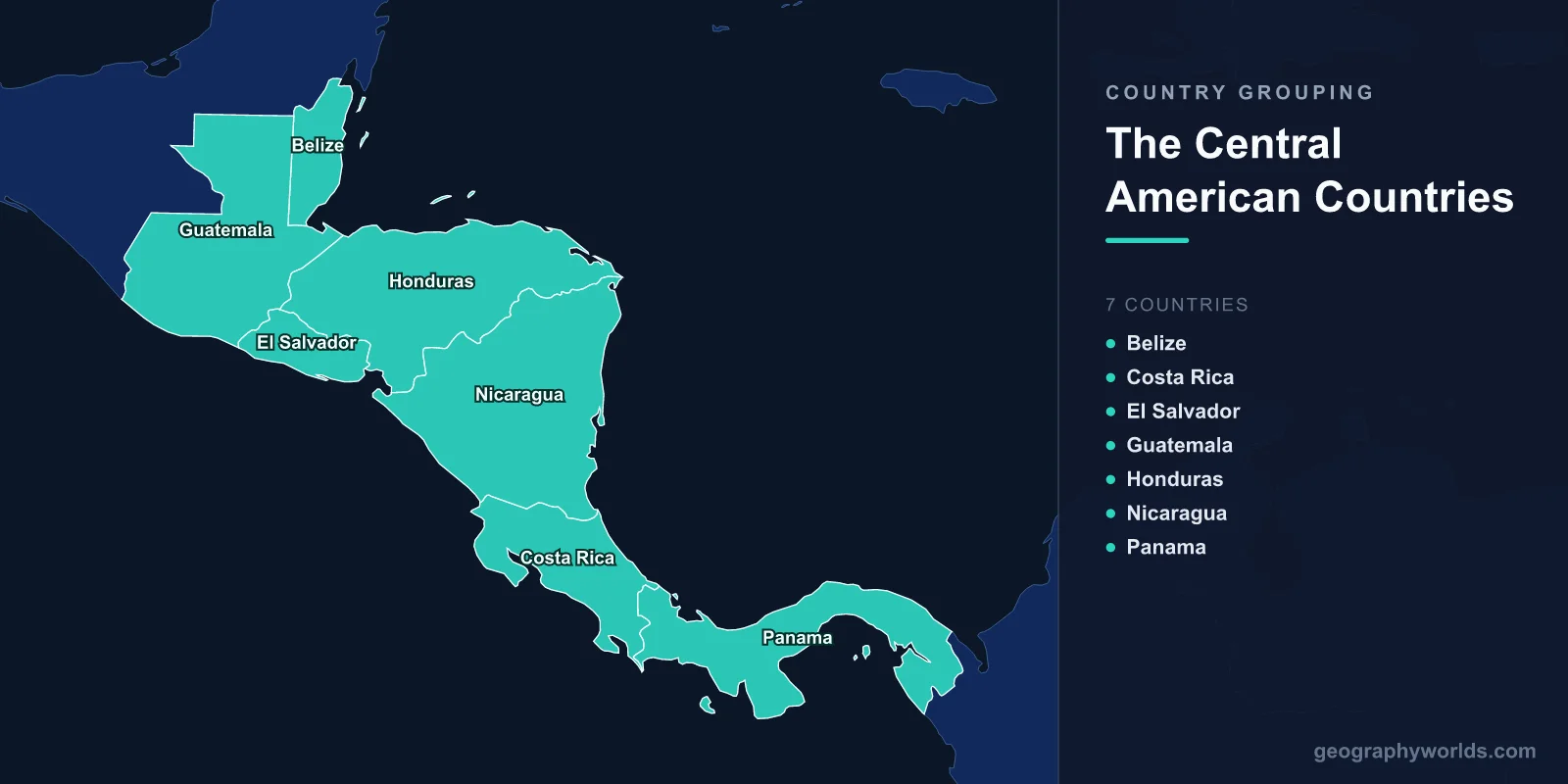
Countries in The Central American Countries
- Belize
- Costa Rica
- El Salvador
- Guatemala
- Honduras
- Nicaragua
- Panama
Location: The narrow isthmus connecting North and South America
Shared Characteristics: Maya heritage, Spanish colonial legacy, tropical biodiversity, volcanic landscapes
History
Central America was home to one of the ancient world's most sophisticated civilizations. The Maya, who flourished from roughly 2000 BCE to 1500 CE, built magnificent cities like Tikal (Guatemala), Copan (Honduras), and Caracol (Belize), developing advanced mathematics, astronomy, a fully developed writing system, and a calendar more accurate than the European one of the same era. The Spanish conquest in the 16th century devastated indigenous populations through warfare and disease, imposing colonial rule that lasted until the 1820s. After independence from Spain, the five central nations (Guatemala, El Salvador, Honduras, Nicaragua, Costa Rica) briefly formed the Federal Republic of Central America before dissolving into separate states. Panama was part of Colombia until 1903, when it gained independence with U.S. backing to facilitate the construction of the Panama Canal. The 20th century was marked by political instability, U.S. interventions, military dictatorships, and civil wars — particularly devastating conflicts in Guatemala (1960-1996), El Salvador (1979-1992), and Nicaragua (1979-1990).
Geography & Climate
Central America's geography is dominated by a volcanic mountain chain running its entire length, part of the Pacific Ring of Fire. Guatemala alone has 37 volcanoes, several of which remain highly active. The mountains create a dramatic divide between the humid Caribbean lowlands and the drier Pacific slopes. The region's biodiversity is extraordinary: Costa Rica alone contains roughly 5% of the world's species on just 0.03% of the planet's surface. Belize's barrier reef is the second largest in the world after Australia's Great Barrier Reef. The Panama Canal, one of the world's most important waterways, cuts through the continental divide at its narrowest point. Nicaragua contains Central America's largest lake (Lake Nicaragua), which is home to the world's only freshwater sharks. Cloud forests, mangrove swamps, tropical dry forests, and coral reefs create an incredible mosaic of ecosystems in a region smaller than Texas.
Culture & Society
Central American culture reflects layers of Maya, Spanish, African, and indigenous influences. Guatemala has the largest indigenous population in the region, with over 20 Maya ethnic groups maintaining distinct languages, traditional dress, and spiritual practices. The vibrant textiles of Guatemalan women are recognized worldwide for their intricate patterns and symbolic meanings. El Salvador and Honduras share the tradition of pupusas — stuffed corn tortillas that are the region's most beloved street food. Costa Rica's "Pura Vida" philosophy (roughly "pure life") reflects a national ethos of contentment and appreciation. Panama's culture blends Latin American, Afro-Caribbean, and indigenous Kuna traditions, visible in everything from music to the famous molas (colorful textile art). Belize is unique in the region for its English-speaking Creole culture alongside Maya and Garifuna (Afro-indigenous) communities. Religion is predominantly Catholic, though evangelical Protestantism has grown dramatically in recent decades.
Economy
Central American economies are diverse but generally face challenges of inequality, limited infrastructure, and vulnerability to natural disasters. Panama leads the region economically, buoyed by the Panama Canal (which generates over $3 billion annually in revenue), a major banking sector, and the Colon Free Trade Zone. Costa Rica has built a reputation for ecotourism, technology manufacturing (Intel and medical devices), and high-quality coffee, achieving the region's highest Human Development Index. Guatemala has the largest economy by GDP in Central America, driven by agriculture (coffee, bananas, sugar), textiles, and remittances. El Salvador made headlines by adopting Bitcoin as legal tender in 2021. Honduras and Nicaragua remain among the poorest countries in the Western Hemisphere. Coffee, bananas, and remittances from migrants in the United States are common economic pillars across the region.
The Region Today
Central America today faces a complex set of challenges and opportunities. Migration northward to the United States remains a defining issue, driven by poverty, violence, corruption, and climate change. The "Northern Triangle" countries (Guatemala, Honduras, El Salvador) have experienced waves of emigration, while also working to improve security and economic conditions. Costa Rica continues to stand out as the region's most stable democracy and environmental leader, having run on over 98% renewable electricity for several consecutive years. Panama's canal expansion (completed in 2016) has increased its global trade significance. Climate change poses severe threats through more intense hurricanes, prolonged droughts in the "dry corridor," and sea-level rise affecting coastal communities. Despite challenges, the region's natural beauty, cultural richness, and young population offer grounds for optimism.
Interesting Facts About The Central American Countries
- Costa Rica has no standing army — it abolished its military in 1948 and redirected spending to education and healthcare
- Panama's canal saves ships a journey of roughly 15,000 km around South America
- Guatemala's Tikal was one of the largest Maya cities, with a peak population estimated at 100,000 or more
- Belize has the second-largest barrier reef in the world, stretching about 300 km along its coast
- El Salvador is the smallest country in Central America but the most densely populated
- Nicaragua's Lake Nicaragua contains bull sharks that have adapted to freshwater — the only known freshwater shark population
Conclusion
The Central American Countries (Belize, Costa Rica, El Salvador, Guatemala, Honduras, Nicaragua, Panama) represent a fascinating regional grouping with shared history, cultural ties, and common challenges. Whether you're studying world geography, planning travel, or simply curious about how the world's nations connect, understanding these regional groupings provides valuable context for making sense of our complex and interconnected world.
