
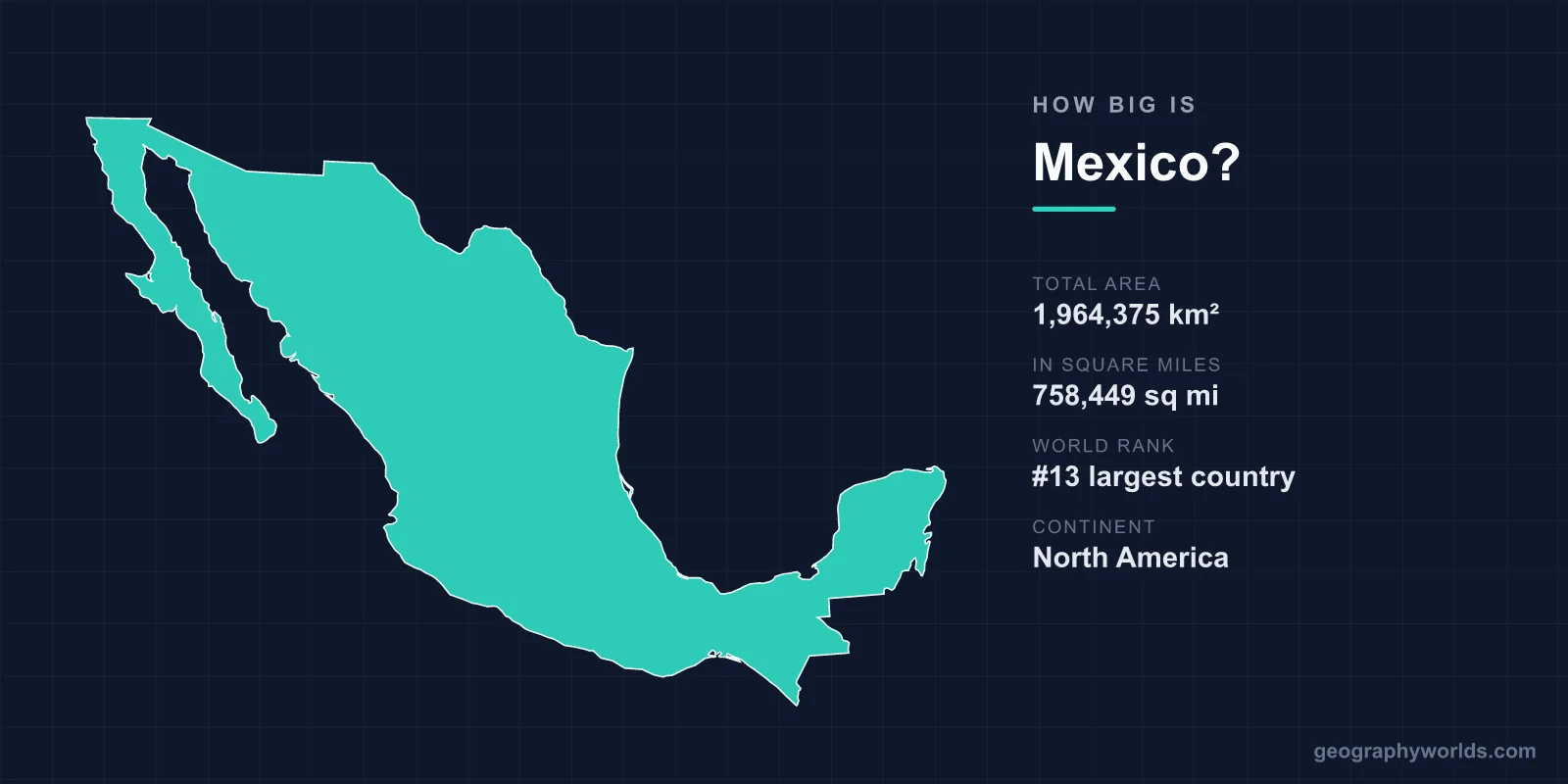
Mexico covers a total area of 1,964,375 km² (758,449 sq mi), making it the 13th largest country in the world — roughly three times the size of the U.S. state of Texas. That landmass accounts for about 1.32% of the Earth's total land area and ranks Mexico as the third-largest nation in North America, behind only Canada and the United States.
Just How Big Is 1.96 Million Square Kilometers?
Raw numbers can be hard to picture, so comparisons help. At nearly two million square kilometers, Mexico is larger than the vast majority of countries on the planet. You could fit the entire United Kingdom inside Mexico around eight times over, and Mexico is roughly 3.1 times the size of France (640,679 km²). Compared with its northern neighbor, Mexico is about a fifth the size of the United States, yet it dwarfs every country in Central America combined.
Within North America, Mexico claims the bronze medal for size. It is comfortably bigger than any single nation in the Caribbean or Central America, and its territory spans an extraordinary range of latitudes, climates, and elevations packed into one continuous landmass.
Dimensions, Coastline, and Borders
Mexico stretches approximately 3,200 km from its northern border with the United States to its southern frontier with Guatemala and Belize, and about 3,000 km across at its widest east-to-west span. That north-south reach is why Mexico straddles both temperate and tropical zones, with the Tropic of Cancer slicing through the middle of the country.
The country boasts an enormous coastline of roughly 9,330 km, touching two major bodies of water. The Pacific Ocean and the Gulf of California define the west, while the Gulf of Mexico and the Caribbean Sea border the east. This dual-ocean access has shaped Mexico's trade, fishing, and tourism for centuries, from the resorts of the Pacific coast to the turquoise beaches of the Riviera Maya.
A Landscape of Mountains, Deserts, and Jungles
Mexico's terrain is as varied as its size suggests. The interior is dominated by the high Mexican Plateau, flanked on either side by two great mountain ranges: the Sierra Madre Occidental to the west and the Sierra Madre Oriental to the east. Slicing across central Mexico is the Trans-Mexican Volcanic Belt, home to the country's tallest peaks.
The highest point is Pico de Orizaba, a dormant volcano rising to 5,636 m (18,491 ft) above sea level — the third-tallest mountain in North America. Elsewhere, the landscape shifts dramatically:
- Northern deserts: the arid Chihuahuan and Sonoran deserts cover huge swaths of the north.
- Southern rainforests: the states of Chiapas and Tabasco hold lush tropical jungle.
- The Yucatán Peninsula: a flat, limestone shelf riddled with caves and sinkholes.
- The Copper Canyon: a network of gorges in Chihuahua that is larger and in places deeper than the Grand Canyon.
Sitting along the Pacific Ring of Fire, Mexico is also dotted with active volcanoes, including the frequently rumbling Popocatépetl near Mexico City.
Why Size Shapes Mexico's Identity
The sheer scale of the country explains its remarkable diversity. Because Mexico spans so many climate zones, it is one of a handful of "megadiverse" nations, hosting an outsized share of the world's plant and animal species. Its size has also fostered enormous cultural variety, from the desert ranching traditions of the north to the Indigenous Maya communities of the southeast.
Geography even leaves marks on individual landmarks. The Yucatán Peninsula contains the buried Chicxulub crater, the asteroid impact site widely linked to the extinction of the dinosaurs. The same peninsula holds thousands of cenotes — natural freshwater sinkholes that were sacred to the ancient Maya and still draw divers today. For a deeper tour of the country's regions, climate, and culture, see our mexico country guide.
Quick Size Facts
- Total area: 1,964,375 km² (758,449 sq mi)
- World rank: 13th largest country
- Rank in North America: 3rd, after Canada and the United States
- Coastline: approximately 9,330 km on two oceans
- Highest point: Pico de Orizaba, 5,636 m (18,491 ft)
- Capital: Mexico City
Frequently Asked Questions
Is Mexico bigger than Texas?
Yes. Mexico is about three times the size of Texas. While Texas is the second-largest U.S. state at roughly 695,000 km², Mexico's nearly 1.96 million km² makes the comparison dramatic — you could fit Texas inside Mexico almost three times.
What rank is Mexico in size among all countries?
Mexico is the 13th largest country in the world by total area, placing it just behind nations like Saudi Arabia and ahead of Indonesia. It is also the third-largest country in North America.
How does Mexico compare to European countries?
Mexico is far larger than any country in Western Europe. It is roughly 3.1 times the size of France and about eight times the size of the United Kingdom. In fact, Mexico is bigger than France, Germany, and Spain combined.
How long is Mexico's coastline?
Mexico has approximately 9,330 km of coastline, split between the Pacific Ocean and Gulf of California on the west and the Gulf of Mexico and Caribbean Sea on the east, giving it access to two oceans.