

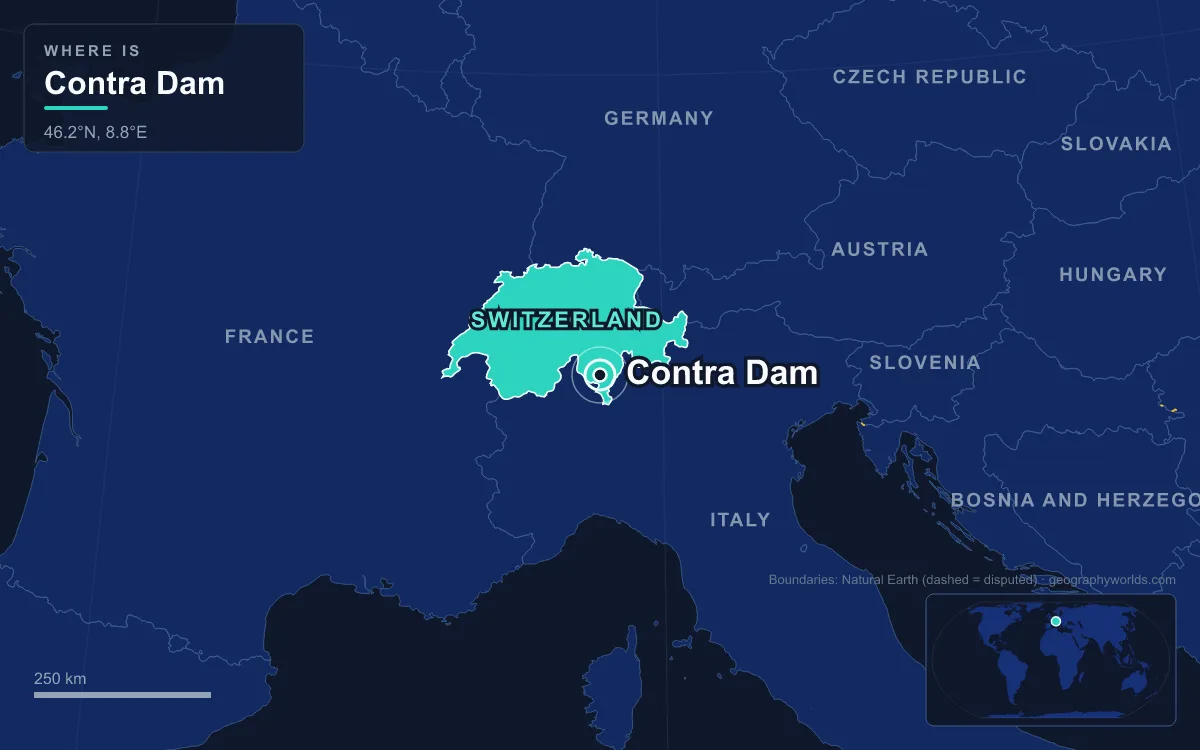
Contra Dam, also called the Verzasca Dam, is a 220 m (720 ft) concrete arch dam on the Verzasca River in the canton of Ticino, in Italian-speaking southern Switzerland. It stands where the Val Verzasca opens out, about 2 km upstream of Lake Maggiore near Tenero. It was built between 1961 and 1965 and holds back Lago di Vogorno, a reservoir of about 105 million m³. That water drives an underground power station of 105 MW, which produces about 234 GWh in an average year. Contra is the fourth-tallest dam in Switzerland and a documented case of earthquakes triggered by filling a reservoir. Since the opening scene of the 1995 James Bond film GoldenEye, it has also been a popular bungee jumping venue.
A 220-Metre Arch Only 7 Metres Wide at the Crest
An arch dam does not hold back water by sheer weight, as a gravity dam does. It curves upstream, so the push of the reservoir is carried sideways into the rock walls of the valley. That is why Contra can be so thin. The wall is 220 m tall and 380 m long at the crest, yet only 25 m thick at the base and 7 m thick at the top. The whole structure contains about 660,000 m³ of concrete. Mauvoisin in Valais, a 250 m arch dam, contains about 2,030,000 m³, roughly three times as much.
The shape was worked out by the engineer Giovanni Lombardi of Lombardi & Gellaro, who designed the dam and supervised its construction. Seen from above, each horizontal arch is elliptical rather than circular. The curve is tightest at the centre and flattens toward the abutments, and it gets tighter from the crest down to the foundation. The wall thickens as it goes down, and it is also made thicker where it meets the rock. That spreads the load so that the gneiss is never pressed harder than about 70 kg/cm², which is what the rock was judged able to take. The slight vertical curve toward the crest reduces tension in the concrete whether the reservoir is full or empty. Lombardi counted Contra among his most elegant dams because of how slender the arch is. The thin design also saved concrete and money.
Building it took careful organisation. Verzasca SA was founded on 6 May 1960 to build the scheme, and work began in 1961. Contra sits lower than the big high-Alpine dams, so the milder climate allowed work to continue through the winter. Cofferdams sent the river through a diversion tunnel that could carry 200 m³/s. The engineers knew that floods could exceed this and accepted the risk. When digging on the right side found weathered rock where sound rock had been expected, the excavation was deepened and the design revised within 15 days.
Concrete was placed over 18 months. The peak was 3,100 m³ in one day and 55,000 m³ in one month. The aggregate was gneiss from a quarry near the site, crushed in a rotary crusher. Steel cooling pipes ran through the concrete, except in the top 30 m, to control shrinkage as it set. A grout curtain injected around and beneath the wall seals the rock against leaks.
Six Weirs and a Flip Bucket on Each Side of the Verzasca Gorge
The Verzasca is an unpredictable river. Its water is usually crystal clear and turquoise, but its seasonal flows are very irregular and in spate it can reach 1,000 m³/s. The dam deals with this through two spillways built into the wall near the abutments. Each spillway has six fixed-crest weirs 12 m wide. There are no gates, so when the reservoir rises above the weir crests, water simply pours over. From each set of weirs the water drops down a single chute to a flip bucket at its foot. The bucket throws the jet outward and turns it toward the centre of the valley about 200 m below, so the falling water breaks up in the air and lands away from the base of the dam. Together the spillways can pass up to 2,150 m³/s. After the dam opened, the piers between the weirs were made larger and extra side deflectors were added near the crest to guide the water better.

Below the spillways are the outlet works. Two discharge pipes can each release up to 170 m³/s. One empties into the old diversion tunnel and the other comes out at the base of the dam into the river valley. These low outlets let operators lower the reservoir well below the weir crests. That mattered in the 1960s, when emptying the lake stopped the earthquakes described below. It still matters for inspections today.
From Lago di Vogorno to a Turbine Hall 277 Metres Lower
Lago di Vogorno fills the lower Val Verzasca behind the wall. It stores about 105 million m³ and covers about 1.6–1.7 km² (sources differ slightly), fed by a catchment of 230 km². The river rises at Pizzo Barone and runs about 30 km south through the valley to Lake Maggiore. The Val Verzasca itself is about 25 km long, with a floor between roughly 500 and 900 m above sea level, and the passes around it average about 2,400 m. None of those passes crosses a cantonal or national border, and the whole valley drains south through the gorge at Contra. Vogorno on the lakeshore and Corippo, Brione, Frasco and Sonogno further up the valley merged into the single municipality of Verzasca on 17 October 2020. The valley’s other communities are Mergoscia, Lavertezzo and Gerra, and in 2004 its total population was about 3,200. Mergoscia, just above the lake, lies near the geographical centre of Ticino.

The power scheme uses the full drop from the reservoir to the lake below. Water leaves Lago di Vogorno at about 470 m above sea level and falls through the mountain to an underground power station at 193 m, the level of Lake Maggiore. That gives a maximum head of 277 m. Three Francis turbines of 35 MW each turn the drop into 105 MW, using up to 50 m³/s of water. The used water leaves through a 1.9 km tailrace tunnel straight into Lago di Verbano, another name for Lake Maggiore. Verzasca SA holds an 80-year concession on the plant, which runs until 2046.
The Earthquakes of 1965–1971 Triggered by Filling the Reservoir
Contra is also studied for another reason. Filling began in August 1964, and Lombardi later described the water as rising exceptionally fast. In May 1965 the valley began to shake. The largest shocks came in October and November 1965, after the reservoir was already full, and on some days there were as many as 25. The epicentres lay on two faults near the dam. No detailed geological study had been done before construction, and several faults are known in the area.
The engineers emptied the reservoir, and the shocks stopped. Inspections found no damage to the arch. When the lake was refilled the tremors came back but grew weaker, and they seemed to settle into a balance that no longer followed changes in the water level. One more large shock came several years after the first filling. By 1971 the seismic activity around the dam and reservoir had ended. Because the shocks began during the first filling and stopped when the lake was emptied, they are attributed to the reservoir’s water load.
What Contra Means for Ticino, from GoldenEye to Red Bull Dual Ascent
For southern Switzerland the dam’s first job is to turn a river of sudden floods, which below the dam runs out across the Magadino plain to Lake Maggiore, into stored water and electricity. Its 234 GWh a year is modest next to the big Valais schemes. The Grande Dixence complex, for example, has an installed capacity of 2,069 MW, almost twenty times Contra’s 105 MW. For how these dams fit into the wider range, see our guide to the Alps.
The dam’s second role began with cinema. In the opening of GoldenEye, the British stuntman Wayne Michaels jumped from the crest as Bond. The dam stood in for a fictional Soviet chemical weapons plant at Arkhangelsk. A 2002 Sky Movies poll voted the jump the best film stunt of all time. Soon after the film came out, the owners began leasing the crest to a commercial bungee operator, which says more than 10,000 people have since made the 220 m jump. The Amazing Race sent contestants off it in the first episode of its 14th season and the fifth episode of its 33rd. The Bollywood film Dhoom 3 shot its climax here. In October 2022 an artificial climbing wall on the downstream face hosted Red Bull Dual Ascent, the first competition climbing event held in a multi-pitch format.
This tourism reaches up the valley. Visitors who come to see the dam often carry on to the clear pools of the upper Verzasca, where the water rarely runs deeper than about 10 m and stays at around 7–10 °C. The river draws divers from late spring to early autumn. For Ticino, a structure built to make electricity in the early 1960s has also become one of its best-known sights. For a sense of scale, compare it with Europe’s tallest dam in our profile of the Grande Dixence Dam, 65 m higher but built on a very different principle.