
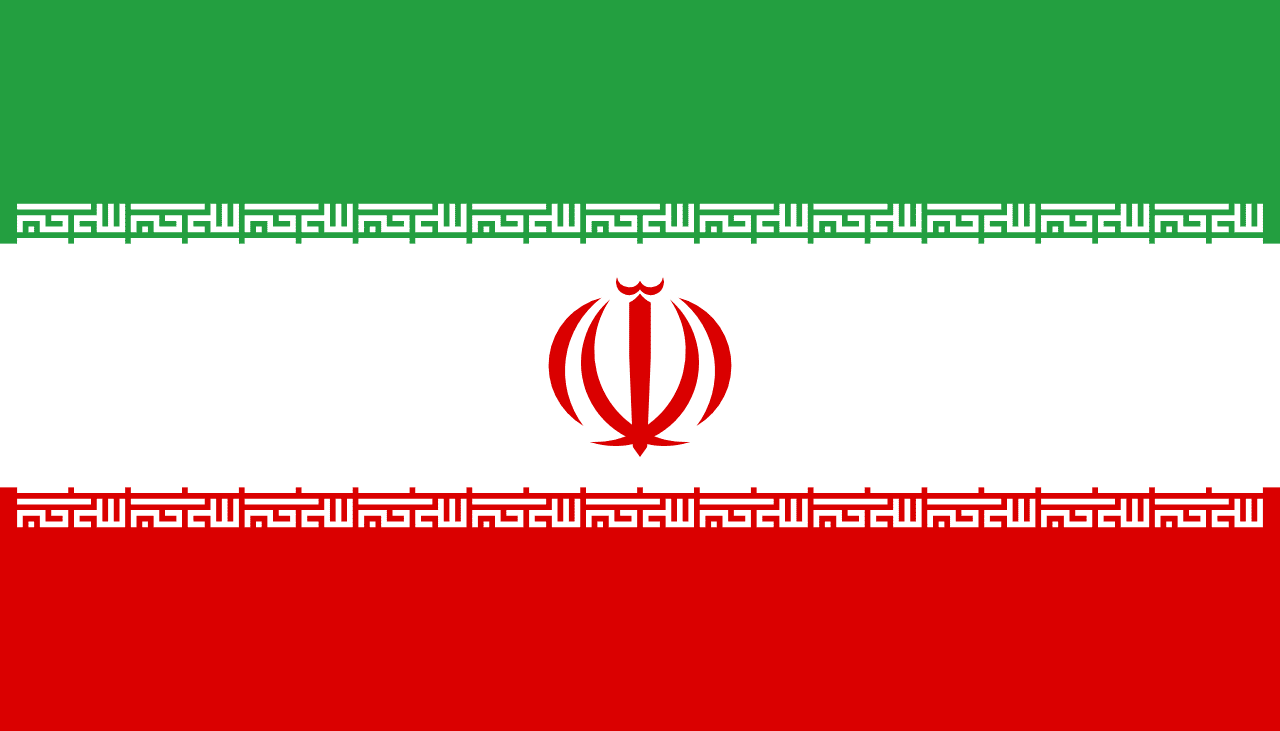
Few national flags pack as much encoded meaning into their cloth as the flag of Iran. At first glance it reads as a familiar horizontal tricolor of green, white, and red. Look closer, though, and you find a sword-like emblem at its heart and a band of stylized script running along the inner edges of the colored stripes. This is a flag that asks to be examined rather than merely glanced at, and every element on it was chosen to tell a story about the country's faith, its people, and the revolution that reshaped it. Adopted in 1980 in the wake of the Islamic Revolution, the modern Iranian flag is one of the most intricate state banners in the world.
A Tricolor Built on Three Colors
The foundation of the flag is a horizontal triband: green on top, white in the middle, and red along the bottom, with each stripe of equal height. These three colors have deep roots in Iranian visual culture and were already associated with the nation long before 1980, but the revolutionary government gave them clear, codified meanings.
Green stands for Islam, the faith that shapes so much of the country's public and private life, and it has long carried connotations of growth, vitality, and paradise in the wider Islamic world. The white central band represents peace, serving as a calm, neutral ground at the center of the design. Red at the base signifies courage, martyrdom, and the sacrifices made by those who fought for the country. Together the three stripes frame the flag's two scripted elements, which is where Iran's banner departs sharply from the plain tricolors of many other nations.
The Emblem and the Hidden Script
Centered on the white stripe is the national emblem, a stylized red device that resembles a tulip and is often read as the word "Allah" rendered as a geometric monogram. It is composed of four crescents and a vertical line, a shape that can also be seen as evoking a sword or a blossoming flower. The tulip carries particular weight in Iranian symbolism, where it is traditionally linked to those who give their lives for a cause.
The flag's most famous detail, however, is easy to miss from a distance. Running along the inner edge of the green stripe and the inner edge of the red stripe is a repeated band of Kufic-style script. This is the takbir, the phrase "Allahu Akbar," meaning "God is Great." The phrase is repeated eleven times along each edge, producing a total of twenty-two repetitions across the whole flag. That number is not arbitrary: it points to the twenty-second day of the Iranian month of Bahman, the date on the Persian calendar associated with the victory of the 1979 revolution.
How the Flag Evolved
Iran's banner did not arrive fully formed. For much of the twentieth century the national flag carried a lion-and-sun emblem, a centuries-old symbol of Persian monarchy, often shown with a sword and crown on a green-white-red field. That imagery was tied closely to the Pahlavi dynasty and the long monarchical tradition that preceded it.
When the Islamic Revolution swept away the monarchy, the new republic needed a flag that reflected a fundamentally different national identity. The lion-and-sun was removed, and in 1980 the current design was adopted: the same three historic colors, but now centered on the Islamic emblem and framed by the repeated takbir. The change preserved continuity with Iran's older visual heritage while signaling a decisive political and religious break. To explore the wider story of the nation behind the banner, see our iran country guide.
Comparing Iran's Flag to Its Relatives
The green-white-red palette places Iran's flag in the company of several other national banners, and it is the added detail that keeps them distinct. The most obvious look-alike is the flag of Italy, which shares the same three colors but arranges them as vertical stripes and carries no emblem or text. Hungary uses an identical horizontal arrangement of red-white-green (with the order reversed top to bottom), and its plain stripes are a useful reminder of how much the central emblem and script do to set Iran apart.
Within its own region, the flag also shares the broad pan-Islamic and pan-Arab habit of using green and red, though Iran's banner is unmistakably its own. No other country fills the margins of its stripes with twenty-two repetitions of a sacred phrase, and the tulip-shaped central monogram is unique among the world's flags. Where a casual observer might confuse a plain tricolor with several neighbors, Iran's design is essentially impossible to mistake once those scripted edges come into view.
A Banner of Faith and National Identity
For Iranians, the flag is inseparable from the identity forged in 1979. The colors connect the modern republic to a much older Persian heritage, while the emblem and inscription tie that heritage explicitly to Islam and to the revolution. This dual character, ancient and contemporary at once, gives the banner a layered significance: it is at once a continuation of long tradition and a declaration of a new political order.
That symbolism makes the flag a charged and meaningful object in public life. It appears on government buildings and official documents, in classrooms and at state ceremonies, and it anchors the visual identity of the Islamic Republic both at home and on the international stage.
The Flag in Modern Life
Today the flag turns up across Iranian civic and sporting life. It is flown on national holidays, most prominently around the anniversary of the revolution, when the symbolism of the twenty-two repetitions of the takbir resonates most strongly. Athletes carry it at international competitions, and it is draped, waved, and worn at football matches and other sporting events where national feeling runs high.
Because Iran sits in southwestern Asia, the flag also represents the country across the Asian continent at regional and global gatherings, from diplomatic summits to multinational tournaments. In each of these settings the same compact design does its work: three historic colors, a single emblem, and a quietly insistent ribbon of script.
Interesting Facts About the Flag of Iran
- The phrase "Allahu Akbar" appears twenty-two times in total, eleven along the green stripe and eleven along the red.
- That count of twenty-two refers to the 22nd of Bahman, the day tied to the 1979 revolution's victory.
- The current design was officially adopted in 1980, after the Islamic Revolution.
- The central red emblem is often read as a stylized rendering of the word "Allah" and is shaped like a tulip.
- Before the revolution, the flag featured a lion-and-sun emblem associated with the monarchy.
- The three colors are read as green for Islam, white for peace, and red for courage.
Frequently Asked Questions
When was the flag of Iran adopted?
The current flag was adopted in 1980, following the Islamic Revolution of 1979. It replaced the earlier monarchical flag that had carried the lion-and-sun emblem, keeping the historic green, white, and red colors while adding the new Islamic emblem and inscription.
What do the colors of the Iranian flag mean?
Green represents Islam, white represents peace, and red represents courage. These three colors have long been associated with Iran, and the revolutionary government gave them their current official meanings when the flag was redesigned in 1980.
What is written on the Iranian flag?
The phrase "Allahu Akbar," meaning "God is Great," is written in stylized script along the inner edges of the green and red stripes. It is repeated eleven times on each edge, for a total of twenty-two times, a number that points to the date of the revolution's victory. The central emblem is a stylized form of the word "Allah."
What continent is Iran on, and what flags look similar?
Iran is located in southwestern Asia. Its green-white-red palette resembles the flags of Italy (vertical stripes, no emblem) and Hungary (horizontal stripes in a reversed order), but the central tulip-shaped emblem and the repeated band of script make Iran's flag immediately distinguishable from any of them.
