
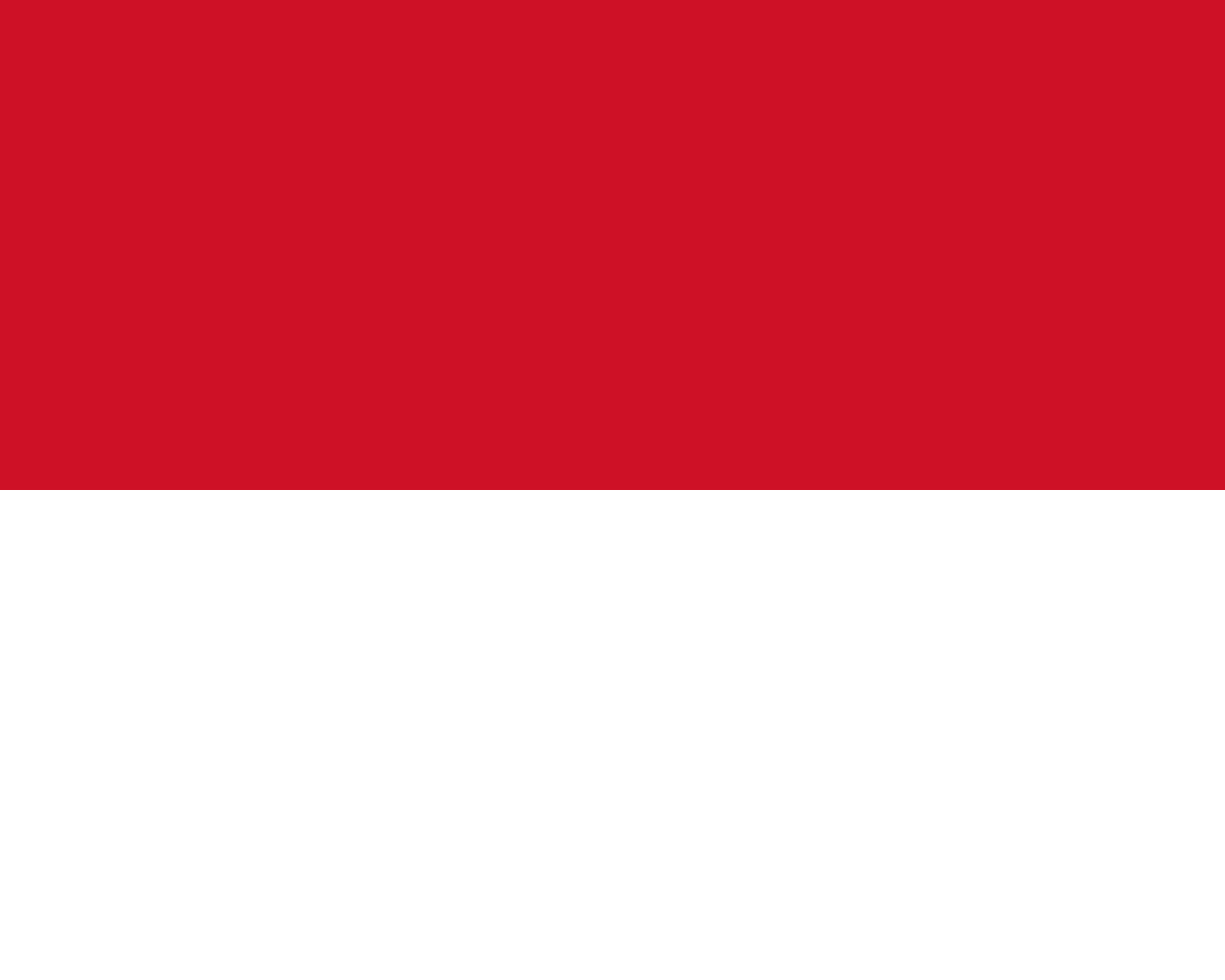
Few flags pack as much paradox into such a simple design as the banner of Monaco. Two clean horizontal bands, red over white, fly above the most densely populated sovereign state on Earth, a Mediterranean micro-nation barely larger than New York's Central Park. There is no crest, no motto, no intricate emblem competing for attention. Yet this unassuming bicolor carries the weight of one of Europe's oldest ruling dynasties and a history of princely rule stretching back more than seven centuries. Adopted in its modern form in 1881, the flag distills the identity of the Principality into two heraldic colors borrowed straight from the coat of arms of the House of Grimaldi.
A Bicolor Born From Heraldry
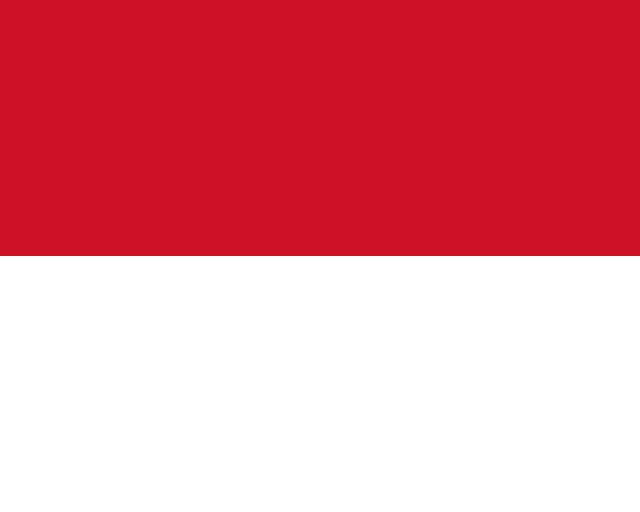
Monaco's flag is a horizontal bicolor: a band of red occupying the upper half and a band of white filling the lower half, the two divided cleanly across the center. That is the entire composition. There are no stars, no stripes within stripes, no canton in the corner. The simplicity is deliberate and ancient, because the colors did not begin life as a flag at all. They were lifted directly from the heraldic shield of the Grimaldi family, the dynasty that has governed Monaco since the late thirteenth century. In the language of heraldry, the Grimaldi arms are blazoned as fusily argent and gules, meaning a pattern of silver (white) and red diamonds. When those colors were translated onto a national banner, white and red were the natural and only candidates.
This is why Monaco's identity feels so tightly bound to its rulers. In many countries a flag represents the people, the land, or a revolutionary ideal. In Monaco the flag represents a household, the family whose fortunes have been inseparable from the rock above the harbor since 1297. To raise the red and white is to raise the colors of the Grimaldis themselves.
What the Red and White Represent
Because the colors come from a coat of arms rather than from a list of abstract virtues, their meaning is dynastic rather than symbolic in the usual sense. Red and white are simply the family colors of the Grimaldis, and through them the colors of the sovereign Prince and the Principality he leads. Over time, observers have read additional sentiment into the pairing, associating the red with courage and sacrifice and the white with peace and integrity, but these interpretations are later embellishments rather than the flag's original intent.
The honest answer to "what do the colors mean" is that they mean continuity. They signal an unbroken line of governance and a state whose legitimacy flows from a single ruling house. For a country that has survived as an independent entity while far larger neighbors absorbed countless smaller territories, that statement of heritage is anything but trivial.
How the Flag Took Its Modern Shape
Red and white have been associated with Monaco for centuries, but the flag as it is recognized today was formally fixed in 1881 under Prince Charles III, the ruler who also lent his name to the gambling quarter of Monte Carlo. Before this standardization, the colors had appeared in various arrangements, and the Principality also flew a state flag bearing the full Grimaldi coat of arms on a white field, a version still reserved for the Prince and for official government use.
The 1881 decision settled the civil and national flag into the plain two-band design used now. The arrangement has remained remarkably stable ever since, surviving the turbulence that reshaped so many European borders in the twentieth century. Where revolutions and republics rewrote the flags of nearby nations, Monaco's bicolor simply endured, a quiet testament to the staying power of the Grimaldi line.
The Famous Resemblance to Indonesia and Poland
The most frequently noted fact about Monaco's flag is that it is almost impossible to tell apart from Indonesia's. Both are horizontal bicolors of red over white, and the resemblance is close enough that the two governments have politely acknowledged the overlap for decades. The principal distinction is proportion. Monaco traditionally uses a ratio close to 4:5, giving its flag a squarer, more compact look, while Indonesia's flag is longer at 2:3. Beyond shape, the two are essentially twins, and the coincidence is genuine: each arrived at the same colors through entirely separate histories, Monaco through Grimaldi heraldry and Indonesia through colors long present in the archipelago's own traditions.
Poland's flag invites the opposite comparison. It uses the same two colors but reverses them, placing white on top and red below. So while Monaco and Indonesia look alike but share no history, Monaco and Poland share a palette yet stack it the other way around. Together these three flags make a neat lesson in how a tiny set of design choices, which color sits where and in what proportion, can separate or unite national symbols. Anyone learning to identify flags quickly discovers that the red-over-white versus white-over-red distinction is one worth memorizing.
A Small Flag on a Big Stage
For a state of roughly two square kilometers tucked against the French coast, Monaco enjoys astonishing global visibility, and its flag rides along with that fame. The red and white appear most spectacularly each May, when the Formula 1 Monaco Grand Prix sends cars screaming past the harbor and the Casino, and the Principality's colors flutter from balconies, yachts, and grandstands. The flag is equally present during the Monaco ePrix and the historic rally that shares the country's name, events that broadcast the bicolor to motorsport audiences across the planet.
Closer to home, the flag is woven into civic and royal life. It is flown for National Day, celebrated on 19 November, a holiday tied to the reigning Prince and marked by ceremonies, a Mass, and public festivities. Princely weddings, accessions, and state occasions all bring out the red and white in force. Readers curious about how the Principality functions day to day, from its tax-free reputation to its packed harbor, can explore the broader monaco country guide for the wider context behind the flag.
Quick Facts Worth Knowing
- Monaco lies in Europe, on the Mediterranean coast bordered almost entirely by France, and is the second-smallest sovereign state in the world.
- The flag's colors derive from the Grimaldi family coat of arms, not from any abstract ideals.
- The modern bicolor was formally adopted in 1881 under Prince Charles III.
- Monaco shares its red-over-white pattern with Indonesia, distinguished mainly by proportion, and inverts the layout used by Poland.
- A separate state flag bearing the full Grimaldi arms on white is reserved for the Prince and official government use.
- National Day on 19 November is the flag's biggest annual showcase, alongside the Formula 1 Grand Prix each May.
Frequently Asked Questions
When was the flag of Monaco adopted?
The modern red-and-white bicolor was officially adopted in 1881, during the reign of Prince Charles III. Red and white had long been linked to Monaco through Grimaldi heraldry, but 1881 fixed the simple two-band design as the national and civil flag.
What do the colors of the Monaco flag mean?
The red and white are taken directly from the coat of arms of the House of Grimaldi, the family that has ruled Monaco since 1297. Rather than standing for abstract concepts, the colors represent the ruling dynasty and the continuity of princely governance, though some later readings link red with courage and white with peace.
Who designed the flag of Monaco?
There is no single named designer. The flag grew out of centuries-old Grimaldi heraldry, with the family's red and white colors gradually becoming the Principality's banner. Prince Charles III's administration standardized the current design in 1881 rather than inventing it from scratch.
Why does Monaco's flag look like Indonesia's?
Both are horizontal bicolors of red over white, so at a glance they appear identical. The difference is proportion: Monaco's flag is squarer, near a 4:5 ratio, while Indonesia's is the longer 2:3. The similarity is pure coincidence, as the two nations arrived at the same colors through completely independent histories. Poland uses the same two colors but reverses them, placing white above red.
