
Among the world's national banners, the flag of Timor-Leste stands out not only for its striking geometry but for its youth. Raised at the stroke of midnight on 20 May 2002, when the small Southeast Asian nation formally restored its independence, it is one of the newest sovereign flags on Earth. Yet behind its crisp red field, layered black and yellow triangles, and lone white star lies a story far older than the date of adoption suggests, a story of resistance, occupation, and a hard-won sense of self.
This article unpacks what each element of the flag means, how its distinctive overlapping-triangle layout came together, where it came from historically, and how it sits among the family of red-and-black liberation flags it resembles. Whether you are a student, a traveler, or simply curious about vexillology, the design rewards a closer look.
A Field of Four Colors
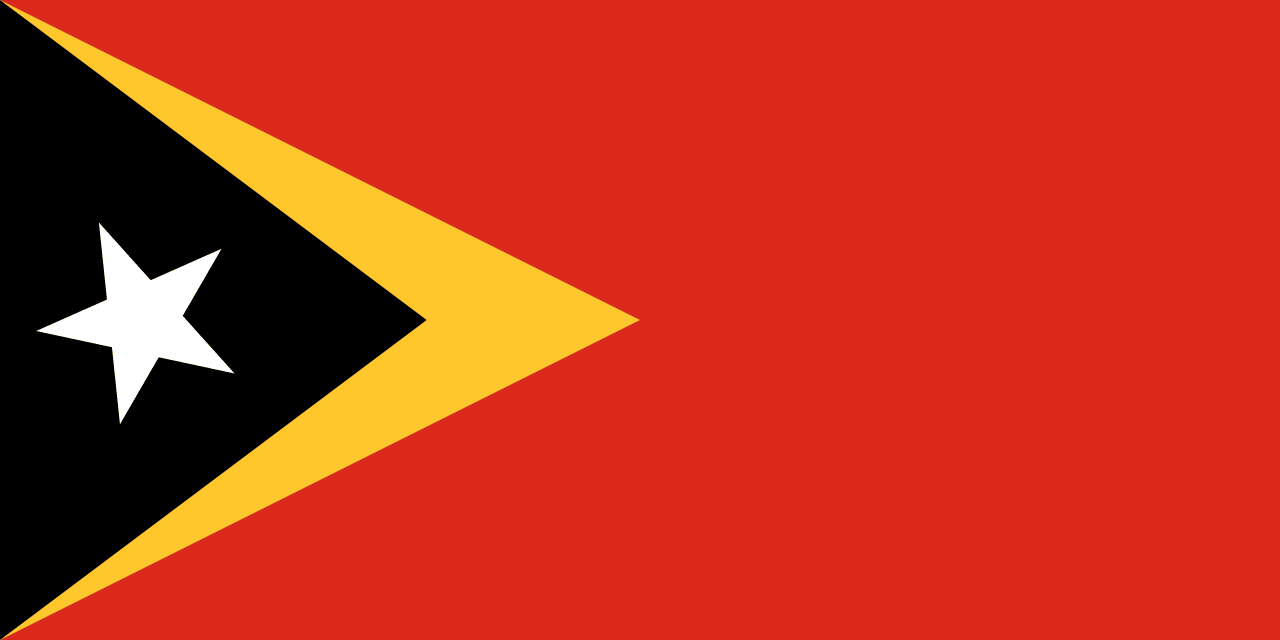
The Timorese flag uses a palette of four colors, each carrying a deliberate and pointed meaning rather than a vague abstraction. The dominant red field represents the long struggle for national liberation, a fitting backdrop for a country that endured centuries of foreign rule before independence. Black stands for the obscurantism that the nation must overcome, the darkness and ignorance left behind by a difficult past. Yellow evokes the traces of colonialism in the country's history, a frank acknowledgment rather than a celebration. Finally, white signifies peace, the goal toward which all the struggle ultimately points.
What makes this color scheme compelling is its honesty. Many flags use color to project pride, prosperity, or natural beauty. Timor-Leste's choices instead narrate a sequence: a people emerging from darkness and colonial shadow, through struggle, toward peace. The symbolism reads almost like a sentence rather than a list of decorative virtues.
Geometry of the Design
The layout is what most people remember. Against the solid red background, two isosceles triangles point inward from the hoist (the side nearest the flagpole), overlapping one another. The larger of the two is black, and it overlays a slightly broader yellow triangle, so that a thin band of yellow frames the black wedge along its edges. The black triangle stretches roughly toward the center of the flag, while the yellow one extends a little farther.
Centered within the black triangle sits a white five-pointed star, often described as a star of guidance or the light that leads the way forward. One point of the star is directed toward the left, anchoring it visually within the converging shapes. The result is a design that feels dynamic and forward-leaning: the triangles act like an arrow or a beam of light pushing into the red field, with the star marking the destination. It is a layout that communicates motion and direction in a way that simple stripes or quartered fields rarely achieve.
From Party Banner to National Symbol
The flag's roots reach back to the period of upheaval in the mid-1970s. Its design is based on the banner of FRETILIN, the Revolutionary Front for an Independent East Timor, the movement that championed independence as Portuguese colonial administration wound down. When Timor-Leste first declared independence in late 1975, this flag was raised, only for that independence to be cut brutally short by the invasion and prolonged occupation that followed.
For roughly a quarter century, the flag became a symbol of resistance rather than a banner flying over government buildings. It carried the aspirations of a people who continued to seek self-determination through years of conflict and hardship. When sovereignty was finally restored in 2002 under the supervision of the international community, the design was readopted as the official national flag, closing a loop that had opened decades earlier. In that sense, the 2002 adoption was less an invention than a restoration, the formal reclaiming of a symbol that had never stopped meaning independence to those who fought for it.
How It Compares to Similar Flags
The combination of red, black, yellow, and a white star places Timor-Leste's flag within a recognizable visual tradition of liberation and revolutionary banners, many of which emerged from anti-colonial movements across the twentieth century. Red fields with bold geometric intrusions and prominent stars appear on a number of flags born from independence struggles, and the family resemblance is no accident: these designs draw on a shared vocabulary of resistance.
Yet several features distinguish the Timorese flag at a glance. The double-triangle construction, with a black wedge nested inside a yellow one, is unusual; most flags that use a triangle at the hoist employ a single one, as seen in several South Asian and African banners. The inward-pointing, overlapping arrangement gives Timor-Leste's flag a layered, three-dimensional quality that few others share. And while a white five-pointed star is common worldwide, here it is tucked deliberately inside the black triangle rather than centered on the field, reinforcing the sense that the star is leading the way out of darkness. Once you learn to spot the stacked triangles, the flag is hard to confuse with any other.
Identity, Pride, and Everyday Use
For a nation that spent so long without the right to fly its own colors, the flag carries an emotional weight that is difficult to overstate. It appears on Restoration of Independence Day each May, marking the anniversary of the 2002 ceremony, and it features in civic ceremonies, schools, and government institutions throughout the year. The banner is a frequent presence at international sporting events, where Timorese athletes carry it during opening processions, and it shows up wherever the country's diaspora gathers to celebrate their heritage.
Because the design is rooted in the resistance movement, raising it is not merely a formality but an act layered with memory. For older generations, the colors recall years of struggle; for younger Timorese born into independence, the flag is a symbol of the future their predecessors secured. If you want to understand the land beneath the banner, the people, the geography, and the culture of this half-island nation, the timor leste country guide offers a fuller picture of the country the flag represents.
Quick Facts Worth Knowing
- Timor-Leste lies in Southeast Asia, occupying the eastern half of the island of Timor along with a few nearby territories.
- The flag was officially adopted in 2002, making it one of the youngest national flags in the world.
- Its design is based directly on the banner of the FRETILIN independence movement.
- The white star is often interpreted as a guiding light pointing the nation toward peace and the future.
- The nested black-and-yellow triangle layout is a relatively rare construction in world vexillology.
- Each of the four colors carries a specific meaning tied to the nation's history rather than decorative symbolism.
Frequently Asked Questions
When was the flag of Timor-Leste adopted?
The flag was officially adopted in 2002, when Timor-Leste formally restored its independence. The design itself, however, dates back to the mid-1970s, when it was first raised during the country's initial declaration of independence before decades of occupation interrupted that sovereignty.
What do the colors of the Timor-Leste flag mean?
Each color tells part of the national story. Red represents the struggle for liberation, black stands for the obscurantism the nation must overcome, yellow refers to the traces of colonialism in its history, and white symbolizes peace. The white star is understood as a guiding light leading the country forward.
Who designed the flag of Timor-Leste?
The flag is based on the banner of FRETILIN, the Revolutionary Front for an Independent East Timor, the movement that led the independence struggle in the 1970s. Rather than being the work of a single individual, it emerged from that liberation movement and was readopted as the official national flag in 2002.
What continent is Timor-Leste on?
Timor-Leste is part of Asia, specifically Southeast Asia. It sits on the eastern portion of the island of Timor, at the southern edge of the Indonesian archipelago and relatively close to northern Australia.
