
Introduction
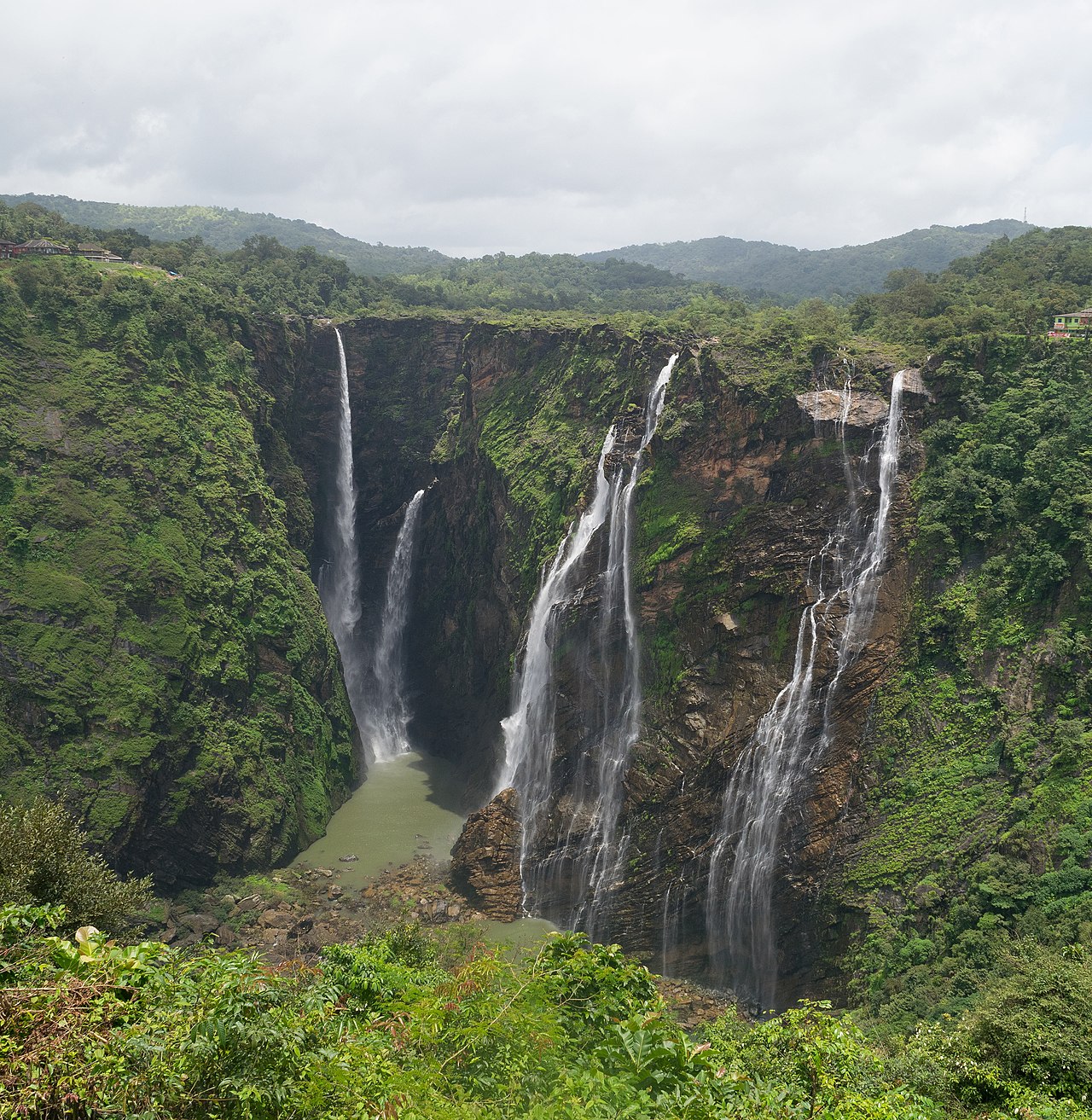
Jog Falls, also known as Gerosoppa Falls, is one of India's most iconic waterfalls. Located on the Sharavathi River in the Shimoga district of Karnataka, the falls plunge 253 meters (830 feet) from the edge of the Deccan Plateau in four distinct cascades named Raja, Roarer, Rocket, and Rani (meaning King, Roarer, Rocket, and Queen).
The falls are at their most spectacular during and immediately after the southwest monsoon season, when the Sharavathi River swells with torrential rain and the four cascades merge into a single thundering wall of water. During the dry season, the flow is significantly reduced due to upstream hydroelectric dams on the Linganamakki reservoir.
Geography & Formation
- Location: Shimoga District, Karnataka, India
- River: Sharavathi River
- Height: 253 m (830 ft)
- Four Cascades: Raja (King), Roarer, Rocket, Rani (Queen)
- Geological Setting: Edge of Deccan Plateau, Western Ghats
Jog Falls formed where the Sharavathi River drops off the western edge of the Deccan Plateau into the coastal lowlands of Karnataka. The Deccan Plateau is composed primarily of ancient gneiss and granite, and the abrupt escarpment of the Western Ghats creates the dramatic cliff over which the river plunges.
The four cascades have distinct characters. Raja, the tallest at 253 meters, falls in a single column. Roarer drops forcefully and creates a dramatic spray. Rocket shoots out at an angle from a narrow gap in the rocks. Rani, the most graceful, cascades in a thin, winding stream down the cliff face. All four merge into a single thundering torrent during peak monsoon.
Water Flow & Dimensions
- Monsoon Peak: July-September (maximum flow)
- Dry Season: January-May (reduced by dams)
- Upstream Dam: Linganamakki Reservoir
- Catchment: Sharavathi River basin, ~2,000 km²
The flow at Jog Falls is heavily influenced by the Linganamakki Dam, constructed upstream in 1964 for the Sharavathi Hydroelectric Project. During the dry season, much of the river's water is diverted through turbines, reducing the falls to a fraction of their natural flow. Only when the reservoir overflows during heavy monsoon rains do the falls return to their full glory.
At peak monsoon, typically in August and September, the spectacle is extraordinary. The four cascades merge into a single wall of water, and the spray column rises well above the cliff top. The roar can be heard from several kilometers away, and the entire viewing area is drenched in mist.
Surrounding Ecosystem
- Biodiversity Hotspot: Western Ghats (UNESCO)
- Forest Type: Tropical semi-evergreen and moist deciduous
- Endangered Species: Lion-tailed macaque, Malabar giant squirrel
- Rainfall: ~5,000 mm annually in the region
Jog Falls lies within the Western Ghats, one of the world's 36 biodiversity hotspots and a UNESCO World Heritage Site. The surrounding forests are among the most biologically rich in India, supporting species found nowhere else on Earth.
The forests around the falls are home to the endangered lion-tailed macaque, the Malabar giant squirrel (with its striking purple and orange fur), king cobras, and numerous endemic amphibians. The Western Ghats are estimated to contain over 7,400 species of flowering plants, 1,814 of which are endemic to the region.
Cultural Significance
- Alternative Names: Gerosoppa Falls, Jogada Gundi
- Historical Trade Route: Ancient pepper trade route to coast
- Local Legends: Associated with Sharavathi River goddess
- Tourism Status: One of Karnataka's top attractions
The name "Jog" is believed to derive from the Kannada word "joga" meaning falls. The falls have also been called Gerosoppa Falls after the nearby historical town of Gerosoppa, which was once a major center of the Indian pepper trade with Portuguese and Arab merchants.
In local tradition, the Sharavathi River is considered sacred, and the falls are associated with legends of the river goddess. Temples dedicated to various deities dot the surrounding area. The four cascades' names, Raja, Roarer, Rocket, and Rani, were given during the British colonial period and have stuck in popular usage.
Visitor Experience
- Viewpoints: Multiple steps carved into the cliff face
- Best Time: August-November (post-monsoon peak)
- Distance from Bangalore: ~380 km (7 hours)
- Facilities: Steps to base, observation decks, light and sound show
The primary viewing area is located on the opposite side of the gorge from the falls, connected by a series of steps carved into the cliff. Over 1,400 steps lead down to the base of the falls, offering progressively closer and more dramatic perspectives. An observation deck at the top provides a panoramic view of all four cascades.
A light and sound show illuminates the falls on certain evenings. The best time to visit is during or immediately after the monsoon season (August to November), when the falls are at full power. During the dry season, the reduced flow, while still impressive, lacks the grandeur of the monsoon spectacle. Nearby attractions include the Linganamakki Dam and the lush Sharavathi Wildlife Sanctuary.
Key Facts
- Jog Falls is India's second highest plunge waterfall at 253 meters.
- The four distinct cascades are named Raja, Roarer, Rocket, and Rani.
- The Linganamakki Dam upstream significantly reduces dry-season flow.
- The falls are located in the Western Ghats, a UNESCO World Heritage biodiversity hotspot.
- At peak monsoon, all four cascades merge into a single thundering wall of water.
Fun Facts
- During the British colonial period, a proposal was made to divert the Sharavathi River entirely for power generation, which would have eliminated the falls completely.
- The region around Jog Falls receives approximately 5,000 mm of rain during the monsoon, among the highest in India.
- The 1,400 steps to the base of the falls were originally cut by convict laborers during British rule.
- Jog Falls was featured on Indian postage stamps and is considered one of the country's natural treasures.
Final Thoughts
Jog Falls is a masterclass in monsoon drama. When the Sharavathi River is at full flood, the four cascading columns merge into one of India's most powerful natural spectacles. Its setting in the biodiversity-rich Western Ghats adds ecological significance to its visual grandeur.
