
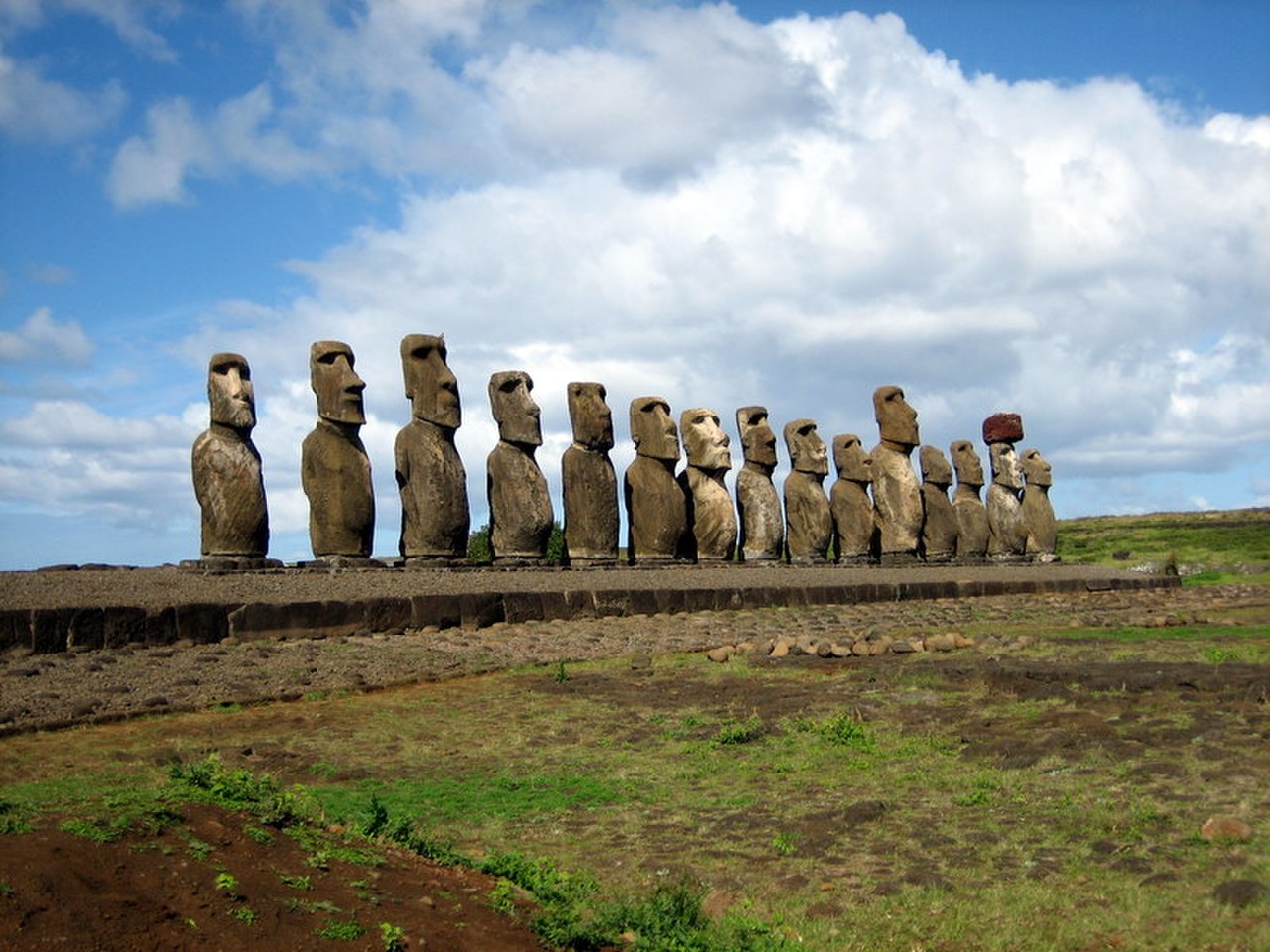
Easter Island (Rapa Nui) is a remote volcanic island in the southeastern Pacific Ocean, lying 3,700 kilometers from Chile and 2,000 kilometers from the nearest inhabited island. Its approximately 1,000 Moai — massive stone statues with oversized heads — are among the most recognizable archaeological objects in the world, carved by the Rapa Nui Polynesian people between approximately 1250 and 1500 CE.
Introduction
The island is a UNESCO World Heritage Site (inscribed 1995), and the Moai are its most defining feature. Carved from compressed volcanic ash (tuff) at the Rano Raraku quarry, the statues were transported across the island and erected on ceremonial platforms called ahu, facing inland to watch over the villages. How the Rapa Nui moved these multi-tonne statues without wheels or beasts of burden remains one of archaeology's great questions.

The Moai
- Total Statues: ~1,000 (887 catalogued)
- Average Height: 4 m
- Tallest Erected: 10 m (Paro)
- Heaviest Erected: ~82 tonnes
The Moai range from about 1 meter to over 10 meters in height. The tallest erected Moai, Paro, stood approximately 10 meters high and weighed about 82 tonnes. An unfinished Moai still attached to the quarry face at Rano Raraku would have stood 21 meters tall and weighed over 270 tonnes had it been completed.
The statues represent ancestral figures — deified chieftains and important leaders whose spiritual power (mana) was believed to protect the living community. Most Moai were placed on ahu (stone platforms) around the island's coastline, facing inland toward the villages rather than out to sea. Some were given coral and obsidian eyes and topped with red scoria cylinders (pukao) representing headdresses.
Carving & Transport
- Quarry: Rano Raraku volcano
- Material: Compressed volcanic tuff
- Transport Theory: "Walking" the statues with ropes
- Roads: Prepared roadways found by archaeologists
Nearly all Moai were carved at the Rano Raraku quarry on the slopes of a volcanic crater. Workers used basalt hand picks (toki) to carve the statues from the relatively soft tuff. A skilled team could complete a mid-sized Moai in approximately one to two years. The quarry still contains nearly 400 Moai in various stages of completion.
The mystery of how the Moai were transported — some up to 18 kilometers from the quarry — has generated decades of debate. The prevailing theory, supported by experimental archaeology, is that the statues were "walked" upright using ropes: teams of workers rocked the statue from side to side while pulling it forward, a technique that matches the Rapa Nui oral tradition that the Moai "walked."
Rapa Nui Civilization
- Settlement: c. 800-1200 CE (Polynesian voyagers)
- Peak Population: ~15,000
- Ecological Collapse: Deforestation led to societal decline
- Modern Population: ~7,700
Easter Island was settled by Polynesian voyagers who navigated thousands of kilometers of open ocean in double-hulled canoes, arriving sometime between 800 and 1200 CE. The population grew to an estimated 15,000 people organized into competing clans, each of which erected Moai on its own ahu as a display of prestige and spiritual power.
The island experienced a dramatic ecological and social collapse. Extensive deforestation — the island was originally forested with giant palms — eliminated the resources needed for canoe-building, Moai transport, and agriculture. Competition between clans intensified, and by the time Europeans arrived in 1722, many Moai had been deliberately toppled in inter-clan warfare. The once-thriving civilization had severely declined.
Visitor Experience
- Location: 3,700 km from Chile (5-hour flight from Santiago)
- Key Sites: Rano Raraku quarry, Ahu Tongariki (15 Moai), Anakena beach
- Best Season: November to March (Southern Hemisphere summer)
- Time Needed: 3-5 days to see major sites
Easter Island is reached by a 5-hour flight from Santiago, Chile, or occasional flights from Tahiti. The island is small (163 km²) and can be explored by car, bicycle, or guided tour. Key sites include the Rano Raraku quarry (where nearly 400 unfinished Moai remain), Ahu Tongariki (the largest restored ahu with 15 Moai in a row), and Anakena beach with its white sand and restored Moai.
The Tapati Rapa Nui festival in February celebrates the island's Polynesian heritage with traditional sports, dancing, and art. Sunrise at Ahu Tongariki, where the first light illuminates 15 silhouetted Moai, is one of the most memorable experiences in Pacific archaeology. The island's remoteness and small size create an atmosphere of profound isolation that amplifies the mystery of the Moai.
Key Facts
- Nearly 1,000 Moai were carved between approximately 1250 and 1500 CE.
- The tallest erected Moai stands 10 meters and weighs about 82 tonnes.
- Most Moai were carved at the Rano Raraku quarry from volcanic tuff.
- The statues were likely "walked" upright using ropes to their platforms.
- Easter Island is one of the most remote inhabited places on Earth — 3,700 km from Chile.
Fun Facts
- The Moai have bodies — many are buried up to their chests, and excavations have revealed full torsos with carved hands and petroglyphs on their backs.
- The largest Moai ever attempted would have stood 21 meters tall and weighed 270 tonnes — it was never finished and remains attached to the quarry.
- The Rapa Nui oral tradition says the Moai "walked" to their platforms — a claim dismissed for centuries but now supported by experimental evidence.
- Easter Island was named by Dutch explorer Jacob Roggeveen, who arrived on Easter Sunday 1722.
Final Thoughts
The Moai of Easter Island are one of humanity's most haunting creations — stone sentinels standing against the Pacific wind on one of Earth's most remote islands, carved by a civilization that pushed its resources to the breaking point in pursuit of monumental ambition. Their story is a parable of human creativity and its environmental cost, as relevant today as it was 500 years ago.
Test Your Knowledge!
Think you know your famous landmarks? Try our interactive quiz!
Play Geography Games →