

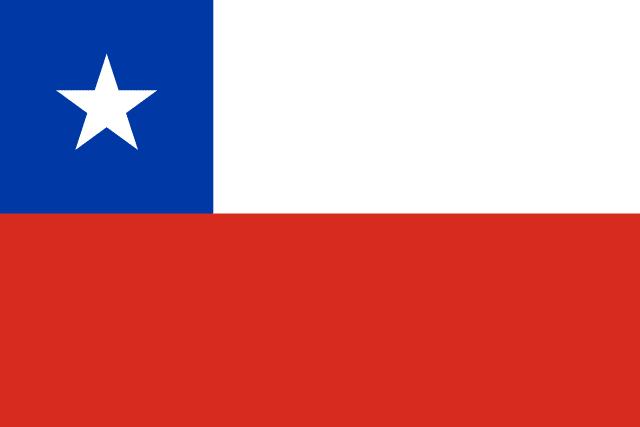
Few banners in the Americas are as instantly recognizable as the flag of Chile. With its split field of white above red, a deep blue square in the upper corner, and a single five-pointed star floating within it, the design feels both simple and assured. Chileans affectionately call it La Estrella Solitaria — "The Lone Star" — a nickname that captures the quiet confidence of a flag built around one bright point of light. First raised in 1817 during the country's fight for independence, it has flown over more than two centuries of national life, and its clean geometry has made it one of the most enduring emblems on the continent.
A Banner Born in Revolution
Chile's modern flag dates to 1817, a pivotal year in the long struggle to break free from Spanish rule. The design is credited to a government minister of the era rather than to a celebrated artist, which suits a flag that prizes clarity over ornament. It replaced earlier patriot banners that had experimented with different arrangements of color, and once it appeared, it stuck. That staying power is remarkable: while many young republics revised their flags repeatedly through the nineteenth century, Chile settled early on a design it never felt the need to abandon. The flag became a fixed point of identity even as the country itself grew, fought, and reinvented its institutions.
Reading the Colors
Every element of the Chilean flag carries meaning rooted in the land and the people who fought for it. The colors are traditionally read as a small portrait of the nation:
- Blue stands for the sky — the vast, clear heavens that arch over the country's long, narrow territory.
- White represents the snow of the Andes, the towering mountain chain that forms Chile's eastern spine and dominates its skyline.
- Red honors the blood shed by those who fought for independence, a solemn nod to sacrifice.
- The star is a symbol of progress and the guiding light of a free and unified state.
What makes this symbolism feel so natural is how closely it maps onto Chile's actual geography. A traveler standing in the central valley really does look up at blue sky, snow-capped peaks, and the long horizon — the flag is almost a landscape compressed into cloth.
Design and Layout
The Chilean flag is a bicolor with a canton — a deceptively economical arrangement. The lower half of the flag is a solid red horizontal band. The upper half is divided: along the hoist sits a blue square, the canton, while the rest of that top portion is white. Centered within the blue square is a single white five-pointed star. Because the blue canton occupies only the upper corner rather than running down the entire hoist side, the white band extends across the top of the flag beside it, giving the composition its distinctive balance.
The genius of the layout lies in its proportions. The star sits high and to the side, drawing the eye immediately, while the broad red band anchors the design with weight and warmth. There is no clutter, no crowded coat of arms, no Latin motto running along an edge. The result reads cleanly from a great distance — exactly what a flag needs to do when it snaps at the top of a pole or marches at the head of a parade.
The Lone Star Among Look-Alikes
Newcomers to vexillology sometimes do a double take when they see the Chilean flag, because at a glance it shares DNA with the flag of Texas and, more loosely, with the flag of the United States. All three lean on a red-white-and-blue palette and feature a star set against a blue field. The resemblances, however, are surface deep.
The Texas flag places its blue panel as a full vertical stripe down the entire hoist, with red and white running as horizontal bars to its right — a different geometry from Chile's corner canton sitting above a single red band. Chile's flag also predates the Texas "Lone Star" flag by decades, so if anything the influence runs the other way in the popular imagination. Compared with the stars-and-stripes of the United States, the contrast is even sharper: Chile carries one star where the American flag carries fifty, and Chile's broad fields of color feel far more open. Within South America, too, Chile stands apart from neighbors whose flags favor green, yellow, or elaborate central emblems. The Lone Star's restraint is precisely what distinguishes it.
A Symbol Woven Into National Life
For Chileans, the flag is far more than a state insignia — it is a fixture of everyday belonging. It appears on government buildings, schools, and ships, and it takes center stage each September during Fiestas Patrias, the national independence celebrations. During that festive stretch, flags blossom from windows, balconies, and lampposts across the country, and displaying one is treated as a point of civic pride. Chilean law has long taken the flag seriously, with rules governing how and when it should be flown, a sign of just how much weight the banner carries.
The Lone Star also travels well beyond official ceremonies. It rides on the shoulders of fans at football matches, waves at concerts and rallies, and turns up wherever Chileans abroad gather to mark a piece of home. Anyone curious about the country behind the banner — its geography, culture, and history — can dive deeper in our chile country guide, which sets the flag in its fuller national context. Wherever it appears, the flag does the quiet work that the best national symbols do: it gathers people together under a single recognizable mark.
Interesting Facts About the Flag
- Its nickname, La Estrella Solitaria, means "The Lone Star" and refers to the single five-pointed star in the canton.
- The flag has been in continuous use since 1817, making it one of the older national flags still flown in essentially its original form.
- The white-over-red split with a blue corner canton gives the design its signature off-balance look, distinct from flags with full-height vertical panels.
- The color symbolism — sky, Andean snow, and the blood of independence — reads almost like a description of the Chilean landscape itself.
- Chile sits on the continent of South America, and its flag's open, uncluttered design stands out among its neighbors.
Frequently Asked Questions
When was the flag of Chile adopted?
The current Chilean flag was adopted in 1817, during the country's war of independence from Spain. It has remained in use ever since, with its core design — the white and red bands, blue canton, and lone star — staying essentially unchanged for more than two hundred years.
What do the colors of the Chilean flag mean?
Blue represents the sky, white represents the snow of the Andes mountains, and red honors the blood shed by those who fought for independence. The single white star stands for progress and the unity of a free nation.
Who designed the flag of Chile?
The flag is credited to a government minister of the independence era rather than to a famous artist. Its straightforward, geometric design reflects that practical origin, prioritizing instant recognition over decorative detail.
What continent is Chile on, and how does its flag compare to similar ones?
Chile is located in South America. Its flag is often compared to the Texas Lone Star flag and the flag of the United States because all three use red, white, and blue with a star on a blue field. Chile's version is distinguished by its corner canton sitting above a single broad red band and by its single star, and it predates the Texas flag by several decades.
