
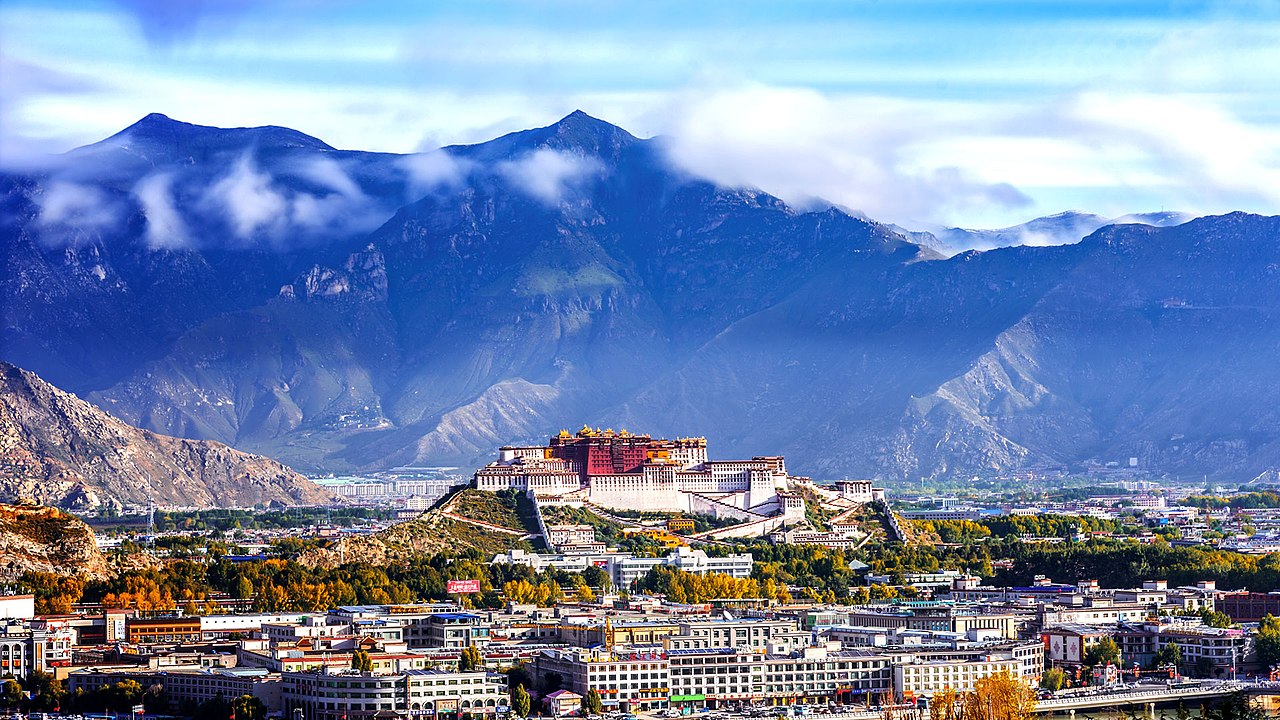
The Potala Palace, rising majestically above the city of Lhasa at an altitude of 3,700 meters on the Tibetan Plateau, is one of the highest and most imposing palace complexes in the world. Built into and on top of Marpo Ri (Red Mountain), the palace rises 117 meters above the hilltop and contains over 1,000 rooms, 10,000 shrines, and approximately 200,000 statues.
Introduction
Inscribed as a UNESCO World Heritage Site in 1994 (with extensions in 2000 and 2001), the Potala Palace was the chief residence of the Dalai Lamas from 1649 until the 14th Dalai Lama fled to India in 1959. The palace is divided into the White Palace, which served as the administrative and living quarters, and the Red Palace, which houses the most sacred chapels and the tombs of eight Dalai Lamas.

Architecture & Design
- Height: 117 m above the hilltop
- Rooms: 1,000+
- Shrines: 10,000
- Elevation: 3,700 m above sea level
The Potala Palace is divided into two main sections. The White Palace, with its whitewashed walls, contained the living quarters of the Dalai Lama, government offices, a seminary, and a printing house. The Red Palace, with its distinctive deep red-brown walls, is the spiritual center, containing chapels, libraries of sacred texts, and the elaborate golden funeral stupas of past Dalai Lamas.
The palace's construction used traditional Tibetan techniques including stone and wood framing, with walls up to 5 meters thick at the base. The structure incorporates copper poured into the foundations to protect against earthquakes. The golden roofs of the Red Palace are gilded with genuine gold and are visible from miles across the Lhasa Valley.
UNESCO Inscription
- Year Inscribed: 1994 (extended 2000, 2001)
- Criteria: Cultural (i, iv, vi)
- Extensions: Jokhang Temple, Norbulingka Palace
The Potala Palace was inscribed as an outstanding example of Tibetan art, architecture, and religious practice. The site was extended in 2000 to include the Jokhang Temple, the holiest temple in Tibetan Buddhism, and in 2001 to include the Norbulingka, the Dalai Lama's summer palace.
UNESCO recognized the Potala as a masterpiece of Tibetan architecture and an outstanding symbol of Tibetan Buddhism, noting its exceptional integration of palace, temple, and garden into a unified architectural composition. The site represents the zenith of Tibetan palatial and religious architecture.
History
- Original Palace: Built by Songtsen Gampo, 637 CE
- Current Palace: Built by 5th Dalai Lama, 1645-1694
- Dalai Lama Residence: 1649-1959
- Workers: Over 7,000 laborers at peak
The first palace on Marpo Ri was built by King Songtsen Gampo in 637 CE when he united Tibet and made Lhasa his capital. That structure was largely destroyed in the 8th century. The current Potala Palace was built by the 5th Dalai Lama beginning in 1645, with the White Palace completed in 1648 and the Red Palace completed after his death in 1694.
The 5th Dalai Lama's death was kept secret for 15 years by his regent to ensure the Red Palace's completion. Over 7,000 workers and 1,500 artisans were employed at the peak of construction. The palace served as the winter residence of every subsequent Dalai Lama until the 14th Dalai Lama escaped to India during the 1959 Tibetan uprising.
Treasures & Sacred Objects
- Funeral Stupas: 8 golden stupas of past Dalai Lamas
- Sacred Texts: Over 20,000 scrolls
- Murals: Cover over 2,500 m²
- Gold Used: 3,721 kg in the 5th Dalai Lama's stupa alone
The Red Palace contains the golden funeral stupas of eight Dalai Lamas. The most elaborate belongs to the 5th Dalai Lama, standing 14.85 meters high and covered with 3,721 kilograms of gold, adorned with over 15,000 pearls, corals, turquoises, and other precious stones. The 13th Dalai Lama's stupa is similarly lavish.
The palace houses an extraordinary collection of Tibetan Buddhist art, including over 2,500 square meters of murals depicting religious scenes, historical events, and daily life in Tibet. The library contains over 20,000 scrolls of Buddhist scripture, many of them hand-written in gold and silver ink on handmade paper.
Visitor Experience
- Daily Visitor Limit: 2,300
- Visiting Time: Limited to 1 hour inside
- Elevation Warning: 3,700 m - altitude sickness risk
- Best Season: May to October
Visiting the Potala Palace requires advance booking, and daily visitor numbers are strictly limited to 2,300 to protect the fragile interiors. Visitors are allowed approximately one hour inside the palace and must follow a prescribed route through the main halls and chapels. Photography is prohibited in most interior spaces.
The climb to the palace entrance involves ascending about 300 steps, which can be challenging at 3,700 meters elevation. Visitors are advised to acclimatize to Lhasa's altitude for at least a day before attempting the visit. The palace is best viewed from the outside at sunrise or sunset, when the whitewashed and red-ochre walls glow against the mountain backdrop.
Key Facts
- The Potala Palace rises 117 meters above its hilltop foundation at 3,700 meters elevation in Lhasa.
- It contains over 1,000 rooms, 10,000 shrines, and approximately 200,000 statues.
- The golden stupa of the 5th Dalai Lama alone contains 3,721 kilograms of gold.
- The palace served as the winter residence of the Dalai Lamas from 1649 to 1959.
- Daily visitor numbers are limited to 2,300 to preserve the fragile interior artwork.
Fun Facts
- The death of the 5th Dalai Lama was concealed for 15 years so that construction of the Red Palace could continue without political disruption.
- The palace foundations contain copper to act as an earthquake dampener, a technique used over 350 years before modern seismic engineering.
- The Potala was one of the few major Tibetan monuments to survive the Cultural Revolution relatively intact, partly because Zhou Enlai personally ordered its protection.
- At 3,700 meters, the Potala Palace is one of the highest major buildings in the world, and many visitors experience altitude sickness during the climb.
Final Thoughts
The Potala Palace is architecture as aspiration, a building that reaches toward the heavens both literally and spiritually. Perched on the roof of the world, encrusted with gold, and filled with the accumulated devotion of centuries, it remains the most powerful symbol of Tibetan civilization and one of the most extraordinary buildings ever constructed by human hands.
Test Your Knowledge!
Think you know your UNESCO World Heritage Sites? Try our interactive quiz!
Play Geography Games →