
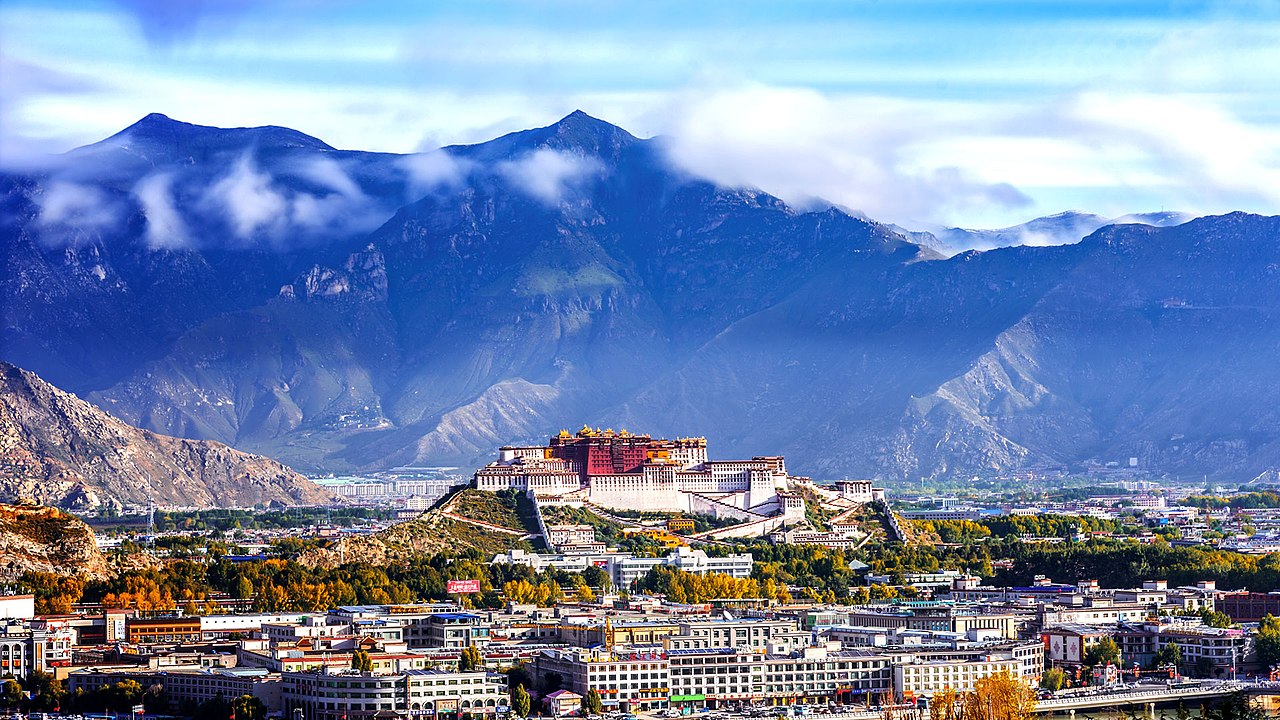
The Potala Palace stands on Marpo Ri (Red Mountain) in the center of Lhasa, the capital of Tibet, at an altitude of 3,700 meters above sea level. Rising 117 meters above the hilltop, the palace complex contains over 1,000 rooms, 10,000 shrines, and approximately 200,000 statues. It served as the winter residence of the Dalai Lamas from 1649 until the 14th Dalai Lama fled to India in 1959.
Introduction
The palace is divided into the White Palace (administrative and residential quarters) and the Red Palace (religious chapels, libraries, and the golden funeral stupas of past Dalai Lamas). A UNESCO World Heritage Site since 1994, the Potala is the highest ancient palace in the world and one of the most sacred sites in Tibetan Buddhism.

Architecture & Design
- Height: 117 m above hilltop
- Rooms: 1,000+
- Elevation: 3,700 m above sea level
- Wall Thickness: Up to 5 m at base
The White Palace was the Dalai Lama's living quarters and the seat of Tibetan government. Its whitewashed walls symbolize peace and are visible from miles across the Lhasa Valley. The Red Palace, distinguished by its deep red-brown walls, is the spiritual heart of the complex, containing chapels dedicated to various Buddhist deities and the elaborate gold-sheathed funeral stupas of eight Dalai Lamas.
The palace was constructed using traditional Tibetan building techniques: stone and timber framing with walls up to 5 meters thick at the base, tapering toward the top. Copper was poured into the foundations as a seismic dampener. The golden roofs of the Red Palace are gilded with genuine gold and gleam spectacularly in the strong Tibetan sunlight.
History
- Original Structure: 637 CE (King Songtsen Gampo)
- Current Palace: 1645-1694 (5th Dalai Lama)
- Dalai Lama Departure: 1959
- Workers: 7,000+ laborers at peak
The first palace on Marpo Ri was built by King Songtsen Gampo in 637 CE when he unified Tibet. That early structure was largely destroyed. The current Potala was begun by the 5th Dalai Lama in 1645, with the White Palace completed by 1648 and the Red Palace completed in 1694, after the Dalai Lama's death, which was kept secret for 15 years to ensure the project's completion.
The palace served every subsequent Dalai Lama until 1959, when the 14th Dalai Lama escaped to India during the Chinese military suppression of the Tibetan uprising. The Potala survived the Cultural Revolution relatively intact, reportedly on the personal orders of Premier Zhou Enlai, though many other Tibetan monasteries were destroyed during this period.
Sacred Treasures
- Funeral Stupas: 8 golden stupas
- 5th Dalai Lama Stupa: 14.85 m tall, 3,721 kg of gold
- Sacred Texts: Over 20,000 scrolls
- Murals: 2,500+ m² of wall paintings
The funeral stupa of the 5th Dalai Lama is the most magnificent object in the palace — a 14.85-meter-high structure covered in 3,721 kilograms of gold and adorned with over 15,000 precious stones including diamonds, pearls, turquoises, and corals. The stupa of the 13th Dalai Lama is comparably lavish.
The palace houses over 20,000 scrolls of sacred Buddhist scripture, many written in gold and silver ink. Over 2,500 square meters of murals depicting religious scenes, historical events, and daily Tibetan life decorate the interior walls. The art collection represents the finest achievement of Tibetan Buddhist artistic tradition.
Visitor Experience
- Daily Limit: 2,300 visitors per day
- Time Inside: Limited to approximately 1 hour
- Steps: ~300 steps to the entrance
- Best Season: May to October
Access to the Potala is strictly controlled, with a daily limit of 2,300 visitors and time inside limited to approximately one hour. Advance booking is essential. The climb of roughly 300 steps to the entrance is challenging at 3,700 meters — visitors are strongly advised to acclimatize to Lhasa's altitude for at least one full day before attempting the visit.
The most spectacular views of the Potala are from the outside, particularly at sunrise or sunset when the white and red walls glow against the Tibetan sky. The palace's reflection in the lake at Lukhang Park creates one of the most photographed scenes in Asia. Photography inside the palace is generally prohibited to protect the delicate artwork.
Key Facts
- The Potala Palace rises 117 meters above its hilltop at 3,700 meters elevation.
- It contains over 1,000 rooms, 10,000 shrines, and 200,000 statues.
- The 5th Dalai Lama's golden stupa contains 3,721 kg of gold.
- Daily visitor numbers are limited to 2,300 to preserve the fragile interiors.
- The palace served as the Dalai Lama's winter residence from 1649 to 1959.
Fun Facts
- The 5th Dalai Lama's death was kept secret for 15 years so construction of the Red Palace could be completed without political disruption.
- Copper poured into the foundations over 350 years ago acts as an earthquake dampener — a technique remarkably ahead of its time.
- The Potala was one of the few major Tibetan religious buildings to survive the Cultural Revolution, reportedly spared by a direct order from Zhou Enlai.
- At 3,700 meters altitude, many visitors experience headaches and shortness of breath just from the climb to the entrance.
Final Thoughts
The Potala Palace is architecture as spiritual statement — a building that reaches toward the sky both physically and metaphysically. Perched on the roof of the world, sheathed in gold and filled with centuries of devotion, it is the most powerful symbol of Tibetan civilization and one of the most extraordinary buildings ever raised by human hands.
Test Your Knowledge!
Think you know your famous landmarks? Try our interactive quiz!
Play Geography Games →