
Introduction
Rapa Nui, known to most of the world as Easter Island, is one of the most isolated inhabited places on Earth — a small volcanic island in the southeastern Pacific Ocean, over 3,500 kilometers from the coast of Chile and 2,000 kilometers from the nearest inhabited island. Despite its remoteness, between approximately 1100 and 1680 CE, the Rapa Nui people carved and transported nearly 900 enormous stone statues called moai — monolithic figures averaging 4 meters tall and 12.5 tonnes in weight, with some reaching 10 meters and 82 tonnes.
Designated a UNESCO World Heritage Site in 1995 as Rapa Nui National Park, the island is a testament to the extraordinary cultural achievements of the Polynesian people who settled it and to the complex relationship between human civilization and the environment.
History & Significance
- Settlement: ~800-1200 CE by Polynesian navigators (dating debated)
- Moai Construction: ~1100-1680 CE
- European Contact: Easter Sunday, 1722 — by Dutch explorer Jacob Roggeveen
- UNESCO Inscription: 1995
Rapa Nui was settled by Polynesian navigators who crossed thousands of kilometers of open ocean in double-hulled canoes, guided by stars, ocean currents, and the flight patterns of birds. The founding legend speaks of King Hotu Matu'a, who led his people to the island after a priest's vision.
The civilization that developed on Rapa Nui was unique even among Polynesian cultures. The moai — carved from volcanic tuff at the Rano Raraku quarry — represented deified ancestors and were placed on stone platforms called ahu along the coastline, facing inland to watch over the living. The effort required to carve, transport, and erect these massive statues organized Rapa Nui society for centuries.
The island's history also serves as a cautionary tale. Deforestation — driven by the need for timber to transport moai, fuel fires, and build canoes — gradually stripped the island of its forests, leading to soil erosion, crop failure, and social collapse. By the time Europeans arrived in 1722, many moai had been toppled and the population had declined dramatically.
Geography & Location
- Area: 163.6 km²
- Highest Point: Mount Terevaka, 507 m
- Location: 27°S, 109°W — southeastern Pacific Ocean
- Distance to Mainland: ~3,510 km from Chile; ~2,075 km from Pitcairn Island
Rapa Nui is a volcanic island formed by three extinct volcanoes — Terevaka, Poike, and Rano Kau — whose overlapping lava flows created its roughly triangular shape. The island has no coral reef and very few sandy beaches; most of the coastline consists of rugged volcanic cliffs battered by powerful Pacific swells.
The interior is a rolling, mostly treeless grassland (the original palm forests were cut down centuries ago). The volcanic crater lakes — particularly the beautiful Rano Kau and Rano Raraku — are among the island's most striking natural features. Rano Raraku, with its steep inner and outer slopes, served as the quarry where nearly all moai were carved, and nearly 400 statues in various stages of completion remain on its slopes.
Notable Features
- Moai Statues: Nearly 900 monolithic statues, carved from volcanic tuff between ~1100-1680 CE
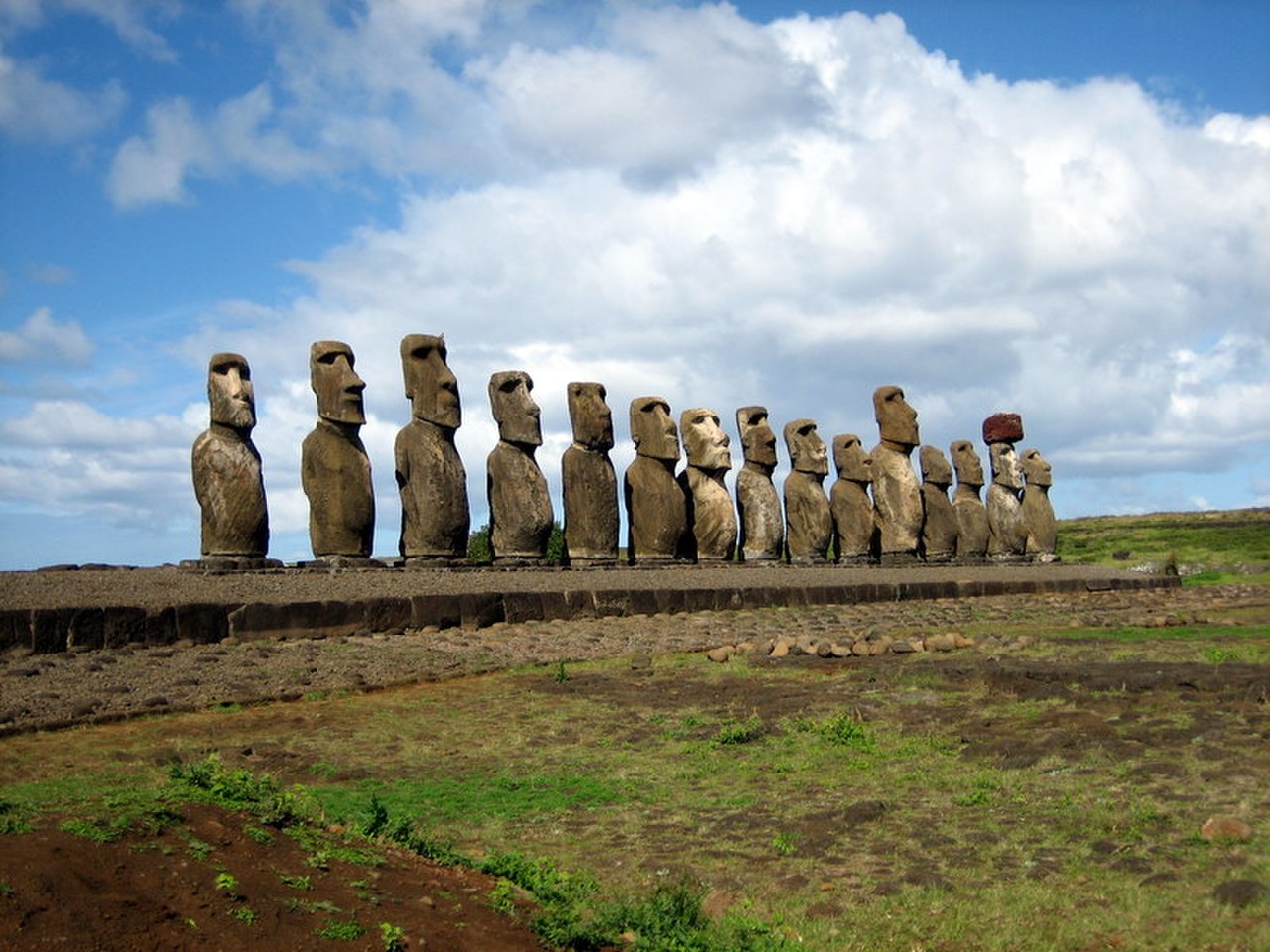
- Ahu Tongariki: The largest ahu, with 15 restored moai standing in a row along the coast
- Rano Raraku: The volcanic quarry where 95% of moai were carved — nearly 400 remain embedded in the hillside
- Orongo Village: A ceremonial village on the rim of Rano Kau crater, center of the Birdman cult
The moai of Ahu Tongariki — 15 statues restored after a 1960 tsunami scattered them inland — form one of the most iconic images in archaeology. Standing against the sunrise on the island's eastern coast, these silent sentinels range from 5 to nearly 9 meters in height. Some wear pukao (red stone "hats" or topknots) carved from a different quarry.
Rano Raraku is equally haunting. The quarry slopes are studded with nearly 400 moai in every stage of completion — some barely outlined in the rock face, others fully carved but still attached at the back, and many standing on the outer slopes, buried up to their chests or necks in sediment, as if they stopped walking mid-journey. The largest moai ever attempted, "El Gigante," lies unfinished in the quarry at 21 meters long — had it been completed, it would have weighed approximately 270 tonnes.
Key Facts
- There are 887 documented moai on the island, with an average height of 4 meters and weight of 12.5 tonnes.
- The moai were transported from the quarry to their platforms — sometimes over 18 km — likely using a "walking" technique involving ropes.
- The island was once covered in palm forest; pollen analysis shows complete deforestation by ~1650 CE.
- Rapa Nui developed its own writing system, Rongorongo — one of very few independent inventions of writing in human history.
- The island has been part of Chile since 1888, and about 7,750 people live there today.
Fun Facts
- Contrary to popular belief, the moai are not just heads — they have full bodies, but many have been buried up to their necks by centuries of soil movement. Excavations have revealed detailed carved torsos and hands.
- Experiments have shown that moai could indeed "walk" — rocked from side to side using ropes, they can be moved forward in an upright position, matching the Rapa Nui oral tradition that the statues "walked" to their platforms.
- The Birdman competition at Orongo — in which contestants raced down a cliff, swam to a nearby islet, and waited for a sooty tern to lay the first egg of the season — replaced moai worship as the island's primary religious practice.
- When Jacob Roggeveen arrived on Easter Sunday 1722, the first islander to board his ship showed no surprise at the European vessels — suggesting either remarkable composure or prior knowledge of the outside world.
Final Thoughts
Rapa Nui is a place of profound mystery and sobering lessons. The moai — silent, monumental, gazing across a treeless landscape that was once forested — speak of a civilization that achieved remarkable things and paid a terrible price. The island's story has become a parable for humanity's relationship with the environment, but it is also a story of resilience: the Rapa Nui people survived, adapted, and continue to live on their remote island, custodians of one of the most extraordinary cultural landscapes on Earth.
