
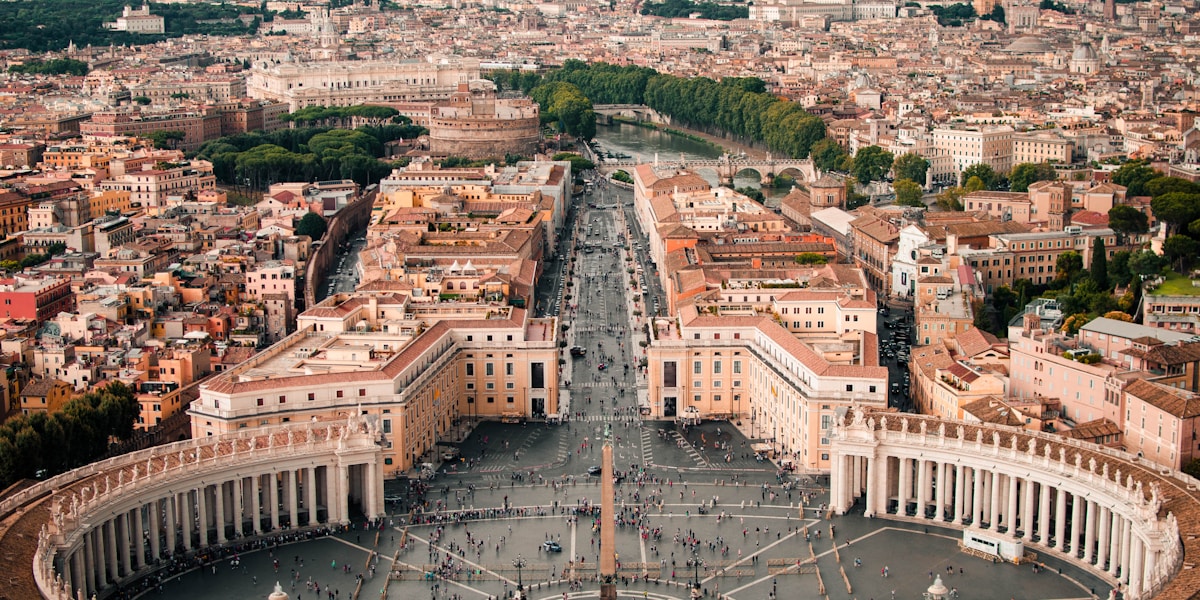
You can walk across the entirety of the world's smallest country in about twelve minutes. The Vatican covers 49 hectares — slightly smaller than the National Mall in Washington, DC — and sits entirely surrounded by the city of Rome. There are no border posts. The crossings are marked, where they are marked at all, by a thin travertine line set into the cobblestones of St Peter's Square. You can stand with one foot in Italy and the other in the only country in the world ruled by an absolute elected monarch who is also the head of a religion practiced by 1.3 billion people. The country has its own postage stamps, its own currency (a special edition of the euro), and its own railway station that handles roughly two trains per week.
The Geography in Detail
The Vatican is bounded on its northeast by St Peter's Square, which opens onto the city of Rome via the Via della Conciliazione. The rest of its perimeter is enclosed by the Leonine Wall, a defensive structure begun in 848 by Pope Leo IV in response to a Saracen raid on St Peter's Basilica. The wall is irregular, following the contours of the Vatican Hill on the right bank of the Tiber. Inside the wall is the basilica, the apostolic palace, the Vatican Museums, the Vatican Gardens (which occupy roughly half the country's land area), a handful of administrative buildings, the Sistine Chapel, the residence of the Pope, the heliport, and the train station. The entire country could fit inside the area enclosed by Central Park.
Sovereignty
The Vatican has been a fully independent state only since the Lateran Treaty of 1929, signed by Mussolini's Italy and Pope Pius XI. Before that, the Papal States — which at various points stretched from the Adriatic to the Tyrrhenian Sea and northward into Emilia-Romagna — had been progressively absorbed by the unifying Kingdom of Italy through the 1860s. Rome itself was annexed in 1870, leaving the Pope as a self-proclaimed "prisoner in the Vatican" for nearly six decades while successive popes refused to leave the palace and recognise Italian sovereignty over the city. The 1929 treaty resolved the standoff by carving out the present small territory and restoring formal independence, with the Pope as head of state and the Vatican as a distinct subject of international law.
The Population Question
How many people live in Vatican City depends on how you count. The number of formal Vatican citizens is around 800, of whom about half are clergy (priests, bishops, cardinals) and the rest are members of the Swiss Guard, lay employees, and their family members. Citizenship is granted by office or appointment rather than by birth, so it is one of the few countries where the citizen list churns substantially with personnel changes. The total daytime population, including the roughly 4,000 Italian and other staff who commute in each day to work at the museums, administration, banks, post office, and gardens, brings the working population to around 5,000. Tourist visitors number around 6 million per year, concentrated in St Peter's Square, the basilica, and the Vatican Museums.
Who Runs It
The Vatican is an absolute monarchy with elected succession. The Pope is the head of state, head of government, and supreme religious authority simultaneously. Day-to-day administration is handled by the Pontifical Commission for Vatican City State, headed by a cardinal-president appointed by the Pope. The Roman Catholic Church's separate executive structure — the Roman Curia, dicasteries (departments), and the diplomatic service — handles Church-wide rather than state-wide affairs from offices within and around the Vatican. The two are formally distinct: the Holy See, the diplomatic entity that signs treaties and exchanges ambassadors, is not the same legal person as the Vatican City State, the territorial entity that controls the 49 hectares.
Money, Stamps, and Postage
The Vatican is in monetary union with the euro under a special agreement. It does not issue regular euro coins for circulation but produces small commemorative editions, which are immediately collected as numismatic items and almost never spent. The Vatican also runs its own bank — the Institute for the Works of Religion, often called the Vatican Bank — which has been the subject of repeated reform efforts and several major financial scandals, most prominently the 1982 collapse of Banco Ambrosiano. The country issues its own postage stamps, which are widely considered among the most efficient mail services in Europe; mail posted from Vatican boxes is processed under separate handling and consistently reaches international destinations several days faster than Italian post.
The Swiss Guard
The Vatican's armed forces consist of the Pontifical Swiss Guard, an organisation founded in 1506 by Pope Julius II that recruits exclusively from Swiss Catholic men aged 19 to 30 with prior service in the Swiss Armed Forces and a height of at least 174 cm. The Guard's 135 members provide ceremonial and security functions, wearing the distinctive blue, red, orange, and yellow Renaissance uniforms that are commonly but incorrectly attributed to Michelangelo (they were actually designed by Commandant Jules Repond in 1914). The Guard is the smallest and oldest standing army in continuous operation in the world.
The 1929 Settlement and Its Consequences
The Lateran Treaty did more than restore Vatican independence. It established Catholicism as the state religion of Italy (a status that was rescinded in 1985 in a renegotiated concordat), paid the Vatican a substantial financial settlement for the lost Papal States, and bound Italy to support the city's sovereignty against any future threats. The treaty also created the legal category of "extraterritorial" Vatican properties — buildings scattered across Rome and Italy that, while not part of Vatican City, enjoy diplomatic immunity. These include the Basilicas of St John Lateran, St Mary Major, and St Paul Outside the Walls, plus the papal summer residence at Castel Gandolfo and various seminaries and offices. The arrangement gives the Vatican administrative reach disproportionate to its tiny territorial footprint.
Visiting
For practical purposes the Vatican has two entrance points open to the public: St Peter's Square and Basilica (no ticket required for the square or basilica itself, security check at entry) and the Vatican Museums (advance booking strongly recommended, lines without booking commonly exceed three hours). The Sistine Chapel is reached at the end of a one-way circuit through the museums; you cannot exit and re-enter without buying a new ticket. The Gardens require a separate guided tour. The papal audience in St Peter's Square on Wednesdays is free but requires advance ticket request. The country is not on the Schengen visa system because it has effectively no border controls at all — anyone who can reach Rome can reach the Vatican.
The Conclave
When a pope dies or resigns, the College of Cardinals — currently around 250 members, of whom the roughly 130 under the age of 80 are eligible to vote — assembles in the Sistine Chapel for the conclave to elect a successor. The voting cardinals are sealed into the Vatican for the duration, with no contact with the outside world. They cast ballots up to four times per day. After each ballot is counted, the paper ballots are burned in a small stove visible from St Peter's Square — with chemical additives that produce black smoke if no candidate has reached the required two-thirds majority and white smoke when a new pope has been elected. The white smoke moment, watched live by hundreds of millions of viewers worldwide, is one of the few visual signals in modern politics whose meaning everyone understands instantly.
The Library and the Archives
Tucked into the apostolic palace are two of the most important holdings of historical documents anywhere in the world. The Vatican Apostolic Library holds around 1.6 million books and 75,000 manuscripts, including the oldest surviving complete copy of the Bible (Codex Vaticanus, 4th century) and the surviving correspondence of European monarchs, popes, and scholars across the past millennium. The separate Vatican Apostolic Archive (renamed in 2019 from "Vatican Secret Archive," which had given the misleading impression of conspiracy material) contains 85 kilometres of shelved documents covering papal administration since the 8th century. Both institutions admit qualified researchers but maintain restrictive access; only papers older than 1939 are generally available, with the Pius XII period (1939-1958) progressively opening since 2020.
A Note on Quirks
The Vatican does not have a hospital but maintains a pharmacy that is reputed to be the busiest in Europe by volume, partly because it offers some medications at prices below the Italian market rate. The country has no birth rate to speak of — the last recorded child born inside the Vatican was in the early twentieth century. The country has more popes per capita than any other country (one). The 1985 case of the British forger Alceo Dossena's sales to the Vatican Museum produced one of the most embarrassing acquisitions of fake antique sculptures in art-history. The Vatican's official language is Latin, though the working languages of administration are Italian, English, French, Spanish, and German.