
Introduction
Yellowstone National Park, established in 1872 as the world's first national park, is a geological wonderland spanning 8,991 square kilometers across Wyoming, Montana, and Idaho. Sitting atop a massive volcanic hotspot, the park contains more than half of the world's active geysers, along with an astonishing array of hot springs, mudpots, fumaroles, and other hydrothermal features that make it one of the most geologically dynamic places on Earth.
Designated a UNESCO World Heritage Site in 1978, Yellowstone is also one of the largest intact temperate-zone ecosystems in the Northern Hemisphere, supporting iconic wildlife including grizzly bears, wolves, bison, and elk in numbers found nowhere else in the contiguous United States.
History & Significance
- Established: March 1, 1872 — signed into law by President Ulysses S. Grant
- Indigenous History: Human habitation dates back at least 11,000 years
- Wolf Reintroduction: 1995 — a landmark event in conservation biology
- UNESCO Inscription: 1978
Yellowstone was the birthplace of the national park concept — the revolutionary idea that landscapes of exceptional natural beauty should be preserved for public enjoyment rather than exploited for private gain. The 1872 Act of Dedication set aside over two million acres "as a public park or pleasuring ground for the benefit and enjoyment of the people."
The reintroduction of gray wolves to Yellowstone in 1995, after a 70-year absence, became one of the most celebrated and studied conservation projects in history. The wolves triggered a "trophic cascade" — a chain of ecological effects that transformed the park, reducing elk overgrazing, allowing vegetation to recover along rivers, stabilizing stream banks, and even changing the behavior of rivers.
Geography & Location
- Area: 8,991 km² (~3,471 square miles)
- Elevation: 1,620 m to 3,462 m (Eagle Peak)
- Location: Primarily Wyoming, with portions in Montana and Idaho
- Caldera: 72 × 55 km — one of the largest active volcanic systems on Earth
Yellowstone sits on a continental hotspot — a plume of superheated rock rising from deep in the Earth's mantle. The Yellowstone Caldera, formed by a catastrophic eruption 640,000 years ago, measures 72 by 55 kilometers and underlies much of the park. The magma chamber beneath the surface heats the groundwater that powers the park's 10,000+ hydrothermal features.
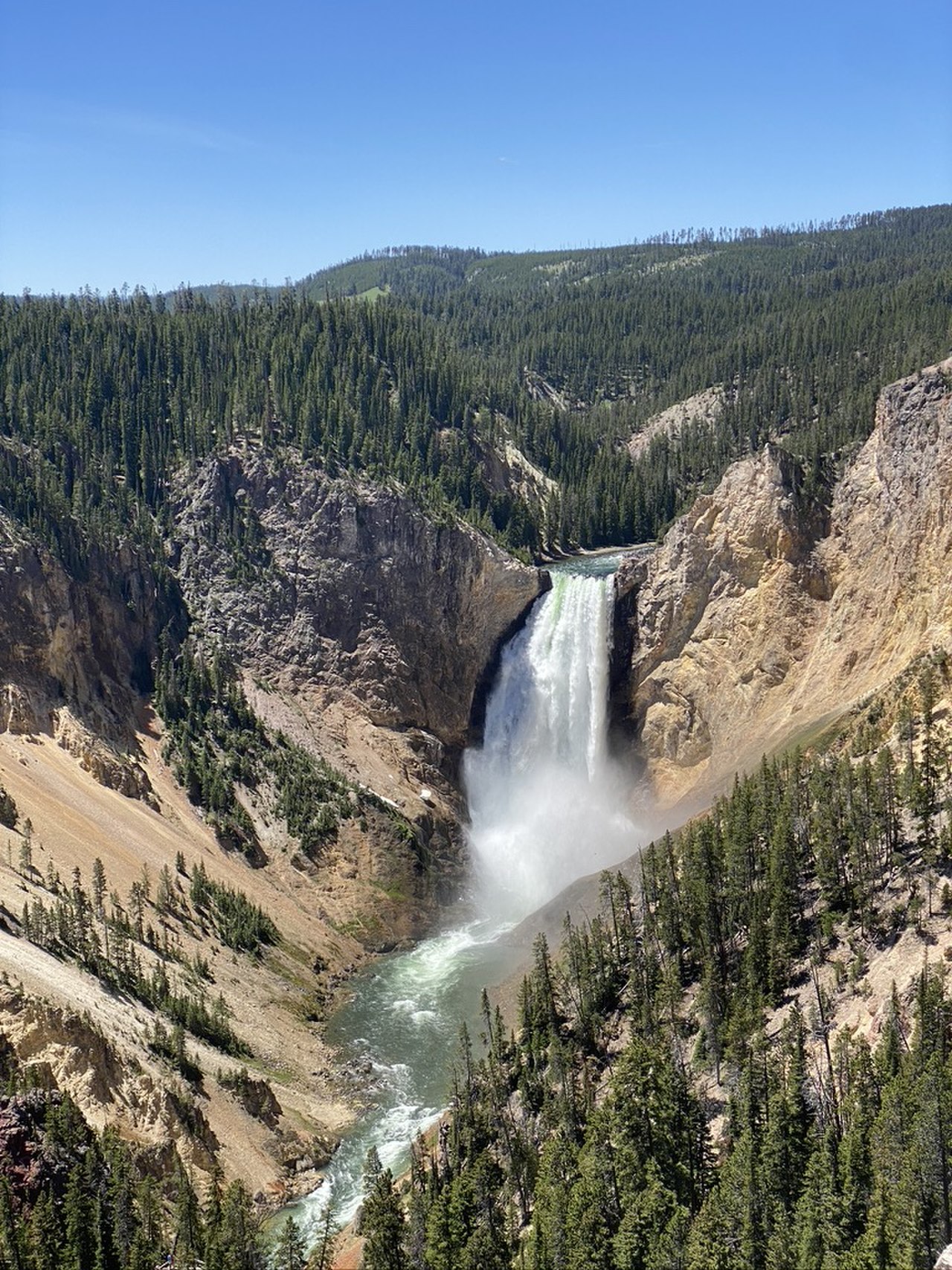
The park encompasses a high volcanic plateau surrounded by mountain ranges of the northern Rocky Mountains. Yellowstone Lake, at 7,733 feet elevation, is the largest high-altitude lake in North America. The Yellowstone River carves the Grand Canyon of the Yellowstone, a spectacular gorge up to 365 meters deep with two major waterfalls.
Notable Features
- Old Faithful: The world's most famous geyser, erupting approximately every 90 minutes
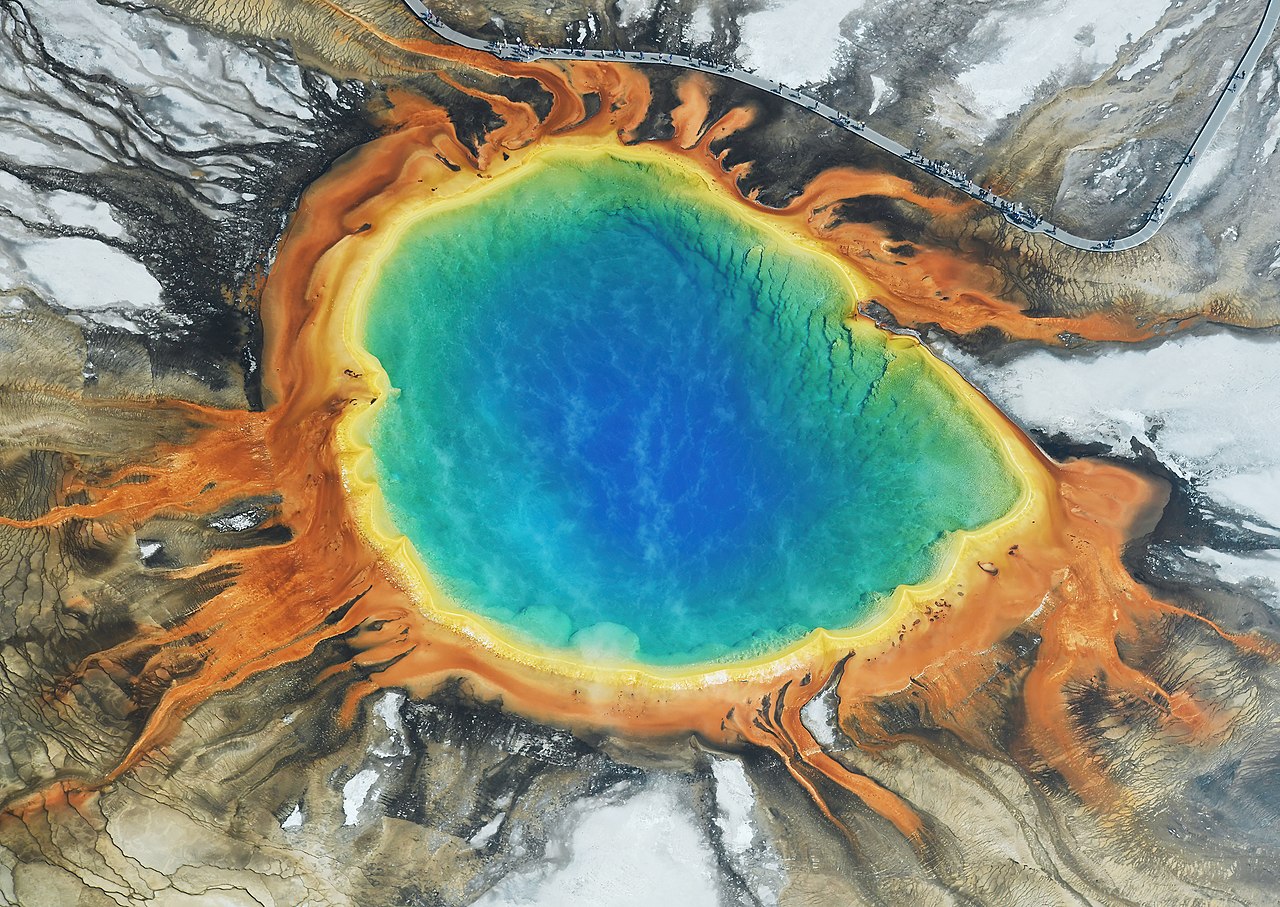
- Grand Prismatic Spring: The largest hot spring in the US and third-largest in the world, famous for its rainbow colors
- Mammoth Hot Springs: Terraced travertine formations built by mineral-laden hot water
- Grand Canyon of the Yellowstone: A 32 km gorge with two spectacular waterfalls
Grand Prismatic Spring is perhaps Yellowstone's most visually stunning feature. Measuring 90 meters across and 50 meters deep, its vivid bands of orange, yellow, green, and blue are created by different species of heat-loving bacteria (thermophiles) that thrive at specific temperatures — the hottest center is deep blue (sterile water at 87°C), while progressively cooler rings support different microbial communities that produce the rainbow colors.
Old Faithful, while not the tallest or most powerful geyser in the park, earned its name through remarkable predictability. It has erupted more than a million times since Yellowstone was established, shooting 14,000-32,000 liters of boiling water up to 56 meters into the air with each eruption.
Key Facts
- Yellowstone contains over 10,000 hydrothermal features, including ~500 geysers — more than half the world's total.
- The park is home to the largest free-roaming bison herd in the US, numbering about 5,000.
- Yellowstone's supervolcano has had three major eruptions: 2.1 million, 1.3 million, and 640,000 years ago.
- The park receives about 4.9 million visitors annually.
- Yellowstone Lake freezes completely each winter and doesn't fully thaw until late May or June.
Fun Facts
- Scientists discovered extremophile bacteria in Yellowstone's hot springs that led to the development of PCR (polymerase chain reaction) — the technology behind DNA testing and COVID tests. The enzyme Taq polymerase was isolated from Thermus aquaticus, found in the park's hot springs.
- The ground in parts of Yellowstone rises and falls by several centimeters each year as the magma chamber "breathes."
- If the Yellowstone supervolcano erupted at full force today, it would blanket most of North America in ash and significantly affect global climate — but geologists say the probability of this occurring in any given year is about 1 in 730,000.
- Yellowstone's wolves became internet celebrities: Wolf 832F ("06 Female") was so well-known to visitors that her death outside the park in 2012 made international headlines.
Final Thoughts
Yellowstone is a place where the Earth itself feels alive — where boiling water shoots from the ground, rainbow-colored springs shimmer in the sunlight, and vast herds of bison roam valleys beneath snow-capped peaks. It is both a geological laboratory and a wildlife sanctuary, a place that inspired the very concept of national parks and continues to reveal new wonders to scientists and visitors alike.
