

Introduction
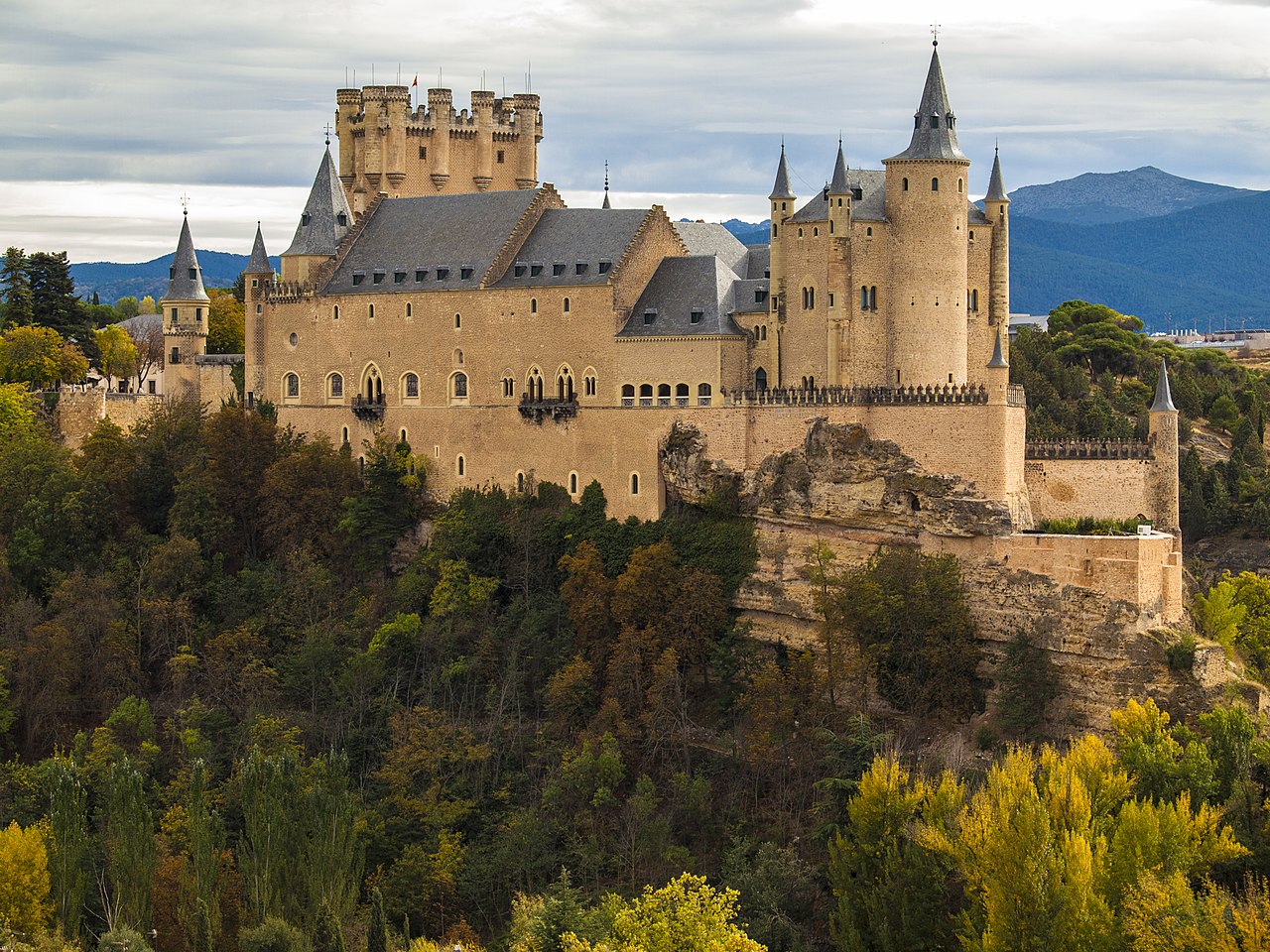
The Alcázar of Segovia (Alcázar de Segovia) is one of the most distinctive castle-palaces in Spain, rising from a rocky promontory at the confluence of the Eresma and Clamores rivers in the ancient city of Segovia, about 90 kilometers northwest of Madrid. Its ship-like profile, with a sharply pointed prow jutting into the valley and a tall keep rising at the stern, has made it one of the most photographed castles in Europe.
The Alcázar's origins date to the Roman period, but the current structure is primarily a medieval fortress expanded and embellished by successive Castilian monarchs from the 12th century onward. Queen Isabella I was proclaimed Queen of Castile here in 1474, and the castle served as a royal residence, state prison, Royal Artillery College, and military academy over its long history. Its romantic silhouette is widely believed to have inspired Walt Disney's design for the Cinderella Castle.
Architecture & Design
- Style: Romanesque, Gothic, Mudéjar
- Main Tower: Tower of John II (80 meters)
- Key Feature: Ship-like promontory profile
- Rooms: Notable Hall of Kings, Throne Room
The Alcázar's architecture reflects centuries of modification. The oldest surviving elements are the 12th-century Romanesque foundations, but the castle was dramatically expanded under Kings John II and Henry IV in the 15th century. The Tower of John II, the castle's tallest structure at approximately 80 meters above the valley floor, features twelve turrets and offers spectacular views of the Castilian meseta, the Guadarrama mountains, and the city of Segovia.
The interior rooms are richly decorated in the Mudéjar style, a distinctively Spanish fusion of Islamic and Christian artistic traditions. The Hall of Kings (Sala de los Reyes) features a carved frieze of 52 polychrome statues depicting every monarch of Castile, León, and Asturias from Pelagius to Juana la Loca. The Throne Room's spectacular gilded ceiling, with its intricate geometric patterns, is considered one of the finest examples of Mudéjar woodwork in Spain.
Location & Setting
- Location: Segovia, Castile and León, Spain
- Elevation: Over 1,000 meters above sea level
- Rivers: Confluence of Eresma and Clamores
The Alcázar occupies one of the most dramatic natural defensive positions of any European castle. The rocky crag on which it stands drops away steeply on three sides, with cliffs falling 80 meters to the river valleys below. This made the castle virtually impregnable from all approaches except the east, where a drawbridge and deep moat provided additional protection.
Segovia itself is a UNESCO World Heritage city, famous for its remarkably preserved Roman aqueduct, its Gothic cathedral (the last Gothic cathedral built in Spain), and its winding medieval streets. The Alcázar sits at the western tip of the old city, at the opposite end from the aqueduct, so a visit typically involves a walk through the entire historic center.
History & Construction
- Origins: Roman fortification, possibly earlier
- Medieval Expansion: 12th–15th centuries
- Fire: 1862 (devastating, destroyed much of the interior)
- Restoration: 1880s–1890s
Archaeological evidence suggests the site was fortified in Roman times and possibly even earlier by Celtic peoples. The first documented reference to the Alcázar dates to 1120, during the Christian reconquest of central Spain. The castle was expanded significantly under Alfonso VIII in the late 12th century and became a favored royal residence of the Castilian monarchy. Isabella I was crowned here in 1474, and the castle played a role in several pivotal moments of Spanish history.
A devastating fire in 1862 gutted much of the interior when the building was serving as the Royal Artillery College. The reconstruction, completed in the 1890s, restored the castle's exterior profile and interior decorations but incorporated some 19th-century romantic interpretations of the medieval originals. The castle subsequently served as a military academy until 1953 and was opened to the public as a museum in 1953.
Cultural Significance
- Royal Coronation: Isabella I proclaimed Queen of Castile, 1474
- Disney Connection: Believed to have inspired Cinderella Castle
- UNESCO Status: Part of the Old Town of Segovia World Heritage Site
The Alcázar's most historically significant moment came on December 13, 1474, when Isabella of Castile was proclaimed queen in Segovia's main square before processing to the Alcázar to take formal possession of the throne. This event set in motion the unification of Spain under Isabella and her husband Ferdinand of Aragón, the sponsorship of Columbus's voyage to the Americas, and the expulsion of the Moors from the Iberian Peninsula.
The castle's fairy-tale silhouette — with its conical slate-blue turrets, soaring tower, and dramatic cliff-edge location — has made it one of the most romantic castles in Europe. Walt Disney reportedly visited Segovia in the 1950s, and the Alcázar is widely cited as one of the inspirations for the iconic Cinderella Castle at Disneyland, though Disney drew on several European castles for his design.
Visitor Experience
- Hours: Open daily year-round
- Tower Climb: 152 steps to the top of the Tower of John II
- Best View: From the road below (Ronda de Don Juan II) for the full ship profile
The Alcázar is one of Spain's most visited monuments, attracting over 500,000 visitors annually. The self-guided tour takes visitors through a sequence of richly decorated rooms, including the Hall of the Throne, the Hall of Kings, the Chapel, and the Weapons Room. Climbing the 152 narrow spiral steps to the top of the Tower of John II is rewarded with panoramic views stretching across the meseta to the snow-capped peaks of the Sierra de Guadarrama.
The most dramatic view of the Alcázar itself is from outside the castle, looking up from the valley below. The road called Ronda de Don Juan II, which circles the base of the promontory, provides the classic ship-prow perspective that appears in countless photographs and paintings. The Alcázar is also beautifully illuminated at night, when its towers and turrets glow against the dark sky.
Key Facts
- The Alcázar of Segovia dates to at least the 12th century, built on Roman-era foundations
- Isabella I was proclaimed Queen of Castile at the Alcázar in 1474
- The castle is widely believed to have inspired Disney's Cinderella Castle
- A devastating fire in 1862 destroyed much of the interior, which was subsequently restored
- The Tower of John II stands approximately 80 meters above the surrounding valley
Fun Facts
- The castle's profile resembles the prow of a ship sailing westward across the Castilian plain
- All 52 statues in the Hall of Kings were originally painted in vivid colors and gold leaf
- The Alcázar served as a state prison from the 16th century, housing some of Spain's most prominent political prisoners
- A secret passage once connected the Alcázar to the city's cathedral, allowing royals to attend services without walking through the streets
Final Thoughts
The Alcázar of Segovia is where fairy tale meets history — a castle that looks like it was conjured from imagination but has in fact witnessed some of the most consequential moments in Spanish history. From Isabella's coronation to Disney's sketchbook, the Alcázar has projected its romantic silhouette across centuries and cultures, remaining one of the most captivating castles in Europe.