

Introduction
The Atacama Desert stretches roughly 1,600 kilometers along the Pacific coast of Chile, wedged between the Andes Mountains and the coastal range. It is the driest non-polar desert on Earth, with some weather stations having never recorded a single drop of rain.
This hyper-arid landscape has been compared to the surface of Mars, and NASA uses it as a testing ground for Mars rover technology. Yet despite its extreme aridity, the Atacama harbors ancient cultures, world-class observatories, and one of the planet's largest lithium reserves.
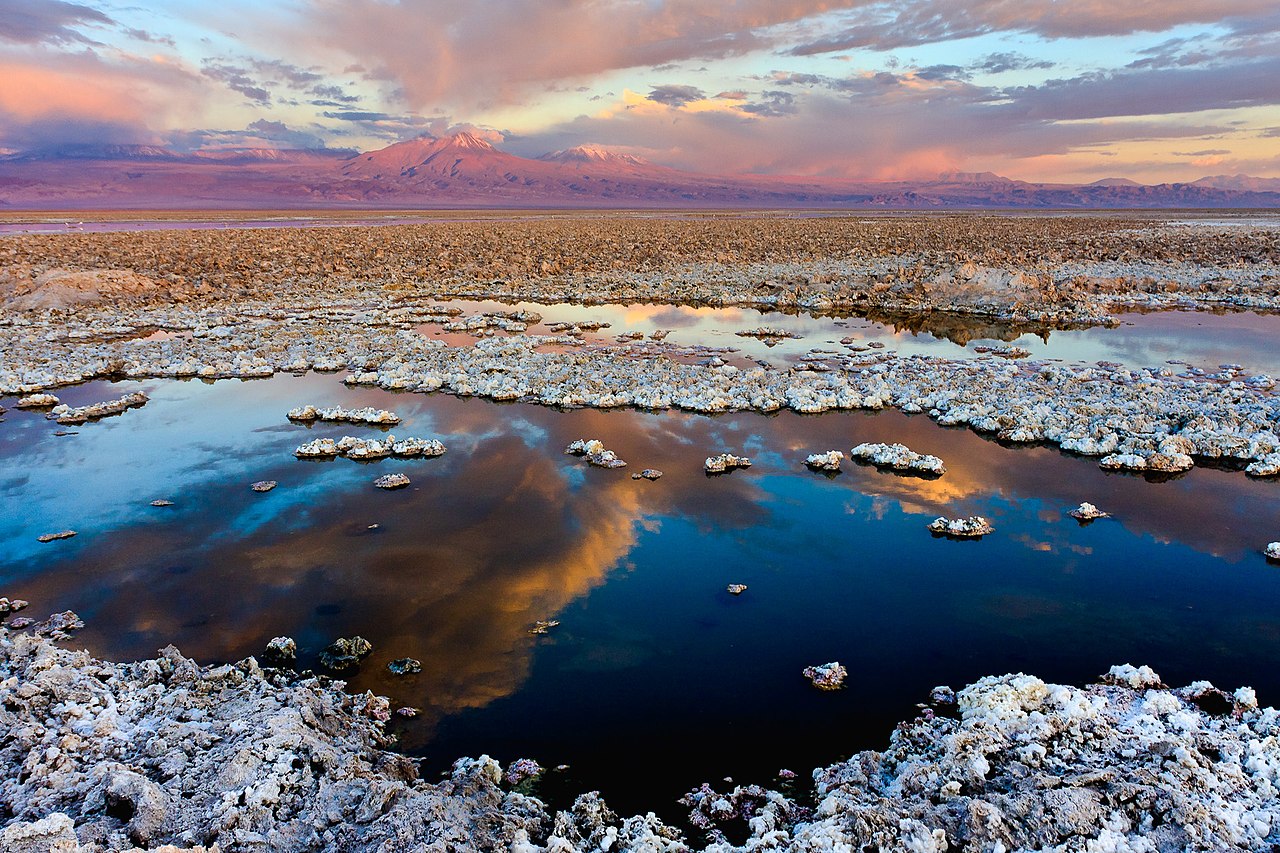
Geography & Location
- Area: 105,000 km²
- Country: Chile (extends into Peru)
- Length: ~1,600 km along the coast
- Elevation: Up to 6,893 m (Ojos del Salado)
The Atacama is a narrow coastal desert running along northern Chile between the Pacific Ocean and the Andes. It is hemmed in by the coastal Cordillera de la Costa to the west and the Andes to the east, creating a double rain shadow that blocks moisture from both the Pacific and the Amazon basin.
The desert encompasses a range of elevations, from sea level salt flats to the towering volcanic peaks of the Andes. Ojos del Salado, the highest active volcano on Earth at 6,893 meters, stands on the Atacama's eastern border.
Climate
- Rainfall: Near zero in core areas
- Driest Period: Some areas: 500+ years without rain
- Average Temp: 18°C (varies greatly with altitude)
The Atacama's extreme aridity results from the cold Humboldt Current off the coast, which stabilizes the atmosphere and prevents rain clouds from forming, combined with the rain shadow of the Andes. The core of the desert receives less than 1 millimeter of rain per year on average.
Some soil samples from the driest parts of the Atacama contain no detectable microbial life, making it the closest analog to Mars found on Earth. Coastal fog called camanchaca provides the only regular moisture for much of the region.
Wildlife
- Flamingo Species: 3 (Andean, Chilean, James's)
- Notable Plant: Llareta (cushion plant, grows 1 cm/year)
- Marine Life: Rich Pacific coast ecosystem
Life in the Atacama is concentrated around oases, river valleys, and the fog-fed coastal hills called lomas. Three species of flamingo feed in the high-altitude salt lakes, and the Atacama is a critical habitat for the endangered Chilean woodstar hummingbird.
The llareta (Azorella compacta) is one of the most remarkable desert plants. This dense, bright green cushion plant grows at high altitudes and adds only about one centimeter per year. Some specimens are estimated to be over 3,000 years old.
Human History
- Earliest Evidence: ~12,000 years ago
- Chinchorro Mummies: 7,000 BCE (oldest in the world)
- Mining Heritage: Nitrate and copper mining since 1800s
The Atacama is home to the Chinchorro mummies, the oldest deliberately preserved human remains in the world, predating Egyptian mummies by over 2,000 years. These coastal people developed mummification practices as early as 7,000 BCE.
In the 19th and early 20th centuries, the Atacama was the center of a booming nitrate mining industry. Ghost towns from this era dot the desert, including Humberstone and Santa Laura, now UNESCO World Heritage Sites. Today, copper mining dominates the economy.
Notable Features
- Observatories: ALMA, VLT, ELT (under construction)
- Salt Flats: Salar de Atacama, 3,000 km²
- Geysers: El Tatio, third largest geyser field
The Atacama's clear, dry skies and minimal light pollution make it the premier location for astronomical observation. The Atacama Large Millimeter Array (ALMA) and the Very Large Telescope (VLT) are located here, with the Extremely Large Telescope (ELT) under construction.
The Salar de Atacama is the largest salt flat in Chile, containing an estimated 27% of the world's lithium reserves. The El Tatio geyser field at 4,320 meters elevation is the third largest in the world, with over 80 active geysers erupting at dawn.
Key Facts
- Some parts of the Atacama have not received measurable rain in over 500 years.
- The Chinchorro mummies (7,000 BCE) are the oldest deliberately preserved human remains on Earth.
- The Atacama contains roughly 27% of the world's known lithium reserves.
- NASA tests Mars rover technology in the Atacama due to its Mars-like conditions.
- The Atacama hosts some of the world's most powerful telescopes thanks to its exceptionally clear skies.
Fun Facts
- When rare rain does fall in the Atacama, dormant flower seeds bloom in a spectacular event called desierto florido (flowering desert).
- Some Atacama soil is so sterile that no bacteria can be detected, even with modern technology.
- The Atacama was the site of the War of the Pacific (1879-1884) between Chile, Bolivia, and Peru, fought over valuable nitrate deposits.
- The Atacama's Salar de Atacama is a critical habitat for flamingos despite being one of the driest places on Earth.
Final Thoughts
The Atacama Desert is a place of extraordinary extremes: the driest non-polar location on Earth, home to the world's oldest mummies, and a window into the cosmos through its world-class observatories. Its stark beauty and scientific significance make it one of the most remarkable deserts on the planet.
