
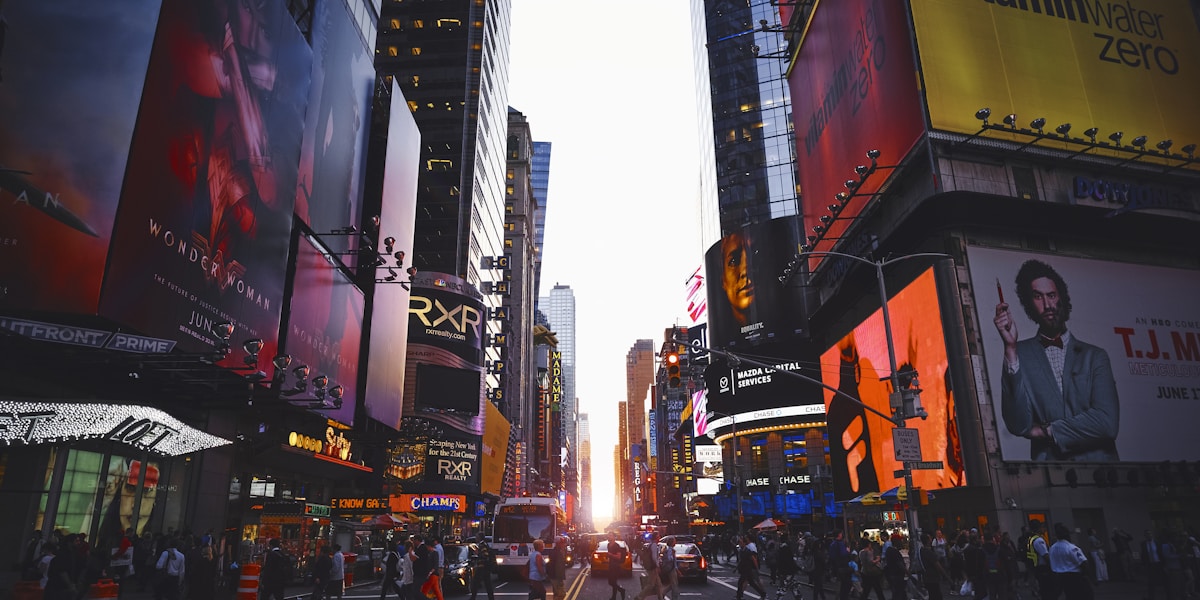
New York City is the most-populous city in the United States and the most-visited US destination, with 8.5 million city residents and 20.1 million across the broader New York metropolitan area. The famous "Big Apple" sits at the southern tip of New York State along the Atlantic Ocean, with the famous five boroughs — Manhattan, Brooklyn, Queens, the Bronx, and Staten Island — totaling 783 km² of urban density. New York City was founded as the Dutch trading post New Amsterdam in 1624; renamed New York after the British seized control in 1664; became the temporary US capital 1789-1790; served as the famous gateway for European immigration through Ellis Island (1892-1954, processing 12 million immigrants); and has been the world's premier financial center for over a century. The city hosts the United Nations headquarters, Wall Street, Broadway, the Metropolitan Museum of Art, the Statue of Liberty, Empire State Building, and dozens of other globally famous attractions.
Major attractions include the Statue of Liberty (the famous 93 m copper statue dedicated 1886, a gift from France — accessible by ferry from Battery Park), Times Square (the famous "Crossroads of the World" with extensive Broadway theaters, dazzling LED billboards, and the famous New Year's Eve ball drop), the Empire State Building (the famous 1931 Art Deco skyscraper, 381 m to the roof, the world's tallest building until 1971), the famous One World Trade Center / Freedom Tower (the famous 541 m memorial skyscraper built on the World Trade Center site, completed 2014), Central Park (the famous 3.4 km² urban park designed 1858 by Frederick Law Olmsted and Calvert Vaux), the Brooklyn Bridge (the famous 1883 suspension bridge), the famous Metropolitan Museum of Art (the famous "Met" — one of the world's largest art museums), the famous Museum of Modern Art (MoMA), the famous American Museum of Natural History, the famous 9/11 Memorial and Museum, the famous Top of the Rock and Edge observation decks, the famous Grand Central Terminal, the famous Wall Street and Charging Bull, the famous High Line elevated park, the famous Broadway theater district with the famous Lion King, Wicked, Hamilton, and dozens of other major productions, the famous Yankees baseball at Yankee Stadium, the famous Mets baseball at Citi Field, the famous Madison Square Garden (the famous "World's Most Famous Arena" — home of the Knicks and Rangers), the famous Coney Island, the famous Brooklyn Botanic Garden with cherry blossoms, and the famous Bronx Zoo. The city has four genuinely distinct seasons compressed into a small geographic footprint.
Quick verdict
Best overall: Late April through June and September through October.
Best for Christmas atmosphere: Late November through December 23. After that, crowds peak through New Year's.
Best for budget travelers: Late January through early March (excluding President's Day weekend).
Best for Broadway: Year-round. Tony Awards in early June; new shows opening throughout the season.
Avoid if you can: August (hot, humid, locals leaving for the Hamptons); the week between Christmas and New Year (peak prices, peak crowds).
Spring (March to May): the city awakens
March is variable. Daytime 3-12 °C with frequent rain and occasional snow. St. Patrick's Day (March 17) brings massive crowds for the parade. The famous Madison Square Garden St. Patrick's events are at peak. Crowds and prices are otherwise at off-season levels.
April brings genuine spring. Cherry blossoms peak in mid-to-late April — the Brooklyn Botanic Garden's cherry blossom festival is among the best in the country. Daytime 8-17 °C. Central Park transforms with new growth. Tourist crowds build through the month.
May is one of the city's best months. Comfortable temperatures (12-22 °C), long evenings (sunset 8 pm by month's end), gardens at peak. The famous Tribeca Film Festival happens in late April-early May. Memorial Day weekend (last weekend of May) brings significant crowds.
Summer (June to August): hot, humid, and packed
June is the perfect transition. Long daylight, comfortable temperatures (18-26 °C), summer in the parks beginning. Free Shakespeare in the Park at the Delacorte Theater starts in early June.
July is full summer. Daytime 24-31 °C with significant humidity. Heat waves push past 35 °C. The famous Fourth of July fireworks over the East River are world-famous. Restaurant outdoor terraces are at peak.
August is hot, humid, and the most challenging month for many travelers. Locals leave for the Hamptons or Fire Island. Many restaurants close for two-week summer holidays. The city smells of garbage on hot afternoons. International tourist crowds peak. The US Open tennis begins in late August through early September — Flushing Meadows is at peak. Hotel rates are at annual highs in some areas.
Autumn (September to November): the magic shoulder
September is excellent. The US Open concludes in early September. The city cools to comfortable 18-25 °C. Crowds drop sharply after Labor Day. The famous New York Fashion Week (early September) brings concentrated fashion industry tourism.
October is widely considered the best month. Daytime 12-19 °C, dramatic autumn light, Central Park trees turning. Halloween (October 31) — the famous Village Halloween Parade and city-wide costume culture. Hotel rates remain reasonable through most of the month.
November sees days shortening. Daytime 6-13 °C. The famous New York Marathon (first Sunday of November) brings 50,000 runners through five boroughs. Thanksgiving (fourth Thursday of November) brings the famous Macy's Parade — book accommodation 4-6 months ahead. The week of Thanksgiving and the days after see significant crowds.
Winter (December to February): Christmas magic and the cheap quiet
December brings the famous Christmas atmosphere. The Rockefeller Center tree lighting (late November-early December) draws hundreds of thousands. The ice skating rinks at Rockefeller, Bryant Park, and Central Park's Wollman are at full operation. Fifth Avenue's department store windows (Saks, Bergdorf Goodman, Macy's) feature elaborate displays. Hotel rates spike through the second half of December.
The week between Christmas and New Year is the most expensive of the year. Times Square's New Year's Eve celebration draws hundreds of thousands. Book accommodation 6-12 months ahead for this window.
January and February are deep winter. Daytime -2 to 5 °C. Snow is regular. Hotel rates drop dramatically — 40-60% below summer peaks. The famous museums (Met, MoMA, Whitney) are walkable without summer crowds. Broadway tickets are easier to obtain. Restaurant Week happens in late January and again in mid-summer.
Festivals and events worth timing around
St. Patrick's Day Parade (March 17). Tribeca Film Festival (late April). Free Shakespeare in the Park (June-August). NYC Pride Parade (last Sunday of June). Fourth of July fireworks. New York Fashion Week (early September). US Open tennis (late August-early September). New York Film Festival (late September-early October). Halloween Village Parade (October 31). New York Marathon (first Sunday of November). Macy's Thanksgiving Day Parade. Rockefeller Tree Lighting (late November). Brooklyn Tree Lighting at Grand Army Plaza. Lunar New Year Parade in Chinatown (varies January-February). Restaurant Week (late January and late July).
Borough and area considerations
Manhattan: Year-round.
Brooklyn: Best May-October for outdoor culture (DUMBO, Williamsburg, Prospect Park, the famous Smorgasburg outdoor food market).
Queens (Flushing Meadows, Astoria): Best US Open in August-September.
The Bronx (Yankee Stadium, Bronx Zoo, Botanical Garden): Best April-October.
Coney Island: Best Memorial Day through Labor Day.
The Hamptons (Long Island): Best June-August — but Manhattan empties.
Staten Island: Year-round (the famous free Staten Island Ferry provides spectacular Statue of Liberty views).
Cultural and practical notes
English is the dominant language with Spanish widely spoken (NYC has 3.5+ million Hispanic residents) plus Chinese (Cantonese and Mandarin), Russian, Arabic, Korean, French, Italian, Yiddish, Polish, Bengali, Punjabi, and many other languages reflecting the city's status as the world's most linguistically diverse city. US dollar (USD) is the currency. Tipping standard 18-22% in restaurants. The famous "New York minute" reflects the city's fast pace. The famous NYC subway runs 24/7 (one of the few in the world); the MetroCard or OMNY contactless payment provides the famous unified transit system. The famous "yellow cab" taxi system competes with Uber and Lyft.
Practical considerations
John F. Kennedy International (JFK), LaGuardia (LGA), and Newark Liberty International (EWR) airports serve NYC. JFK handles the most international flights; LGA primarily domestic; EWR mixed. The famous AirTrain connects JFK to subway, but no rail link to LGA (only buses and taxis). The famous "NYC subway" provides the most extensive urban transit in North America. The famous Hop-on Hop-off bus tours and the famous Big Apple Greeter program (free local-led tours) provide accessible introductions. Hotel rates in Manhattan are among the world's highest — budget travelers should consider hostels (Brooklyn hostels are popular) or hotels in Queens/Jersey City with subway access. The famous TKTS booth in Times Square sells same-day discounted Broadway tickets; the famous Brooklyn TKTS booth has shorter lines.
Verdict by traveler type
First-time visitors: May, June, late September, or October.
Broadway travelers: Year-round. Tony season early summer.
Photography travelers: Late October for autumn color, January after fresh snow.
Budget travelers: January-February (excluding holiday weeks).
Christmas atmosphere travelers: First three weeks of December.
Sports fans: Yankees April-September, US Open August-September, Marathon November.
Food travelers: January or late July for Restaurant Week.
Family travelers: May-June or September-October for parks and outdoor culture.
Bottom line
New York rewards spring and autumn visits decisively. May, June, September, and October deliver comfortable weather, dramatic light, and the city at its operational best. Summer works for travelers committed to outdoor culture despite heat. Winter delivers Christmas magic at a steep premium or post-holiday quiet at significant value. Allow 4-5 days for first-time visits; 7-10 days for comprehensive NYC exploration including outer boroughs.