

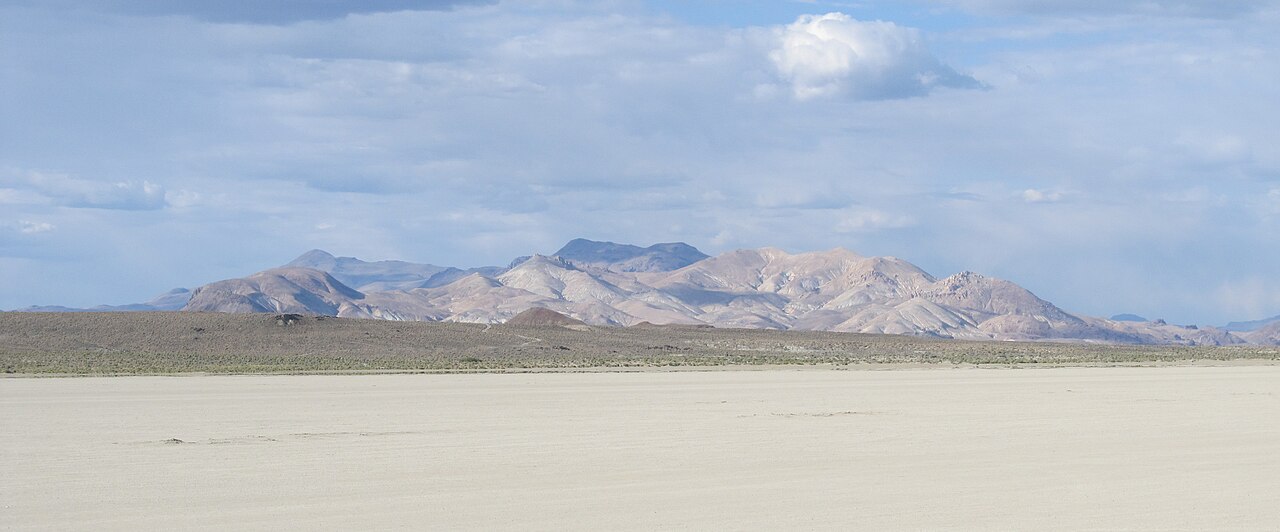
The Black Rock Desert is a vast dry lake bed, or playa, in the high desert of northern Nevada, spanning over 2,600 square kilometers of flat, cracked alkali terrain. This remnant of ancient Lake Lahontan is one of the flattest natural surfaces on Earth, so perfectly level that it has been used for land speed record attempts and become the iconic setting for the Burning Man arts festival.
Introduction
Despite its austere appearance, the Black Rock Desert has a rich history stretching from prehistoric lakeshores to pioneer wagon trails to modern-day cultural events. The playa's surface, hard as concrete when dry, transforms into an impassable mud flat when wet, embodying the extremes that define Nevada's basin-and-range landscape.
Geography & Geology
- Area: ~2,600 km² (playa and surrounding desert)
- Location: Northern Nevada, Pershing/Humboldt counties
- Playa Surface: Hard alkali flat (dry); impassable mud (wet)
- Ancient Lake: Lake Lahontan (Pleistocene)
The Black Rock playa is the bed of ancient Lake Lahontan, a massive ice-age lake that covered much of northwestern Nevada during the Pleistocene epoch. At its maximum extent around 13,000 years ago, Lake Lahontan was over 250 meters deep and covered more than 22,000 square kilometers.
As the climate warmed and dried, the lake evaporated, leaving behind a flat expanse of fine-grained silt, clay, and alkali salts. The playa surface is so flat that over a distance of 16 kilometers, it varies by only about 30 centimeters in elevation, making it one of the most perfectly flat surfaces in nature.
Land Speed Records
- First Record: 1983 (Richard Noble, 633 mph)
- Current Record: 1997 (Andy Green, 763 mph / Mach 1.016)
- Vehicle: ThrustSSC (first car to break the sound barrier)
The Black Rock Desert's vast, flat, hard surface has made it the premier site for land speed record attempts. In 1997, British driver Andy Green piloted the ThrustSSC jet car to 763 miles per hour (1,228 km/h), becoming the first person to break the sound barrier on land. The achievement sent a sonic boom echoing across the playa.
The playa provides an ideal surface for such attempts: it is flat enough, hard enough, and long enough to allow vehicles to accelerate to extreme speeds and safely decelerate. The Black Rock Desert remains the only location where the land speed record has been set since the 1980s.
Burning Man
- First Event: 1986 (Baker Beach, San Francisco); moved to Black Rock 1990
- Attendance: ~80,000 participants
- Duration: One week in late August/early September
Since 1990, the Black Rock Desert has hosted Burning Man, an annual gathering that creates a temporary city (Black Rock City) on the playa. The event brings together art, self-expression, community, and survival in one of the harshest environments in the American West.
During Burning Man, participants construct elaborate art installations, theme camps, and mutant vehicles on the empty playa. The event operates on principles of radical self-reliance, gifting, and leave-no-trace. After the event, organizers and volunteers conduct extensive environmental remediation to restore the playa to its natural state.
Emigrant Trail History
- Route: Applegate-Lassen Trail (1840s–1850s)
- Challenge: Waterless crossing of ~65 km
- Hazard: Alkali dust, heat, dehydration
In the 1840s and 1850s, the Applegate-Lassen Trail crossed the Black Rock Desert, offering pioneers an alternative route to California. The crossing was among the most dangerous stretches of any emigrant trail, with approximately 65 kilometers of waterless desert between water sources.
Many emigrants described the crossing as a terrifying ordeal of choking alkali dust, extreme heat, and abandoned wagons. The hot springs at the playa's edge, while offering water, were often dangerously scalding. Several emigrant journals describe the Black Rock Desert as the worst stretch of their entire westward journey.
Environment & Access
- Protected Status: Black Rock Desert–High Rock Canyon Emigrant Trails National Conservation Area
- Hot Springs: Several along the playa's edge
- Season: Playa accessible when dry (typically May–October)
The Black Rock Desert was designated a National Conservation Area in 2000, protecting 1,200 square kilometers of playa, hot springs, and surrounding desert. The conservation area preserves emigrant trail remnants, Native American sites, and fragile desert ecosystems.
The playa is only accessible when dry, typically from late spring through early fall. During wet periods, the surface becomes a shallow lake or impassable mud. Visitors must be self-sufficient, as there are no services on the playa. The nearest towns, Gerlach and Empire, are tiny communities at the desert's edge.
Key Facts
- The Black Rock playa is a remnant of ancient Lake Lahontan, a Pleistocene lake over 250 m deep.
- The land speed record (763 mph / Mach 1.016) was set here in 1997 by ThrustSSC.
- Burning Man has been held on the Black Rock playa since 1990, drawing ~80,000 participants.
- The playa is so flat that elevation varies by only ~30 cm over 16 km.
- The Applegate-Lassen emigrant trail crossed the desert in the 1840s–1850s.
Fun Facts
- ThrustSSC created an actual sonic boom audible across the playa when it broke the sound barrier in 1997.
- The Black Rock playa is so flat and featureless that mirages make distant objects appear to float above the surface.
- During Burning Man, Black Rock City temporarily becomes one of the largest cities in Nevada by population.
- Ancient Lake Lahontan was once home to giant fish called Lahontan cutthroat trout, which can still be found in remnant streams.
Final Thoughts
The Black Rock Desert is a landscape of extremes and paradoxes: an ancient lake bed now bone-dry, a barren waste that hosts one of the world's largest art festivals, and a surface so flat it enables vehicles to break the speed of sound. From pioneer hardship to modern celebration, this stark playa has drawn humans to test their limits against its unforgiving expanse.
Test Your Knowledge!
Think you know your deserts? Try our interactive geography quiz!
Play Geographic Features Quiz →