

The Blue Ridge Mountains are the eastern front range of the Appalachian Mountain system, stretching approximately 885 kilometers from Springer Mountain in northern Georgia through the Carolinas and Virginia to South Mountain in southern Pennsylvania. Part of a mountain chain that formed 480 million years ago, the Blue Ridge contains some of the oldest rocks and highest peaks in eastern North America, including Mount Mitchell (2,037 meters) — the highest point east of the Mississippi River.
Introduction
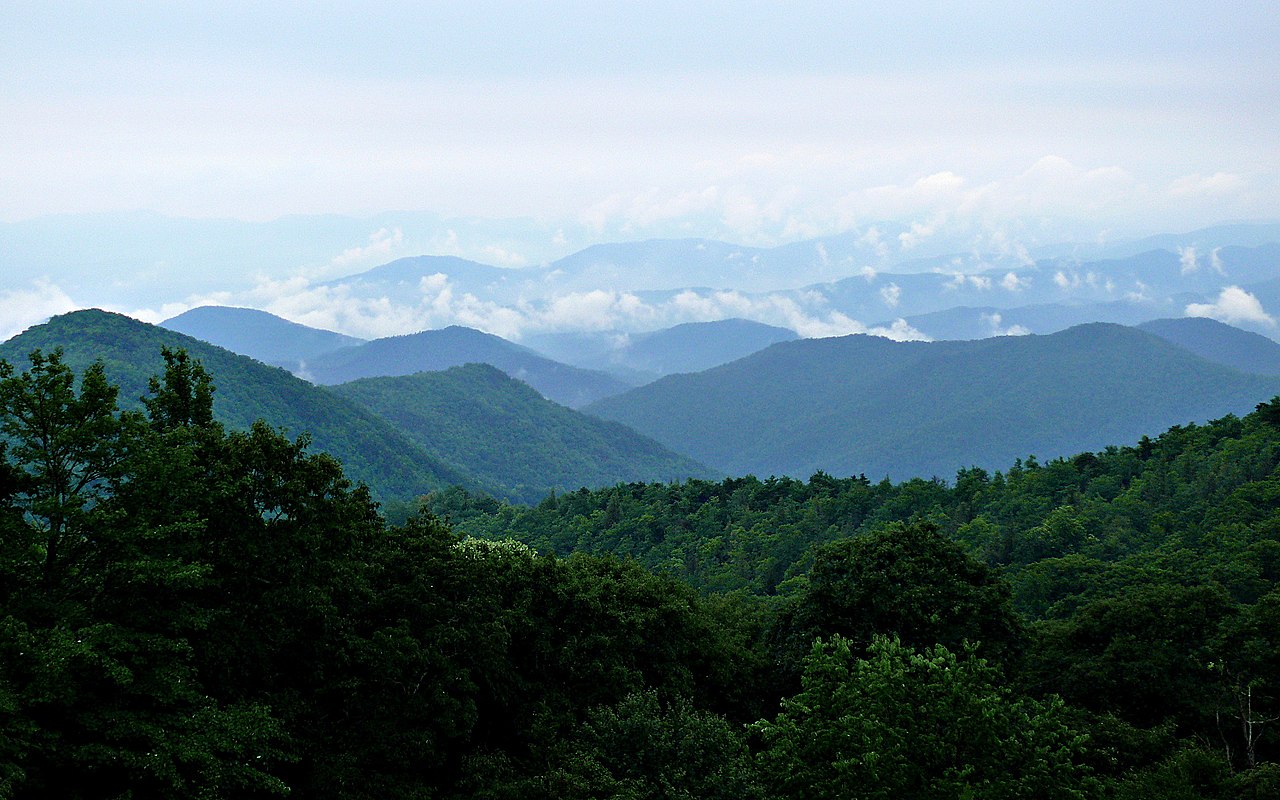
The Blue Ridge gets its name from the bluish haze that often envelops the mountains, caused by isoprene and other volatile organic compounds released by the dense deciduous forests. This natural phenomenon gives the mountains their distinctive ethereal appearance, especially when viewed from a distance. The Blue Ridge is both a geological province and a cultural region — home to communities with deep Appalachian heritage, a thriving craft and music tradition, and some of the most visited natural areas in the United States.
Geography & Geology
- Length: ~885 km (Georgia to Pennsylvania)
- Highest Peak: Mount Mitchell, NC (2,037 m)
- Geological Age: ~480 million years (some rocks 1+ billion years)
- States: Georgia, South Carolina, North Carolina, Tennessee, Virginia, West Virginia, Maryland, Pennsylvania
The Blue Ridge is composed of some of the oldest rocks in North America. The basement rocks — metamorphic gneiss and granite — are over 1 billion years old, predating complex life on Earth. These ancient rocks were thrust upward and westward during the Alleghanian orogeny approximately 300 million years ago, when the collision of Africa and North America created a mountain range rivaling the modern Himalayas. Half a billion years of erosion have worn these peaks to their current rounded forms.
The Blue Ridge varies dramatically in width and character along its length. In Virginia, it is a narrow, single ridge rarely exceeding 15 kilometers wide. In North Carolina and Tennessee, it broadens to over 100 kilometers, encompassing the massive Black Mountains (home to Mount Mitchell), the Balsam Mountains, and the Great Smoky Mountains. Grandfather Mountain in North Carolina exposes rocks over 1 billion years old at its summit and features the Mile High Swinging Bridge at 1,600 meters elevation.
Blue Ridge Parkway
- Length: 755 km (longest linear park in the US)
- Route: Shenandoah NP (VA) to Great Smoky Mountains NP (NC/TN)
- Annual Visitors: 15+ million (most visited NPS unit)
- Tunnels: 26 tunnels, mostly in North Carolina
- Elevation Range: 198 m to 1,845 m
The Blue Ridge Parkway is a 755-kilometer scenic road connecting Shenandoah National Park in Virginia to Great Smoky Mountains National Park in North Carolina and Tennessee. Conceived during the Great Depression and built over 52 years (1935–1987), it is the longest linear park in the United States and consistently ranks as the most visited unit of the National Park Service, with over 15 million recreational visits annually.
The Parkway follows the Blue Ridge crest, offering sweeping views from hundreds of overlooks along its winding, speed-limited route. It crosses the highest point on the Blue Ridge at Richland Balsam (1,845 meters) and passes through 26 tunnels carved through mountain ridges. The road was designed as a recreational motor route — no commercial vehicles are permitted — and its design philosophy of blending the road into the landscape rather than conquering it was revolutionary for American highway engineering.
Biodiversity & Ecology
- Tree Species: Over 130 native tree species (more than all of Europe)
- Salamanders: World epicenter of lung-less salamander diversity
- Wildflowers: Over 1,600 species in the Smokies alone
- Black Bears: Estimated 2,000+ in Great Smoky Mountains NP
The Blue Ridge harbors extraordinary biodiversity, a legacy of its age, elevation range, and role as a glacial refugium. The Great Smoky Mountains contain more tree species than all of Northern Europe — over 130 native species, from subtropical tulip poplars in the valleys to Canadian-zone Fraser firs on the highest peaks. The region is the global epicenter of salamander diversity, with over 50 species of lungless salamanders, many endemic to individual mountain ranges or stream systems.
The fall foliage display in the Blue Ridge is among the most spectacular in the world. The diversity of tree species means that autumn color progresses from the highest peaks in late September down to the foothills in late October, creating weeks of peak color across different elevations. Spring wildflower displays — including trilliums, lady slippers, and flame azaleas — draw thousands of botanical enthusiasts to the region each year. An estimated 2,000 or more black bears inhabit Great Smoky Mountains National Park alone.
Culture & Heritage
- Music: Old-time fiddle, bluegrass, ballad singing
- Crafts: Quilting, pottery, woodcarving, weaving
- Asheville: Arts hub, craft brewing capital of the Southeast
- Shenandoah Valley: Agricultural heartland of Virginia
Blue Ridge culture is rooted in the Scots-Irish, English, and Cherokee traditions that have shaped the mountains for centuries. Music is central: old-time fiddle tunes, banjo picking, and ballad singing traditions that arrived with 18th-century settlers have been continuously performed and evolved, giving rise to bluegrass music in the 20th century. The Galax Old Fiddlers' Convention in Virginia, held since 1935, is the oldest and largest fiddlers' convention in the world.
Asheville, North Carolina, nestled in a valley at the edge of the Blue Ridge, has become one of the most vibrant small cities in America. Its arts scene, farm-to-table restaurant culture, and extraordinary concentration of craft breweries (more per capita than any city in the US) have drawn creative professionals and tourists in droves. The Biltmore Estate, the 250-room Vanderbilt mansion completed in 1895, is the largest privately owned house in the US and Asheville's most visited attraction.
Challenges & Future
- Air Quality: Haze reducing visibility from 145 km to ~30 km
- Fraser Fir Decline: Balsam woolly adelgid killing high-elevation firs
- Climate Change: Warming shifting species ranges upslope
- Development: Mountain-top development and viewshed intrusion
Air quality is a major threat to the Blue Ridge. Haze from power plants, vehicle emissions, and agricultural sources has reduced average visibility from a natural 145 kilometers to roughly 30 kilometers on many days. While the Regional Haze Rule and the decline of coal-fired power plants have improved conditions since the 2000s, the Blue Ridge's trademark blue haze is now often replaced by white-gray smog, diminishing the scenic experience and harming sensitive plant species.
The balsam woolly adelgid, an invasive insect from Europe, has devastated Fraser fir forests on the highest Blue Ridge peaks. These relic boreal forests, isolated on mountain summits since the last Ice Age, are irreplaceable ecosystems. Climate change is compounding the threat by pushing plant and animal species upslope — a process that will eventually eliminate habitat for species already living at the highest elevations. The hemlock woolly adelgid is similarly destroying eastern hemlock forests throughout the region.
Key Facts
- The Blue Ridge Mountains stretch ~885 km from Georgia to Pennsylvania.
- Mount Mitchell (2,037 m) is the highest point east of the Mississippi River.
- The Blue Ridge Parkway is the most visited NPS unit with 15+ million annual visitors.
- The Smokies contain more tree species than all of Northern Europe.
- The Blue Ridge is the global epicenter of lungless salamander diversity.
Fun Facts
- The "blue" in Blue Ridge comes from isoprene gas released by trees, which scatters blue light — a natural phenomenon, not pollution.
- Grandfather Mountain in North Carolina exposes rocks over 1 billion years old at its summit.
- The Blue Ridge Parkway took 52 years to build (1935–1987), making it one of the longest construction projects in US history.
- The Biltmore Estate in Asheville has 250 rooms, 65 fireplaces, and a 43-bathroom count.
Final Thoughts
The Blue Ridge Mountains are a landscape of ancient geology and living culture — where billion-year-old rocks support forests of astonishing diversity, and where musical and craft traditions stretching back centuries continue to evolve. The Blue Ridge Parkway offers one of the great scenic drives on Earth, but the mountains' true value lies in their role as a biological ark, a cultural repository, and a reminder that even the oldest mountains on the continent are still changing.
Test Your Knowledge!
Think you know American geography? Try our interactive geography quiz!
Play Geography Games →