

Cable cars and funiculars are the engineering answer to one of urban geography's oldest challenges: how to move people up steep hills that defeat conventional wheeled transport. San Francisco's cable cars have been climbing 21% grades since 1873, while funicular railways — counterbalanced cars on fixed tracks — operate in over 100 cities worldwide, from Lisbon to Valparaíso to Hong Kong.
Introduction
The distinction is simple: cable cars grip and release a continuously moving underground cable (like San Francisco's system), while funiculars use two counterbalanced cars on a single track connected by a cable, with one ascending as the other descends. Both technologies emerged in the 1860s-1870s to serve cities built on terrain too steep for horse-drawn vehicles, and both remain essential urban transport in hilly cities today.
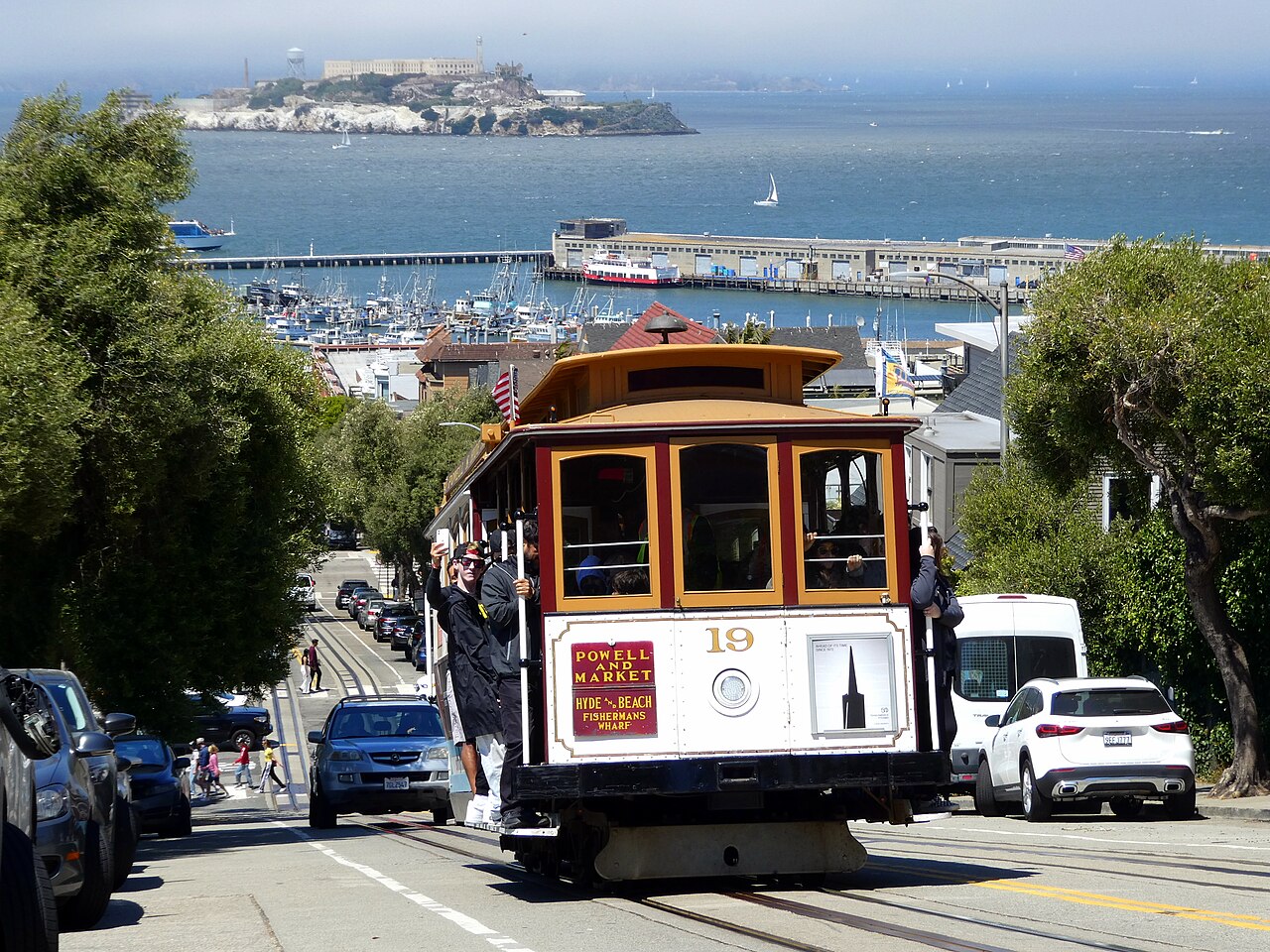
San Francisco Cable Cars
- System: 3 lines, 23 cable cars
- Track Length: 8.8 km total
- Maximum Grade: 21% (Jones Street)
- Cable Speed: 15.5 km/h
- Daily Riders: ~19,000
- Status: National Historic Landmark since 1964
San Francisco's cable car system is the world's last manually operated cable car system, a National Historic Landmark that has operated since August 2, 1873. Andrew Hallidie designed the system after witnessing horses struggle and die on the city's steep hills. At its peak in 1890, the system had 23 lines and 600 cars; today three lines remain with 23 cars, carrying approximately 19,000 riders daily.
The system works by gripping an underground cable that runs continuously at 15.5 km/h through a slot in the street. Gripmen use a lever to clamp onto or release the cable — a skill that takes months to learn. The cable, 2.5 centimeters thick and made of steel wire rope, runs in a continuous loop from a central powerhouse on Mason Street. Each car weighs about 8 tons and can carry roughly 60 passengers.
Hong Kong Peak Tram
- Opened: 1888
- Track Length: 1,365 m
- Elevation Gain: 363 m
- Maximum Gradient: 27° (51%)
- Daily Capacity: ~11,000 passengers
- Renovation: $684 million upgrade completed 2022
The Peak Tram is Hong Kong's oldest public transport system, carrying passengers from the Central district to Victoria Peak since 1888. The funicular railway climbs 363 meters over just 1,365 meters of track, with a maximum gradient of 27 degrees (51%) — so steep that buildings appear to lean sideways when viewed from the moving car. The tram was originally built to serve the colonial elite who lived on the cooler heights above the tropical harbor.
A major $684 million renovation completed in 2022 replaced the 1989-era cars with new 210-passenger cabins featuring panoramic windows, increasing capacity by 75%. The new sixth-generation tram retained the funicular system while modernizing everything else. Victoria Peak, the tram's upper terminus at 396 meters, offers one of the world's most famous urban panoramas, with the Hong Kong skyline and Victoria Harbour spread below.
Naples & Italian Funiculars
- Naples Funiculars: 4 lines (Centrale, Montesanto, Chiaia, Mergellina)
- Centrale Line: Opened 1928, 1,270 m, carries ~30,000/day
- Italy Total: ~40 funicular systems nationwide
- Funiculì Funiculà: 1880 song celebrating the first Vesuvius funicular
Naples operates four funicular railways connecting the low-lying centro storico to the Vomero hill district, carrying over 40,000 passengers daily combined. The Centrale funicular, the busiest, carries roughly 30,000 passengers per day along a 1,270-meter track with a 170-meter elevation gain. Italy has approximately 40 funicular systems in total, the densest concentration in any country.
The world's most famous funicular song, "Funiculì, Funiculà" (1880), was written to celebrate the opening of the funicular railway up Mount Vesuvius — which was subsequently destroyed by the 1944 eruption. Italian funiculars remain integral urban transport: Bergamo's funicular connects the lower and upper cities, Genoa's system navigates the steep terrain above the port, and Turin's Superga funicular reaches the hilltop basilica at 672 meters.
Valparaíso Ascensores
- System: 15 surviving funiculars (of original 30)
- Oldest: Ascensor Concepción (1883)
- UNESCO Status: Part of Valparaíso Historic Quarter World Heritage Site
- Fare: 100-300 Chilean pesos (~$0.10-$0.30)
Valparaíso, Chile's principal port, is built on 42 steep cerros (hills) surrounding a bay, making funiculars essential infrastructure since 1883. At its peak, the city operated 30 ascensores (funiculars); 15 survive, though not all are operational. The Ascensor Concepción (1883) and Ascensor Artillería (1893) are among the oldest still running and are integral to the UNESCO World Heritage-listed Historic Quarter.
The ascensores are not tourist attractions but essential daily transport for hillside residents. Each funicular serves a different cerro, connecting steep residential neighborhoods to the port-level flat area (el plan) where commerce and services concentrate. The rides cost just 100-300 pesos (~$0.10-$0.30) and take 1-3 minutes, saving residents exhausting climbs up stairways with grades exceeding 40%.
Modern Funicular Renaissance
- Innsbruck: Hungerburgbahn, redesigned by Zaha Hadid (2007)
- Barcelona: Montjuïc funicular integrated with metro
- Istanbul: Tünel (1875, world's second-oldest metro)
- New Systems: Budapest, Baku, Tbilisi, Bergen all operate funiculars
Funiculars are experiencing a renaissance as cities rediscover their advantages for steep terrain. Innsbruck's Hungerburgbahn, redesigned by Zaha Hadid in 2007, features flowing organic stations that have become architectural landmarks. Barcelona integrated its Montjuïc funicular with the metro network, making the hillside Olympic facilities seamlessly accessible. Istanbul's Tünel, opened in 1875, is the world's second-oldest underground railway after London's Metropolitan line.
The economics favor funiculars on steep gradients: they use gravity and counterbalancing (the descending car helps pull up the ascending one), making them among the most energy-efficient transport modes. A funicular consumes only about one-third the energy of an equivalent bus service on steep routes. New systems continue to be built: Baku's 2012 funicular serves the hilltop Martyrs' Lane memorial, while Tbilisi's connects the old town to the Narikala Fortress.
Key Facts
- San Francisco operates the world's last manually operated cable car system, a National Historic Landmark since 1964.
- Hong Kong's Peak Tram climbs a 27° gradient and underwent a $684 million renovation completed in 2022.
- Naples operates 4 funicular lines carrying over 40,000 passengers daily.
- Valparaíso, Chile has 15 surviving funiculars dating from 1883, part of its UNESCO World Heritage site.
- Istanbul's Tünel (1875) is the world's second-oldest underground railway.
Fun Facts
- San Francisco's cable cars grip a continuously moving underground cable at exactly 15.5 km/h — they literally cannot speed.
- The famous Italian song "Funiculì, Funiculà" (1880) was an advertising jingle for the Mount Vesuvius funicular, which was destroyed by the 1944 eruption.
- Hong Kong's Peak Tram is so steep that trees and buildings appear to lean sideways when viewed from inside the moving car.
- Funiculars are so energy-efficient that the descending car provides most of the power needed to pull up the ascending one.
Final Thoughts
Cable cars and funiculars are elegant solutions to the eternal challenge of urban topography. From San Francisco's 150-year-old gripping mechanism to Innsbruck's Zaha Hadid-designed stations, these systems prove that the steepest hills can be conquered with relatively simple technology. As cities worldwide grapple with sustainable transport, the funicular's extraordinary energy efficiency and minimal land footprint make it more relevant than ever.
Test Your Knowledge!
Think you know your transportation geography? Try our interactive quiz!
Play Geography Games →