
Cahokia Mounds, situated in the Mississippi River floodplain near present-day Collinsville, Illinois, was the largest and most complex pre-Columbian settlement north of Mexico. Flourishing from roughly 600 to 1400 CE as the center of the Mississippian culture, Cahokia reached its peak around 1050 to 1200 CE, when its population may have exceeded 20,000 people — making it larger than contemporary London.
Introduction
The site encompasses more than 120 earthen mounds spread over nearly 9 square kilometers, centered on the enormous Monks Mound, the largest prehistoric earthwork in the Americas. Cahokia was the political, ceremonial, and economic hub of a vast network of Mississippian communities stretching across the central and southeastern United States. Designated a UNESCO World Heritage Site in 1982, it remains one of the most important archaeological sites in North America.
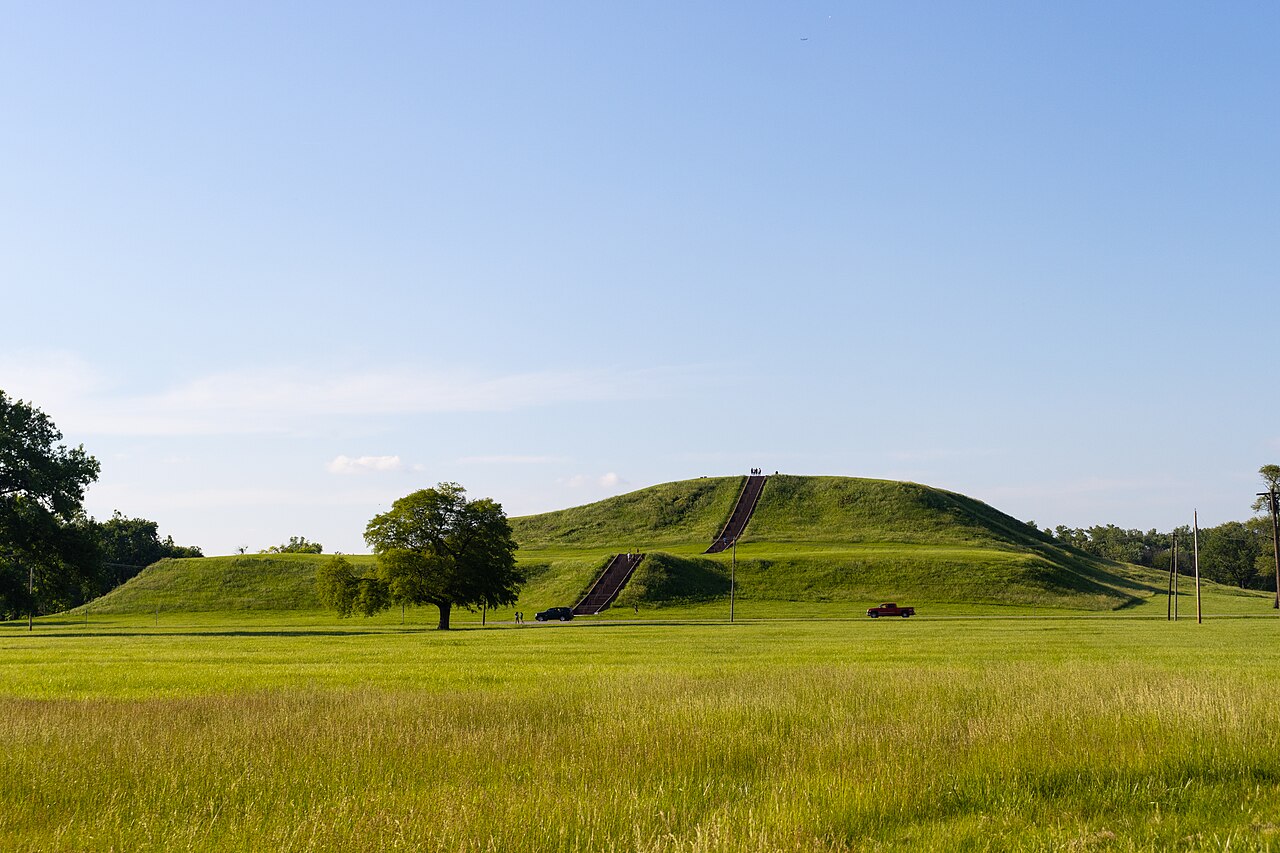
Geographic Setting
- Location: Collinsville, Illinois, USA (near East St. Louis)
- Elevation: Approximately 128 meters above sea level
- Climate: Humid continental, 1,000mm annual rainfall
- Terrain: Mississippi River floodplain, American Bottom
Cahokia occupies the American Bottom, a broad, flat floodplain where the Missouri, Illinois, and Mississippi rivers converge — one of the most fertile and resource-rich landscapes in North America. This confluence created an exceptionally productive environment with rich alluvial soils for maize agriculture, abundant fish and waterfowl, and forested uplands providing timber, nuts, and game.
The river system also provided transportation routes connecting Cahokia to distant regions. Artifacts found at the site include copper from the Great Lakes, mica from the Appalachians, marine shells from the Gulf of Mexico, and chert from quarries hundreds of kilometers away. This geographic centrality was fundamental to Cahokia's rise as a major urban and trade center.
Architecture & Engineering
- Monks Mound: 30 m tall, base covers 5.6 hectares
- Total Mounds: Over 120 within the site area
- Grand Plaza: 19 hectares, leveled and drained
- Woodhenge: Series of timber circle calendars
Monks Mound is the centerpiece of Cahokia, a terraced platform mound standing approximately 30 meters tall with a base covering 5.6 hectares — larger than the base of the Great Pyramid of Giza. Built in stages over several centuries entirely by hand, the mound required the movement of an estimated 622,000 cubic meters of earth, carried in woven baskets. A large wooden building, likely the residence of Cahokia's paramount chief, stood on the summit.
The Grand Plaza, a flat, open area covering 19 hectares immediately south of Monks Mound, was deliberately leveled by Cahokia's builders — an engineering project requiring the removal or addition of thousands of cubic meters of earth. A series of large timber circles, dubbed "Woodhenge" by archaeologists, functioned as solar calendars, with posts aligning to mark the solstices, equinoxes, and other important dates.
Historical Significance
- Emergence: c. 600 CE as a village
- Urban Expansion: c. 1050 CE, rapid population growth
- Peak Population: 10,000–20,000 around 1100 CE
- UNESCO Status: World Heritage Site since 1982
Around 1050 CE, Cahokia underwent a dramatic transformation sometimes called the "Big Bang." The population exploded, monumental construction intensified, and the site was reorganized with a formal grid-like layout oriented to the cardinal directions. This event may have been triggered by a charismatic leader, a new religious movement, or some combination of political and spiritual factors that drew people from across the region.
Cahokia's influence extended over a vast area through trade, religious authority, and possibly military power. The Southeastern Ceremonial Complex, a shared set of symbols and rituals, connected Mississippian communities from Oklahoma to Florida. Cahokia began to decline after 1200 CE, and was largely abandoned by 1400 CE. The causes likely include environmental degradation, deforestation, political instability, and possibly climate changes associated with the Medieval Warm Period's end.
Conservation & Tourism
- Annual Visitors: ~300,000
- Management: Cahokia Mounds State Historic Site, Illinois
- Threats: Urban development, flooding, erosion
- Access: Interpretive center, 13 km east of downtown St. Louis
Cahokia Mounds is managed as an Illinois state historic site with an interpretive center that provides context on Mississippian culture and daily life. Many of the original 120-plus mounds have been destroyed or damaged by two centuries of farming, urban development, and road construction. The surviving mounds within the protected area are maintained with grass cover to prevent erosion, and archaeological monitoring continues.
The site's proximity to the St. Louis metropolitan area means ongoing pressure from development, highways, and industrial activity. Flooding from the nearby Mississippi River is a periodic threat. Despite these challenges, Cahokia Mounds remains the most important Mississippian site in North America and provides crucial evidence of indigenous urban civilization on a scale that challenges common misconceptions about pre-Columbian North America.
Key Facts
- Cahokia's population may have reached 20,000 at its peak around 1100 CE.
- Monks Mound is 30 meters tall with a base larger than the Great Pyramid of Giza.
- Over 120 earthen mounds were built across a 9 km² area.
- The site was designated a UNESCO World Heritage Site in 1982.
- Cahokia was largely abandoned by 1400 CE.
Fun Facts
- At its peak, Cahokia may have been larger than London, which had about 18,000 people at the same time.
- Monks Mound required the movement of an estimated 622,000 cubic meters of earth, carried entirely in woven baskets.
- A series of timber posts called Woodhenge served as a solar calendar marking solstices and equinoxes.
Final Thoughts
Cahokia Mounds is a powerful reminder that complex urban civilization flourished in North America long before European contact. Located at the strategic confluence of major rivers in the heart of the continent, it rose to become the largest city north of Mexico, leaving behind monumental earthworks that testify to the organizational sophistication and cultural richness of the Mississippian peoples.
Test Your Knowledge!
Think you know the world's ancient ruins and archaeological sites? Try our geography quiz games!
Play Geography Games →