
Introduction
Cuba 🇨🇺 and Jamaica 🇯🇲 are two of the best-known islands in the Caribbean, close neighbours separated by a short stretch of sea yet shaped by very different histories and landscapes. One is the largest island in the region; the other is far smaller but packed with people and mountains. This comparison sets them against each other across size, population, capitals, climate, and the natural features that draw travellers to each.
Whether you are studying the Caribbean, weighing up an island holiday, or simply curious how these two nations differ, the tables and figures below lay out the key facts.
Size & Geography
| Feature | Cuba 🇨🇺 | Jamaica 🇯🇲 |
|---|---|---|
| Area | 109,884 km² | 10,991 km² |
| Continent | North America | North America |
| Region | Caribbean | Caribbean |
| Land Borders | None (island nation) | None (island nation) |
| Landscape | mostly flat to rolling plains; rugged hills in southeast | mountainous island; narrow discontinuous coastal plain |
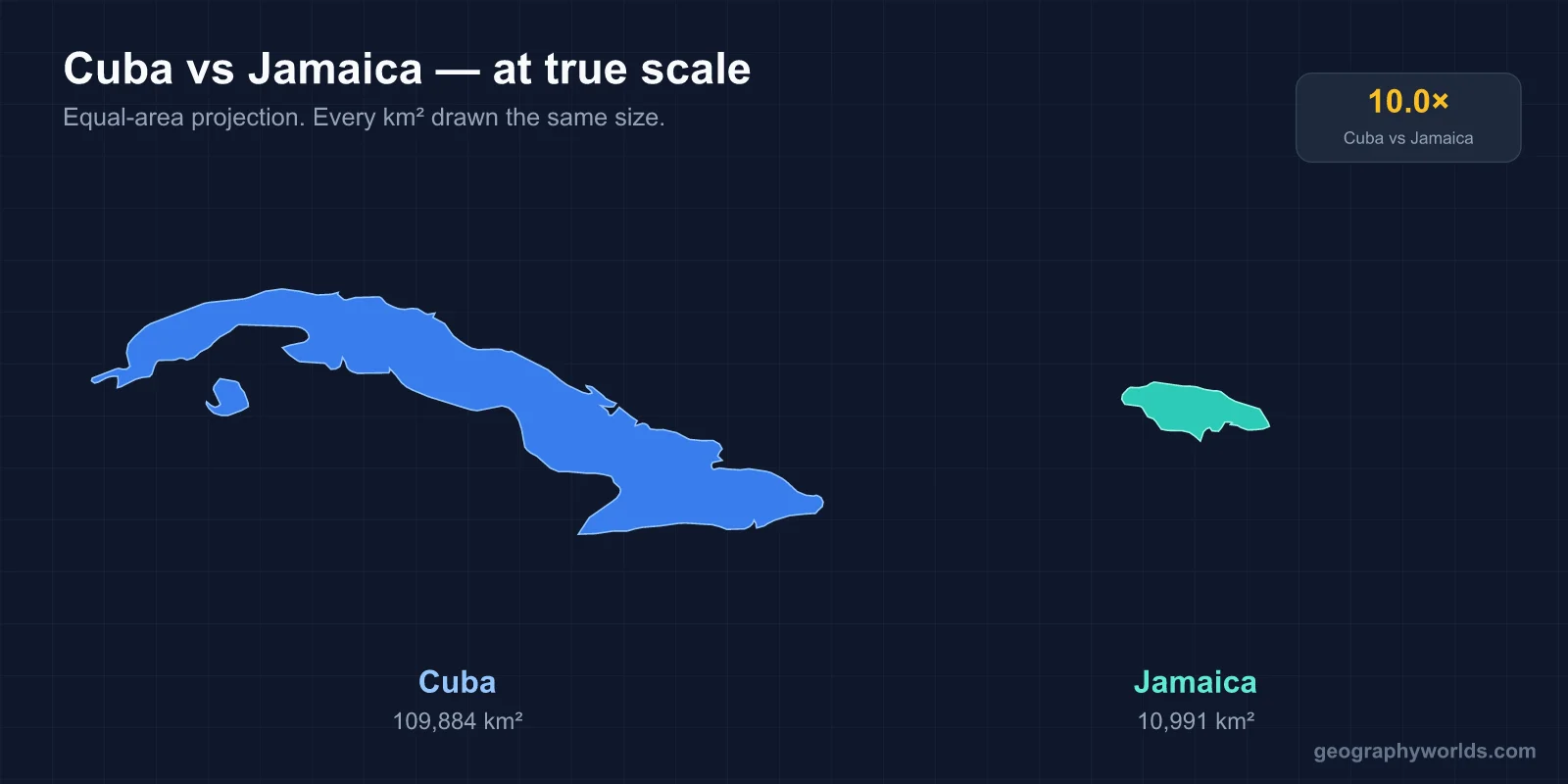
The difference in scale is striking. Cuba spreads across 109,884 km², about 10 times the 10,991 km² of Jamaica. As island nations, neither shares a land border with anyone. Their terrain differs as much as their size: Cuba is mostly flat to gently rolling, with rugged hills concentrated in the southeast, while Jamaica is mountainous throughout, its interior rising sharply and leaving only a narrow, broken ribbon of coastal plain around the edges.
Population & Demographics
| Metric | Cuba 🇨🇺 | Jamaica 🇯🇲 |
|---|---|---|
| Population | 10.9 million | 2.8 million |
| Population Density | 99.1 per km² | 257.8 per km² |
Cuba's larger size carries over to its population: about 10.9 million people, roughly 3.8 times Jamaica's 2.8 million. But because Jamaica's residents are squeezed onto a much smaller, mountainous island, it is by far the more crowded of the two, with 257.8 people per square kilometre against Cuba's 99.1 — a gap of about 158.7 per km². In other words, while Cuba has many more people overall, Jamaica fits its smaller population into a far tighter space.
Capital Cities
Havana is the capital of Cuba and Kingston the capital of Jamaica. Both are Caribbean port cities and both anchor their islands' politics and economy, yet they reflect distinct colonial legacies, Havana a centre of Spanish heritage and Kingston of the British Caribbean.
Language, Currency & Culture
| Aspect | Cuba 🇨🇺 | Jamaica 🇯🇲 |
|---|---|---|
| Languages | Spanish (official) | English (official), Jamaican Patois widely spoken |
| Currency | Cuban Peso (CUP) | Jamaican Dollar (JMD) |
Language is where the two islands' different colonial pasts show most clearly. Cuba is Spanish-speaking, a legacy of centuries of Spanish rule, while Jamaica's official language is English, reflecting its British colonial history, alongside the widely spoken Jamaican Patois. Each island also keeps its own currency, the Cuban Peso in Cuba and the Jamaican Dollar in Jamaica.
Climate & Natural Features
| Aspect | Cuba 🇨🇺 | Jamaica 🇯🇲 |
|---|---|---|
| Climate | tropical; moderated by trade winds | tropical; hot, humid; temperate interior |
| Key Features | Viñales Valley, Sierra Maestra, coral reefs, colonial architecture | Blue Mountains, Dunn's River Falls, coral reefs |
| Economy | tourism, tobacco (cigars), sugar, nickel, pharmaceuticals | tourism, mining (bauxite), agriculture, remittances |
Both islands are tropical, but they wear the climate differently. Cuba's weather is moderated by the trade winds, and its landscape ranges from the tobacco-growing Viñales Valley and the Sierra Maestra range to coral reefs and the colonial architecture of its cities. Jamaica is hot and humid along the coast yet noticeably cooler in its highland interior, where the Blue Mountains rise; its draws include Dunn's River Falls and reefs of its own. Tourism leads both economies, though Cuba also leans on tobacco, sugar, nickel, and pharmaceuticals, while Jamaica is shaped by bauxite mining, agriculture, and money sent home from its large diaspora.
What Makes Each Country Unique
Cuba is instantly recognisable for its classic vintage cars, hand-rolled cigars, revolutionary history, salsa music, and the colourful streetscapes of Havana. It also boasts one of the highest literacy rates in the world, above 99%, and has trained more doctors per capita than most nations.
Jamaica punches far above its size culturally, known for reggae and Bob Marley, Blue Mountain coffee, world-beating sprinters, and fiery jerk cuisine. The island has won more Olympic sprint medals per capita than any other country, and Usain Bolt alone claimed 8 Olympic gold medals.
Key Differences at a Glance
- Area: Cuba (109,884 km²) vs Jamaica (10,991 km²) — Cuba is 10.0x larger
- Population: Cuba (10.9 million) vs Jamaica (2.8 million) — Cuba is 3.8x more populous
- Capitals: Havana vs Kingston
- Currency: Cuban Peso (CUP) vs Jamaican Dollar (JMD)
- Continents: North America vs North America
- Density: Jamaica is far more densely populated (difference of ~158.7 people per km²)
- Languages: Spanish (official) vs English (official)
Verdict
Cuba and Jamaica sit close together in the Caribbean but offer two very different island experiences. Cuba is by far the larger, about 10 times Jamaica's area and 3.8 times its population, yet smaller, mountainous Jamaica is the more densely packed, fitting many more people into each square kilometre. Land area and crowding clearly do not move in step here.
Cuba's identity is bound up with its Spanish heritage, gently rolling tobacco country, and a long revolutionary story, while Jamaica's character rises with its Blue Mountains and resonates through reggae, coffee, and athletic legend. Tourism drives both, but each island leans on its own mix of resources beyond it.
Compared side by side, the two make a compelling study in Caribbean contrast. Whether you are planning a visit, learning the region's geography, or simply satisfying your curiosity, holding them together reveals just how much variety a single sea can hold.
Test Your Knowledge!
Think you know your countries? Try our interactive geography quiz!
Play Geography Games →