

Asia, the largest and most populous continent, is home to some of the oldest civilizations in human history and an unparalleled collection of landmarks that span millennia of cultural achievement. From the 2,000-year-old Great Wall of China to the gleaming skyscrapers of Dubai and Singapore, Asia's famous landmarks represent an extraordinary diversity of architectural styles, religious traditions, and engineering feats. Here are the top 25 landmarks that define Asia's rich heritage and modern ambitions.
1. Great Wall of China, China

The Great Wall of China is the longest man-made structure in history, stretching over 21,196 kilometers across northern China. Built over more than 2,000 years by successive Chinese dynasties, the wall was designed to protect against invasions from the northern steppe. The most famous sections near Beijing date from the Ming Dynasty (1368-1644) and feature walls averaging 7.8 meters high with watchtowers every few hundred meters. Approximately 10 million people visit the wall each year.
2. Taj Mahal, Agra, India

The Taj Mahal is widely considered the most beautiful building ever constructed. Built between 1632 and 1653 by Mughal Emperor Shah Jahan as a memorial for his beloved wife Mumtaz Mahal, it is a masterwork of Mughal architecture combining Islamic, Persian, and Indian styles. The white marble dome rises 73 meters above ground, and the exterior is inlaid with 28 types of precious and semi-precious stones. Over 7 million visitors come to Agra each year to see this UNESCO World Heritage Site.
3. Angkor Wat, Cambodia

Angkor Wat is the largest religious monument in the world, covering an area of approximately 162.6 hectares (402 acres), including a moat that stretches 1.5 kilometers on each side. Built in the early 12th century by King Suryavarman II as a Hindu temple dedicated to Vishnu, it was gradually converted to Buddhism by the end of the 12th century. The temple's five lotus-shaped towers, representing Mount Meru (the home of the gods in Hindu cosmology), are Cambodia's national symbol and appear on the country's flag.
The bas-reliefs at Angkor Wat are among the most extensive in the world, stretching for over 800 meters and depicting scenes from Hindu mythology, historical events, and daily life in the Khmer Empire. The temple receives approximately 2.6 million visitors annually.
4. Petra, Jordan

Petra is an ancient Nabataean city carved directly into rose-red sandstone cliffs in southern Jordan. Established around the 4th century BCE, the city controlled vital trade routes and was home to approximately 30,000 people at its peak. The Treasury (Al-Khazneh), standing 40 meters tall, is the most famous of over 800 carved structures. Lost to the Western world for centuries, Petra was rediscovered in 1812 and has been a UNESCO World Heritage Site since 1985.
5. Forbidden City, Beijing, China

The Forbidden City (Palace Museum) in Beijing is the largest palatial complex in the world, covering 72 hectares (178 acres) with 980 buildings containing 8,707 rooms. Built between 1406 and 1420 during the Ming Dynasty, it served as the Chinese imperial palace for nearly 500 years, housing 24 emperors of the Ming and Qing dynasties. Surrounded by a 7.9-meter-high wall and a 52-meter-wide moat, it was off-limits to ordinary citizens for centuries. Today it is China's most-visited museum with approximately 17 million visitors per year.
6. Mount Fuji, Japan

Mount Fuji is Japan's highest peak at 3,776 meters (12,389 feet) and is an active stratovolcano that last erupted in 1707. Its near-perfect symmetrical cone shape has made it an iconic symbol of Japan and a subject of countless works of art, most famously Katsushika Hokusai's "Thirty-six Views of Mount Fuji." The mountain is sacred in Shinto and Buddhist traditions and has been a pilgrimage destination for centuries. Approximately 300,000 people climb to the summit each year during the official climbing season (July-September). It became a UNESCO World Heritage Site in 2013.
7. Borobudur, Java, Indonesia
Borobudur is the world's largest Buddhist temple, built in the 9th century on the island of Java. The monument consists of nine stacked platforms (six square and three circular) decorated with 2,672 relief panels and 504 Buddha statues, crowned by a central dome. The temple was abandoned following the decline of the Sailendra dynasty and the eruption of Mount Merapi, and was hidden under volcanic ash and jungle growth until its rediscovery in 1814.
8. Hagia Sophia, Istanbul, Turkey
Hagia Sophia is a masterpiece of Byzantine architecture built in 537 CE under Emperor Justinian I. Its massive dome, 31 meters in diameter, was the largest in the world for nearly a thousand years. The building has served as a cathedral, mosque, museum, and mosque again, reflecting Istanbul's position at the crossroads of European and Asian civilizations. Its interior features stunning Byzantine mosaics alongside Ottoman calligraphy.
9. Marina Bay Sands, Singapore
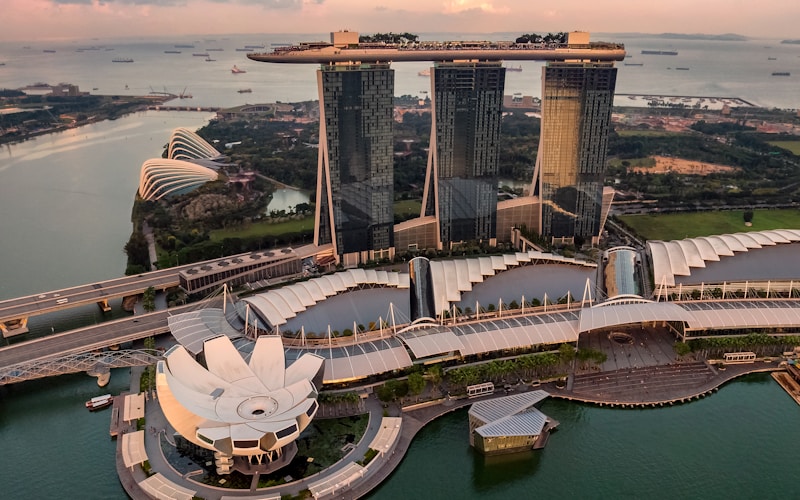
Marina Bay Sands is a landmark integrated resort completed in 2010 that has become Singapore's most recognizable modern structure. Designed by Moshe Safdie, the complex features three 55-story towers connected at the top by the SkyPark, a 340-meter-long observation deck that includes the world's largest rooftop infinity pool. The complex cost approximately US$5.7 billion to build, making it one of the most expensive buildings ever constructed.
10. Petronas Towers, Kuala Lumpur, Malaysia
The Petronas Twin Towers in Kuala Lumpur stood as the world's tallest buildings from 1998 to 2004 at 451.9 meters (1,483 feet). Designed by Argentine-American architect Cesar Pelli, the twin towers' design incorporates Islamic geometric patterns reflecting Malaysia's Muslim heritage. A sky bridge connecting the towers at the 41st and 42nd floors offers visitors panoramic views of the city. The towers remain the tallest twin structures in the world.
11. Fushimi Inari Shrine, Kyoto, Japan
Fushimi Inari Taisha is the head shrine of Inari, the Shinto god of rice, and is famous for its thousands of vermilion torii gates that straddle a network of trails behind the main shrine buildings. The trails lead into the wooded forest of Mount Inari (233 meters) and the hike to the summit takes approximately two hours. The shrine was founded in 711 CE and is Kyoto's most visited shrine with millions of visitors annually.
12. Bagan Temples, Myanmar
The ancient city of Bagan on the plains of central Myanmar contains over 2,200 surviving temples and pagodas from a period when over 10,000 Buddhist monuments were built between the 11th and 13th centuries. The temples spread across an area of approximately 104 square kilometers, and viewing the sunrise or sunset over the temple-studded plain is one of the most extraordinary experiences in Southeast Asia.
13. Burj Khalifa, Dubai, UAE
The Burj Khalifa in Dubai is the tallest structure ever built by humans, standing 828 meters (2,717 feet) with 163 floors. Completed in 2010, the tower's Y-shaped floor plan was inspired by the desert flower Hymenocallis. The observation deck on the 148th floor (At the Top SKY) offers views extending up to 95 kilometers. The tower holds multiple world records, including tallest building, highest occupied floor, and highest outdoor observation deck.
14. Terracotta Army, Xi'an, China
The Terracotta Army is a collection of approximately 8,000 life-sized clay soldiers, 520 horses, and 130 chariots buried with China's first emperor, Qin Shi Huang, around 210 BCE. Discovered accidentally in 1974 by farmers digging a well, the army was designed to protect the emperor in the afterlife. Each warrior has unique facial features, and traces of original paint suggest they were once brightly colored. The site receives approximately 2 million visitors per year.
15. Meiji Shrine, Tokyo, Japan
Meiji Shrine (Meiji Jingu) is a Shinto shrine in Tokyo dedicated to Emperor Meiji and Empress Shoken. Set within a 70-hectare forest of 120,000 trees donated from across Japan, the shrine provides a tranquil oasis in the heart of the world's largest metropolitan area. The shrine's torii gate, made from a 1,500-year-old cypress tree, is the largest wooden torii in Japan.
16. The Golden Temple, Amritsar, India
The Harmandir Sahib (Golden Temple) in Amritsar is the holiest gurdwara of Sikhism. The temple's upper floors are covered with approximately 750 kilograms of pure gold, giving it its distinctive appearance reflected in the surrounding sacred pool (Amrit Sarovar). The temple's community kitchen (langar) feeds up to 100,000 free vegetarian meals per day to visitors of all faiths, making it the world's largest free kitchen.
17. Sigiriya, Sri Lanka
Sigiriya (Lion Rock) is a massive rock fortress rising 200 meters above the surrounding plains in central Sri Lanka. Built in the 5th century CE by King Kashyapa I, the summit once held a royal palace, and the approach featured a monumental lion-shaped gateway (only the paws survive today). The rock face is decorated with famous frescoes of celestial maidens, and the summit offers 360-degree views of the surrounding landscape.
18. The Potala Palace, Lhasa, Tibet
The Potala Palace is a massive fortress-like structure in Lhasa, Tibet, that served as the winter residence of the Dalai Lamas from 1649 to 1959. Rising 117 meters above the Red Hill, the palace contains over 1,000 rooms, 10,000 shrines, and approximately 200,000 statues. The White Palace served as the living quarters, while the Red Palace houses the tombs of eight Dalai Lamas, decorated with tonnes of gold and precious gems.
19. Baalbek, Lebanon
Baalbek is home to some of the best-preserved Roman temple ruins in the world, including the Temple of Bacchus, which is larger than the Parthenon, and the massive Temple of Jupiter, of which only six towering columns remain standing at 22 meters tall. The site also contains the Stone of the Pregnant Woman, a quarried block weighing approximately 1,000 tonnes, one of the largest stone blocks ever cut by humans.
20. Prambanan, Java, Indonesia
Prambanan is the largest Hindu temple compound in Indonesia and the second-largest in Southeast Asia, built in the 9th century. The complex features 240 temples, with the central compound containing three main temples dedicated to Brahma, Vishnu, and Shiva. The tallest temple (Shiva) rises 47 meters and is decorated with intricate relief carvings depicting the Ramayana epic.
21. The Dead Sea, Jordan/Israel
The Dead Sea is the lowest point on Earth's surface, sitting at approximately 430 meters below sea level. Its extreme salinity (approximately 34%, nearly ten times saltier than the ocean) makes it impossible for most organisms to survive but allows humans to float effortlessly on its surface. The mineral-rich mud and waters have been used for therapeutic purposes for thousands of years.
22. Temples of Bali, Indonesia
Bali's landscape is dotted with over 20,000 temples, but the most iconic include Tanah Lot (a sea temple perched on a rocky outcrop), Uluwatu (a clifftop temple 70 meters above the Indian Ocean), and the "Mother Temple" Besakih on the slopes of Mount Agung. These temples are central to Balinese Hindu culture and offer some of the most dramatic settings of any religious buildings in Asia.
23. Ha Long Bay, Vietnam
Ha Long Bay features over 1,600 limestone karst islands and islets rising from emerald green waters in the Gulf of Tonkin. The karst formations were shaped over 500 million years of geological history and contain numerous caves, grottoes, and floating fishing villages. The bay was selected as one of the New Seven Wonders of Nature in 2011 and is a UNESCO World Heritage Site.
24. Gyeongbokgung Palace, Seoul, South Korea
Gyeongbokgung is the largest and most iconic of Seoul's five grand palaces, built in 1395 as the main royal palace of the Joseon dynasty. The complex covers 40 hectares and contains 330 buildings. The Gyeonghoeru Pavilion, set on an artificial island in a lotus pond, is one of the most beautiful architectural spaces in Korea. Visitors can rent traditional hanbok clothing and explore the palace grounds.
25. Cappadocia, Turkey
Cappadocia in central Turkey is famous for its surreal landscape of "fairy chimneys" — tall, cone-shaped rock formations created by millions of years of volcanic eruptions followed by wind and water erosion. The region also contains extensive underground cities (Derinkuyu could shelter 20,000 people) and hundreds of rock-cut churches decorated with Byzantine frescoes. Hot air balloon rides over the landscape at sunrise have become one of the most popular tourist experiences in the world.
Key Facts
- Asia is home to the world's tallest building (Burj Khalifa, 828 m), largest palace (Forbidden City), and largest religious monument (Angkor Wat)
- The Forbidden City receives approximately 17 million visitors per year, making it the most-visited landmark in Asia
- The Great Wall of China stretches over 21,196 km across northern China
- Mount Fuji is an active volcano that last erupted in 1707
- Angkor Wat covers 162.6 hectares and features over 800 meters of bas-relief carvings
- The Terracotta Army contains approximately 8,000 unique clay soldiers, each with individual facial features
- Asia contains over 280 UNESCO World Heritage Sites
Test Your Knowledge!
Think you know your famous landmarks? Try our interactive quiz!
Play Geography Games →