
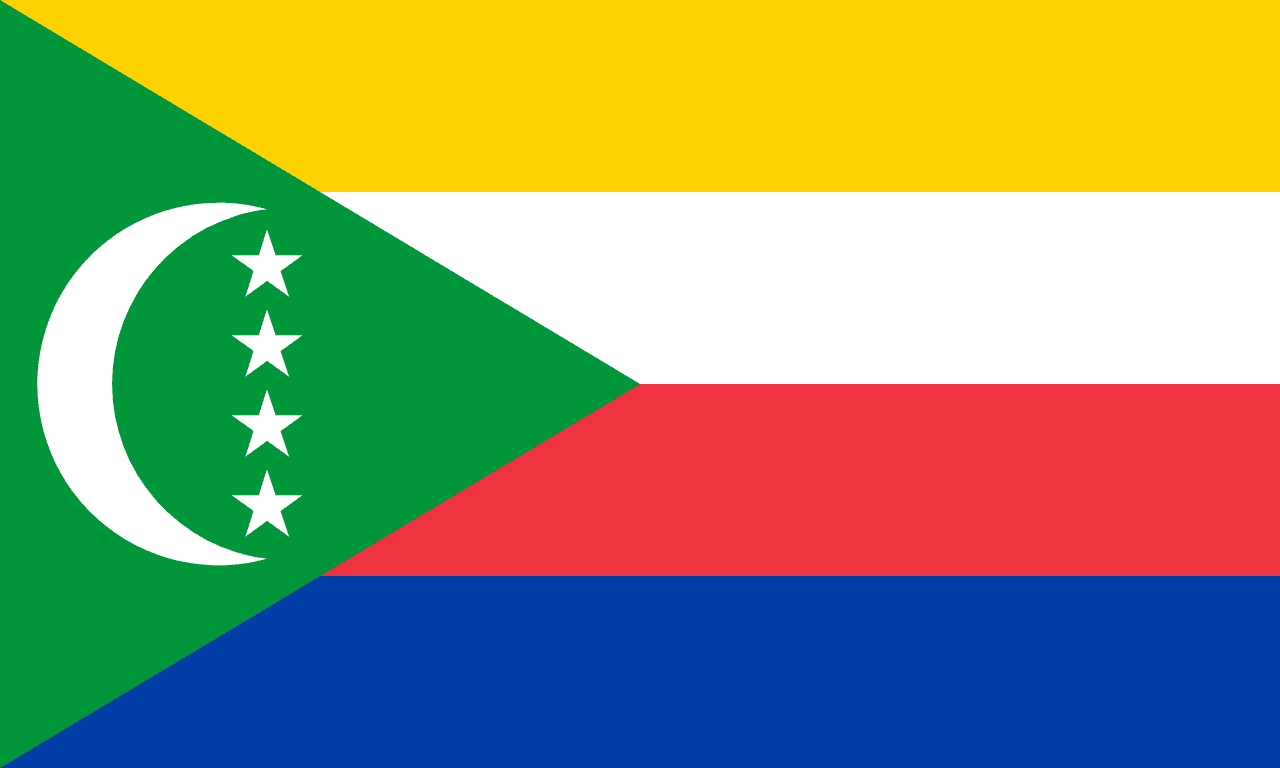

Few national flags wear their geography as plainly as the flag of Comoros. This small archipelago in the Indian Ocean, scattered between mainland Africa and the northern tip of Madagascar, is made up of distinct islands that have spent much of their modern history negotiating how to belong together. The flag answers that question visually: four horizontal stripes, four stars, and a crescent set against a green triangle. It is a banner built almost entirely out of arithmetic, and once you know what the number four stands for, the whole design suddenly reads like a sentence.
Adopted in 2002, this is the version most people recognize today, and it reflects a country still working out the balance between unity and the strong individual identities of its islands. To understand why it looks the way it does, it helps to start with the colors.
The Colors and What They Stand For
The flag draws on a palette of five colors: green, yellow, white, red, and blue. Four of them appear as horizontal stripes running across the field, while green is reserved for the triangle anchored at the hoist. Each stripe corresponds to one of the four islands of the archipelago, so the color scheme is not decorative shorthand but a direct roll call of the nation's constituent parts.
Green, the color of the triangle and the crescent, carries the Islamic identity that runs deep through Comorian culture. Islam is woven into daily life across the islands, and green is the traditional color associated with the faith throughout much of the world. The crescent reinforces that connection, making the religious dimension of the flag impossible to miss. The remaining stripe colors give each island its own visual signature within the single shared banner, a clever way of saying we are distinct, but we are one.
Reading the Design
The layout is straightforward once decoded. Four equal horizontal bands fill the rectangle. Overlaid on the left, pointing inward from the hoist, sits a green triangle. Inside that triangle is a white crescent, and arranged in a vertical line are four small white stars.
Both the four stripes and the four stars stand for the same thing: the four islands. This deliberate repetition is the heart of the design. The stripes represent the islands as territory, blocks of color stacked together, while the stars represent them as a constellation gathered under the crescent. The crescent and stars together also tie the flag to the broader visual language of the Islamic world, where the crescent appears on banners from North Africa to Southeast Asia. What sets the Comorian flag apart is the count: most crescent flags carry a single star, but here the crescent watches over four, one of the relatively few national flags to pair a crescent with multiple stars.
A Flag Shaped by a Restless History
The current flag did not arrive fully formed. Comoros has cycled through several designs since independence, and each iteration tells part of the story of a young nation finding its footing. The crescent and stars have been a constant thread, but the way the rest of the flag was arranged shifted as the political situation evolved. Earlier versions leaned more heavily on a single field of green with the crescent and stars, emphasizing the Islamic and unified character of the state.
The 2002 redesign introduced the four-stripe scheme that defines the flag today. That change was not merely aesthetic. It coincided with a reworking of how the islands related to one another within the union, giving each island a clearer place in the national symbol. By assigning every island both a stripe and a star, the flag acknowledged the centrifugal pull that has periodically strained the archipelago while still insisting on a common frame. In that sense the flag is a quiet record of compromise, the visual settlement of a long conversation about togetherness.
What the Flag Means to Comorians
For a nation spread across separate islands, a shared flag does real work. It is one of the few things every Comorian sees regardless of which island they call home, and the symbolism of four-as-one speaks directly to the central challenge of national life. The green and the crescent affirm a faith held in common, while the four stripes and stars insist that no single island disappears into the whole.
That layered meaning makes the flag more than ceremonial. It functions as a kind of constitutional diagram in cloth, reminding citizens that unity here is a negotiated thing rather than an assumption. Readers who want the broader picture of the country's geography, culture, and islands can explore the comoros country guide for context that fills in the world the flag represents.
The Flag in Everyday Life
Like any national flag, the Comorian banner appears at the expected moments: independence celebrations, official ceremonies, government buildings, and international gatherings where the country is represented. It flies at the United Nations alongside the flags of every other member state, and it travels with Comorian athletes and delegations abroad, serving as instant identification for a nation many people abroad would struggle to place on a map.
Because the design is so legible, it does that identifying job well. The four stars in particular act as a memorable fingerprint, distinguishing the flag at a glance from other green crescent banners and giving Comorians a symbol that is genuinely their own rather than a generic regional template.
Quick Facts Worth Knowing
- The flag uses five colors in total: green, yellow, white, red, and blue.
- Both the four stripes and the four stars represent the four islands of the archipelago.
- The green triangle and white crescent reflect the strong Islamic heritage of the country.
- It is one of relatively few national flags that combine a crescent with multiple stars.
- The version flown today was adopted in 2002 as part of a reordering of the union of islands.
- Comoros sits in the Indian Ocean off the southeastern coast of Africa, near Madagascar.
Frequently Asked Questions
When was the current flag of Comoros adopted?
The flag in use today was adopted in 2002. It replaced earlier designs and introduced the four horizontal stripes, each standing for one of the country's four islands, while keeping the crescent and stars that had long been associated with the nation.
What do the colors and symbols on the flag mean?
The four stripes and the four stars each represent the four islands of the archipelago, expressing the idea of unity among distinct parts. The green triangle and the white crescent signal the Islamic faith that is central to Comorian culture. Together the elements present a single nation built from several islands.
What continent is Comoros on?
Comoros is part of Africa. It is an island nation in the Indian Ocean, lying between the African mainland and the northern end of Madagascar, which makes it one of the continent's island states rather than a mainland country.
How does the flag compare to other crescent flags?
Many flags around the world feature a crescent, but most pair it with just one star. The Comorian flag is unusual in showing a crescent alongside four stars, a choice driven by the need to represent each of the four islands. That detail, plus the four colored stripes, makes it easy to tell apart from other green-and-crescent banners.