
Almost every flag on Earth is a rectangle. Nepal's is not. Hanging against the Himalayan sky, the national flag of this South Asian kingdom-turned-republic is a pair of stacked triangular pennants, edged in deep blue and filled with crimson, each carrying a celestial emblem. It is the single exception to a rule so universal that most people never realize the rule exists. That quiet defiance of convention is exactly why Nepal's flag is one of the most instantly recognizable banners in the world, and why it rewards a closer look at the colors, geometry, and centuries of mountain history packed into its unusual shape.
A Flag Shaped Like No Other
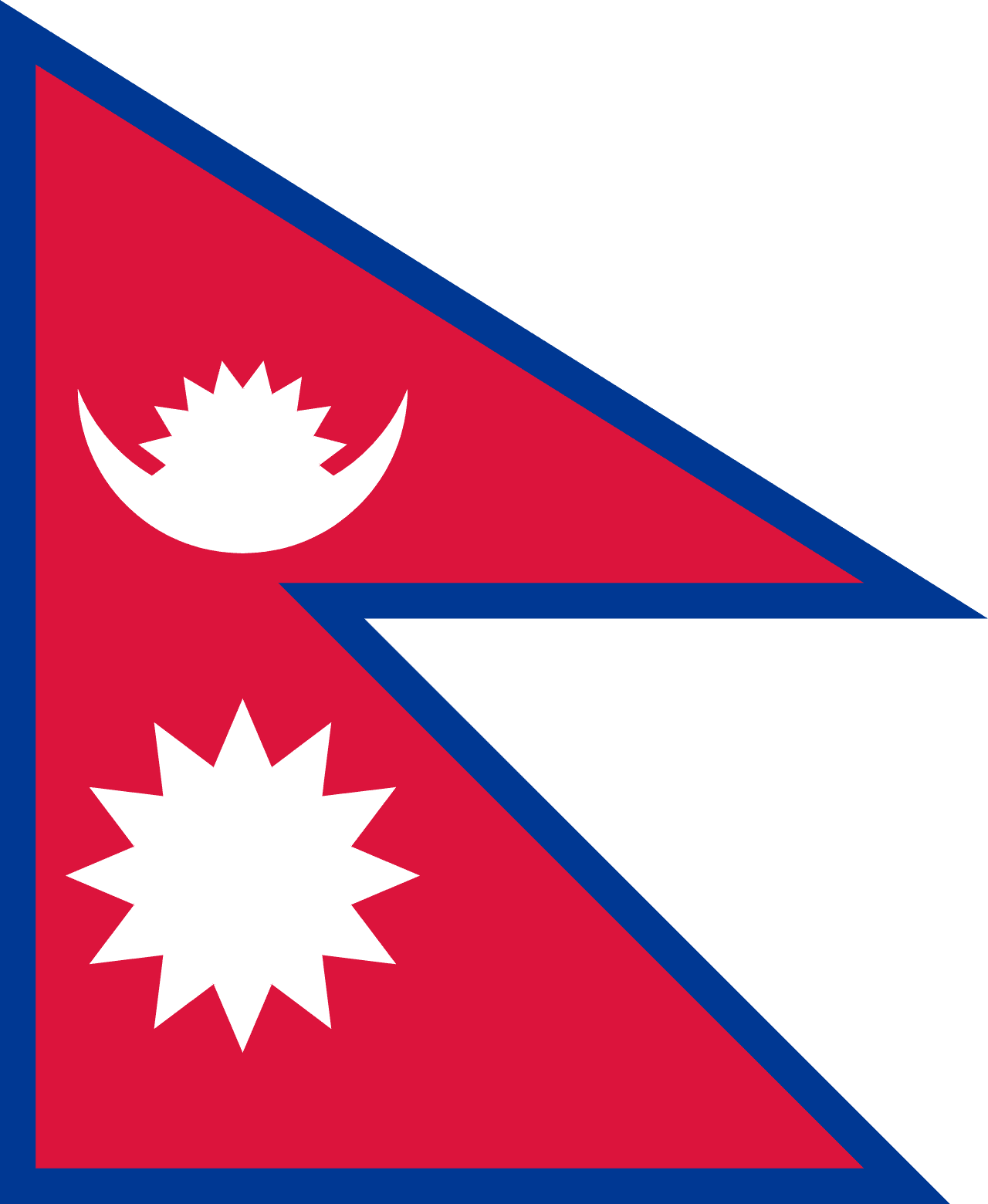
The most striking fact about Nepal's flag is also the simplest to state: it is the only non-rectangular national flag in the world. While every other sovereign state flies a four-cornered rectangle or square, Nepal flies a double pennant, two triangular flags joined one above the other so that the right edge forms two points rather than a single straight side. The shape is not a stylistic flourish invented for novelty. It descends from much older banners flown across the Himalayan region, and the modern flag essentially formalized a form that had been waving over the country for generations.
The two triangles sit on a common vertical hoist along the staff. The upper pennant is the smaller of the two and contains a white moon; the lower, larger pennant contains a white sun. A blue border traces the entire outer edge, and the field within is a vivid crimson. The result reads as a single, unified flag with a serrated fly edge rather than two separate flags, which is how it is treated in law and in everyday use.
Crimson, Blue, and White: What the Colors Mean
The palette is tight and deliberate, just three colors doing three jobs. The dominant crimson is the color of the rhododendron, Nepal's national flower, and it stands for bravery and the fighting spirit long associated with the country's soldiers. It is a warm, assertive red that fills almost the entire surface of the flag.
Framing that crimson is a band of blue, which represents peace and harmony. The pairing is intentional: courage in the center, peace at the edges, a balance the nation likes to claim for itself. The two white emblems, the sun and the moon, complete the meaning. Together the celestial pair expresses a hope that Nepal will endure as long as those bodies shine in the sky, a wish for permanence and continuity stretching into the future. White, here, carries the calm and purity that so often attaches to the color across world flags.
Reading the Design: Sun, Moon, and Two Points
Look closely and the symbolism deepens. The crescent moon in the upper pennant and the rayed sun in the lower one are sometimes read as the cool, serene character of the Himalayan highlands set against the hotter lowlands of the south, the two climates a Nepali traveler can pass between in a single day. The celestial bodies also nod to the royal house and to ruling families historically linked to the sun and the moon.
The geometry of the flag is unusually precise. Nepal's constitution lays out an exact step-by-step construction method, a sequence of measured lines and arcs that anyone can follow with a ruler and compass to reproduce the flag at any size. Few countries specify their flag with such mathematical care, and the instructions are a small marvel of national documentation: they guarantee that the two triangles, the blue border, and the placement of sun and moon come out identically every time.
From Mountain Banners to a Single National Flag
The flag's roots run deep into Nepal's past. For centuries the rulers of the region flew two separate triangular pennants, an emblem associated in particular with the powerful Rana family that dominated Nepali politics for much of the nineteenth and early twentieth centuries. The two pennants were eventually combined into the joined double-triangle form recognizable today.
The version now in use was standardized in 1962, when a new constitution defined the flag's precise proportions and the exact rendering of its sun, moon, and borders. Earlier depictions of the celestial emblems had included human-like faces; the modern standardization simplified them into the clean geometric sun and crescent seen on the flag now. So while the shape is ancient, the carefully measured flag flying today is a twentieth-century codification of a much older tradition. Readers who want the wider story of the country's geography and culture can explore our nepal country guide.
How It Compares to Other Flags
Because of its shape, Nepal's flag has no true look-alike. Every comparison ends up highlighting a difference. Many flags share its crimson-and-white energy, India's tricolor and Japan's red sun disc among them, and several use celestial imagery, but none combine a sun, a moon, and a serrated double-pennant outline. Pennant shapes do appear elsewhere in the world, on naval signal flags, on the swallow-tailed civil flags of a few states, and on countless sporting and decorative banners, yet no other national flag abandons the rectangle entirely.
The closest cultural cousins are the prayer-flag strings and temple banners of the broader Himalayan and Tibetan Buddhist world, which often hang as triangular pennants in repeating rows. Nepal's flag belongs visually to that family far more than it belongs to the rectangular tricolors of its neighbors. What distinguishes it is that a whole sovereign state chose to keep the pennant form rather than fall in line with the global rectangle.
The Flag in National Life
For a country sitting in Asia, on the southern slopes of the Himalaya between India and China, the flag is a compact statement of identity. Nepalis take genuine pride in flying a banner unlike any other, and the shape has become shorthand for the nation itself, appearing on souvenirs, climbing expeditions, embassy buildings, and the kits of athletes competing abroad. When Nepali mountaineers reach a summit, the double pennant is the cloth they unfurl for the camera.
The flag features in civic ceremonies, school assemblies, and national holidays, and its distinctive outline makes it a favorite in international flag displays where rows of identical rectangles are suddenly interrupted by Nepal's twin points. Software engineers, too, have a quiet relationship with it: rendering the flag's curved borders and exact angles is a famous small challenge precisely because it cannot be drawn as a simple rectangle of stripes.
Quick Facts Worth Knowing
- It is the only non-rectangular national flag in the world.
- The current standardized design dates to 1962.
- The three colors are crimson, blue, and white.
- The crimson echoes the rhododendron, Nepal's national flower, and signifies bravery.
- The sun and moon express a hope that the nation will last as long as those bodies endure.
- Nepal's constitution includes exact geometric instructions for constructing the flag.
- The two-triangle form evolved from older Himalayan and Rana-era pennants.
Frequently Asked Questions
When was Nepal's flag adopted?
The modern flag was standardized in 1962, when a new constitution fixed its proportions and the precise design of the sun, moon, and borders. The triangular pennant shape itself, however, is far older and was flown in the region long before that date.
What do the colors of the Nepal flag mean?
Crimson, the dominant color, stands for bravery and recalls the rhododendron, the national flower. The blue border represents peace and harmony. The white sun and moon together express a hope that Nepal will endure as long as the sun and moon shine in the sky.
Who designed the Nepal flag?
The flag has no single famous designer. Its double-pennant form grew out of centuries-old Himalayan banners associated with Nepal's ruling families, including the Rana dynasty. The version in use today is a standardized codification of that long tradition rather than the invention of one individual.
What continent is Nepal on, and how does its flag compare to others?
Nepal is in Asia, landlocked in the Himalaya between India and China. Its flag is unique because it is the only non-rectangular national flag. While other flags share its crimson tones or use celestial symbols, none combine a sun, a moon, and a serrated two-triangle outline.