
**Itaipu Dam** on the Paraná River at the Brazil-Paraguay border is the world's most productive hydroelectric power station, holding the record for the most cumulative electricity generated by any single facility in history. With an installed capacity of **14,000 MW** across 20 turbines, Itaipu supplied **103.1 TWh** in 2016 — its record year — and provides approximately **15 percent of Brazil's** and **86 percent of Paraguay's** total electricity consumption.
Introduction
This binational mega-project was built jointly by Brazil and Paraguay between 1975 and 1984, requiring the diversion of the seventh-largest river in the world and one of the most massive construction efforts ever undertaken. The dam's output has been instrumental in powering Brazil's industrial economy and effectively supplies nearly all of Paraguay's electrical needs at virtually no fuel cost.
Engineering & Structure
- Type: Hollow gravity dam (main section) + multiple dam types
- Height: 196 meters (main dam)
- Crest Length: 7,919 meters (total)
- Concrete Volume: 12.3 million m³
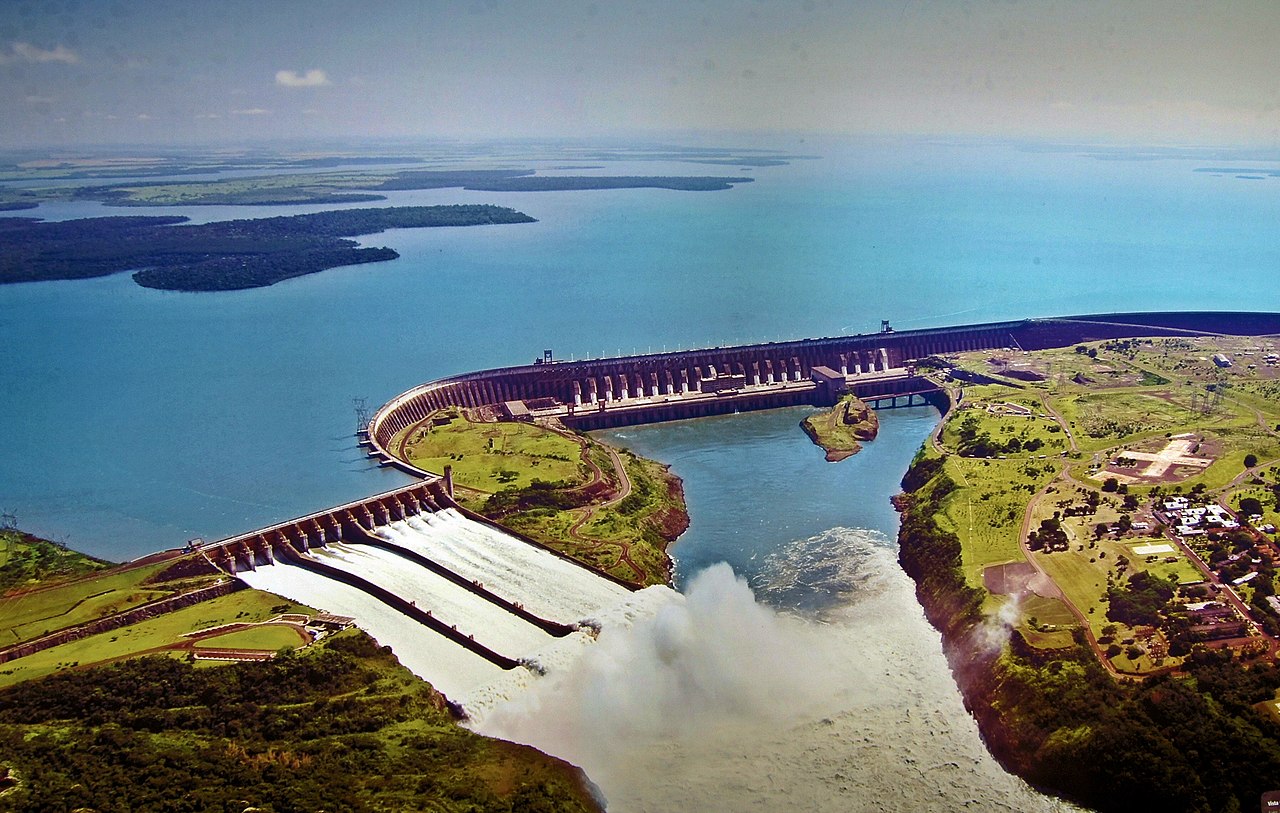
Itaipu's dam complex stretches 7,919 meters across the Paraná River valley, incorporating several dam types: a hollow gravity concrete main dam, an earthfill wing dam, a rockfill wing dam, and a concrete buttress dam. The main concrete section rises 196 meters above the riverbed. The total concrete volume of 12.3 million cubic meters was the largest of any dam at the time of construction.
The power station houses 20 turbine-generator units, each rated at 700 MW. Ten units generate at 60 Hz for Brazil's electrical grid and ten at 50 Hz for Paraguay's grid — a unique dual-frequency arrangement reflecting the different electrical standards of the two countries. Paraguay's surplus 50 Hz power is sold to Brazil and converted to 60 Hz at a massive frequency converter station.
Geographic Setting
- River: Paraná River
- Location: Foz do Iguaçu (Brazil) / Ciudad del Este (Paraguay)
- Coordinates: 25.41°S, 54.59°W
- Reservoir Area: 1,350 km²
The Paraná River is the second-longest river in South America (after the Amazon) and seventh-largest in the world by discharge. At the dam site, the river once thundered through the now-submerged Sete Quedas (Guairá) Falls, which by volume of water had been the largest waterfall system on Earth. The dam's reservoir drowned these falls permanently when it filled in 1982.
The reservoir extends 170 kilometers upstream along the Brazil-Paraguay border, occupying a subtropical landscape of rolling hills, Atlantic Forest remnants, and agricultural land. The Itaipu Biological Reserve, established along the reservoir's margins, protects 100,000 hectares of restored Atlantic Forest habitat and serves as a wildlife corridor in one of the most deforested biomes on Earth.
Hydroelectric Power
- Installed Capacity: 14,000 MW
- Record Annual Output: 103.1 TWh (2016)
- Turbines: 20 × 700 MW Francis turbines
- Power Split: 50% Brazil, 50% Paraguay (by treaty)
Itaipu's 20 turbines each weigh approximately 3,400 tonnes and can individually power a city of one million people. The dam's annual output regularly exceeds 90 terawatt-hours, and in 2016 it set a world record of 103.1 TWh. While the Three Gorges Dam surpassed Itaipu in installed capacity, Itaipu's more consistent water supply has allowed it to generate more cumulative electricity over its lifetime.
Under the 1973 Treaty of Itaipu, each country owns 50 percent of the dam's output. Paraguay consumes only about 15 percent of its share, selling the surplus to Brazil at a price set by treaty. This arrangement has been a source of ongoing political tension, with Paraguay periodically seeking higher compensation for its surplus energy.
Environmental & Social Impact
- People Displaced: ~10,000 families
- Sete Quedas Falls: Permanently submerged
- Conservation: 100,000-hectare biological reserve
The most irreversible environmental impact was the submersion of the Sete Quedas Falls, which had been a natural wonder of comparable grandeur to Iguazu Falls, located just 150 kilometers downstream. The falls' destruction was mourned internationally and remains a sensitive subject in the region. Approximately 10,000 families were displaced by the reservoir, along with diverse plant and animal communities.
To offset ecological damage, Itaipu Binacional operates one of the largest reforestation programs in South America, having planted over 43 million trees along the reservoir margins. The Itaipu Biological Reserve has become an important refuge for species such as jaguars, ocelots, and harpy eagles. The entity also maintains fish ladders and hatcheries to mitigate the dam's blockage of fish migration routes on the Paraná.
Key Facts
- Itaipu has generated more cumulative electricity than any other hydroelectric dam in history.
- Its 20 turbines produce 14,000 MW, supplying 15% of Brazil's and 86% of Paraguay's electricity.
- The dam complex stretches nearly 8 kilometers across the Paraná River valley.
- Construction permanently submerged the Sete Quedas Falls, once the world's largest waterfall by volume.
- The Itaipu Biological Reserve protects 100,000 hectares of restored Atlantic Forest.
Fun Facts
- Each of Itaipu's turbines could individually power the entire country of Paraguay's residential electricity demand.
- The amount of iron and steel used to build Itaipu would be enough to construct 380 Eiffel Towers.
- The reservoir filled in just 14 days in October 1982 due to the enormous flow of the Paraná River.
- Workers discovered and rescued over 37,000 animals during the reservoir filling, relocating them to higher ground.
Final Thoughts
Itaipu Dam is the undisputed champion of hydroelectric energy production, a testament to what binational cooperation can achieve on the world's great rivers. Its extraordinary output powers two nations, while its environmental programs attempt to heal the ecological wounds left by one of the largest construction projects in human history.
Test Your Knowledge!
Think you know the world's great dams and reservoirs? Try our geography quiz games!
Play Geography Games →