
Introduction
Malaysia 🇲🇾 and Singapore 🇸🇬 sit on the same stretch of Southeast Asian coastline, share a long tangled history, and are linked by causeways carrying some of the busiest land traffic on Earth. Yet almost everything about their geography operates at a different scale: one is a sprawling federation split across two land masses, the other a single dense island that doubles as both city and nation.
This side-by-side comparison walks through how the two countries differ across area, population, capitals, language, climate, and the natural features that define each. Whether you are studying for a geography class, planning a trip, or just curious, the tables below lay out the figures and the text explains what they actually mean.
Size & Geography
| Feature | Malaysia 🇲🇾 | Singapore 🇸🇬 |
|---|---|---|
| Area | 330,803 km² | 733 km² |
| Continent | Asia | Asia |
| Region | Southeast Asia | Southeast Asia |
| Land Borders | Thailand, Indonesia, Brunei | None (connected to Malaysia by causeways) |
| Landscape | Peninsular and East Malaysian portions; mountains, coastal plains, rainforests | lowlying island; gently undulating central plateau |
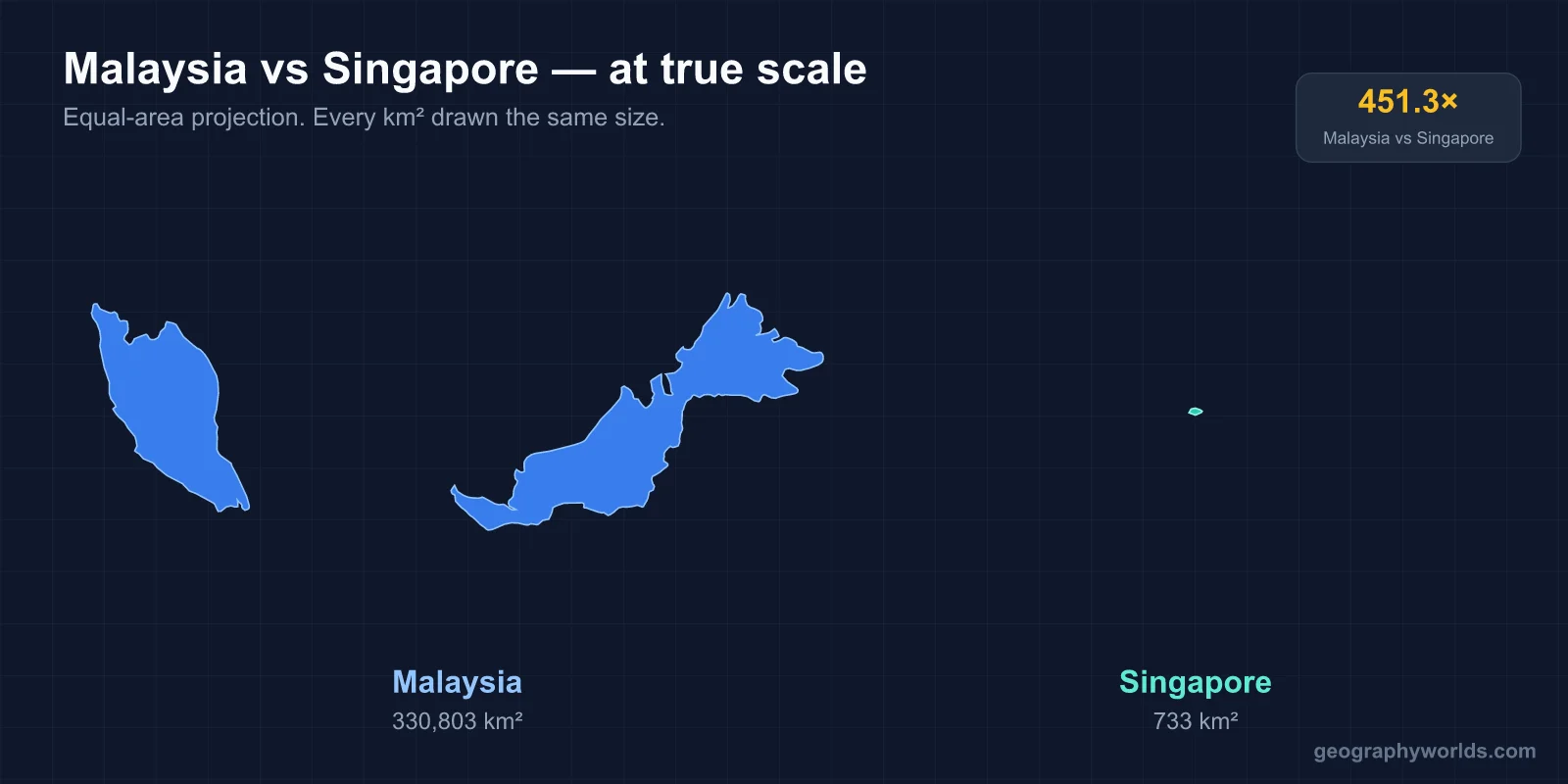
The gap in size is enormous. Malaysia covers 330,803 km² against Singapore's 733 km², making it roughly 451.3 times larger. Malaysia's territory is also split in two: Peninsular Malaysia on the mainland and East Malaysia on the island of Borneo, a layout that gives it mountains, coastal plains, and rainforests across both halves. Singapore, by contrast, is a single low-lying island with a gently undulating central plateau. That difference in landmass shapes nearly everything else, including who each country borders. Malaysia touches Thailand, Indonesia, and Brunei by land, while Singapore has no land border at all and instead connects to Malaysia across the Johor Strait by causeway.
Population & Demographics
| Metric | Malaysia 🇲🇾 | Singapore 🇸🇬 |
|---|---|---|
| Population | 36.4 million | 5.9 million |
| Population Density | 110.0 per km² | 8057.0 per km² |
Here the comparison flips in an instructive way. Malaysia is home to 36.4 million people, about 6.2 times Singapore's 5.9 million, so it leads on raw headcount. But once you account for land, the picture reverses sharply. Malaysia averages 110.0 people per km², while Singapore packs in 8,057.0 per km² — a gap of roughly 7,947.0 people per km². In other words, the larger population spreads across a vast territory, whereas Singapore concentrates almost six million people onto a single island, which is exactly why it ranks among the most densely settled places on the planet.
Capital Cities
Malaysia's capital is Kuala Lumpur, the federal seat best known for its skyline. Singapore presents an unusual case: the city of Singapore is also the country of Singapore, so the capital and the nation are effectively one and the same. Both lie in the Southeast Asia region of the Asian continent, but only one of them has the rest of a country surrounding it.
Language, Currency & Culture
| Aspect | Malaysia 🇲🇾 | Singapore 🇸🇬 |
|---|---|---|
| Languages | Malay (official), English, Mandarin, Tamil | English, Malay, Mandarin, Tamil (all official) |
| Currency | Malaysian Ringgit (MYR) | Singapore Dollar (SGD) |
Both countries are strikingly multilingual, and they even draw on the same pool of languages — Malay, English, Mandarin, and Tamil all appear on each side. The difference is in status. Malaysia names Malay as its sole official language, with English, Mandarin, and Tamil widely used alongside it. Singapore instead recognises all four as official languages, a reflection of its diverse Chinese, Malay, and Indian communities, and leans on English as the common working tongue. On money, the two part ways cleanly: Malaysia uses the Malaysian Ringgit (MYR), Singapore the Singapore Dollar (SGD).
Climate & Natural Features
| Aspect | Malaysia 🇲🇾 | Singapore 🇸🇬 |
|---|---|---|
| Climate | tropical; annual monsoons | tropical; hot, humid, rainy; no distinct seasons |
| Key Features | Borneo rainforest, Petronas Towers, Cameron Highlands | Marina Bay, Singapore Strait, compact city-state |
| Economy | electronics, palm oil, petroleum, tourism | finance, trade, technology, shipping hub |
Both countries sit just north of the equator and share a hot, wet, tropical climate. Malaysia's is shaped by annual monsoons, while Singapore stays hot, humid, and rainy year-round with no distinct seasons. Their natural and built landmarks reflect their scale: Malaysia spans the ancient Borneo rainforest, the cool Cameron Highlands, and the Petronas Towers in Kuala Lumpur, whereas Singapore's signatures are tightly clustered — Marina Bay, the busy Singapore Strait, and the compact city-state itself. Economically the split is just as telling. Malaysia balances electronics, palm oil, petroleum, and tourism across a resource-rich territory, while Singapore, with little land or raw material to draw on, has built its wealth on finance, trade, technology, and its role as a global shipping hub.
What Makes Each Country Unique
Malaysia is known worldwide for the Petronas Twin Towers, its multicultural cuisine, the rainforests of Borneo, and its island resorts. That Borneo rainforest is estimated at around 130 million years old — older than the Amazon — and shelters some of the richest biodiversity anywhere on Earth.
Singapore earns its reputation through Gardens by the Bay, Marina Bay Sands, world-class hawker food, and its standing as a global financial centre. It is also one of only three surviving city-states in the world, alongside Monaco and Vatican City, and is smaller in area than many individual cities elsewhere.
Key Differences at a Glance
- Area: Malaysia (330,803 km²) vs Singapore (733 km²) — Malaysia is 451.3x larger
- Population: Malaysia (36.4 million) vs Singapore (5.9 million) — Malaysia is 6.2x more populous
- Capitals: Kuala Lumpur vs Singapore
- Currency: Malaysian Ringgit (MYR) vs Singapore Dollar (SGD)
- Continents: Asia vs Asia
- Density: Singapore is more densely populated (difference of ~7947.0 people per km²)
- Languages: Malay (official) vs English
Verdict
Malaysia and Singapore make a revealing pair precisely because they are neighbors at such different scales. Malaysia wins decisively on land, at 451.3 times the area, and also leads on population by a factor of 6.2 — a reminder that the two measures usually go together. Singapore's edge shows up only when you divide one by the other: its density of 8,057.0 people per km² dwarfs Malaysia's 110.0, the natural result of fitting a whole country onto one island.
Beyond the numbers, each country has carved out a distinct identity. Malaysia leans on space and resources — monsoon-fed rainforests, an electronics and commodities economy, landmarks scattered from Borneo to Kuala Lumpur. Singapore turns its lack of land into an advantage, building a year-round tropical city-state around finance and trade and concentrating its attractions, like Marina Bay, into a few dense square kilometers.
Put together, the two show how proximity and shared history do not guarantee similar geography. Whether you are planning a visit, studying world geography, or simply curious, comparing them side by side is one of the clearest ways to see how size, population, and density interact.
Test Your Knowledge!
Think you know your countries? Try our interactive geography quiz!
Play Geography Games →