

Introduction
The Maldives is a nation of superlatives: the lowest country on Earth, the flattest country, and among the most geographically dispersed. Its 1,192 coral islands are grouped into 26 natural atolls stretching over 800 km through the Indian Ocean, southwest of Sri Lanka. No point in the entire country rises more than 2.4 meters above sea level.
These islands are the exposed tips of an ancient volcanic mountain range, now capped by coral reef growth over millions of years. The Maldives' extraordinary marine biodiversity, crystal-clear waters, and white sand beaches have made it one of the world's most sought-after tropical destinations, even as climate change and rising sea levels pose an existential threat to the nation's very existence.
Geography & Geology
- Total Islands: 1,192
- Inhabited Islands: ~200
- Total Land Area: 298 km²
- Highest Point: 2.4 meters above sea level
The Maldives is built atop the Chagos-Maldives-Laccadive Ridge, a submarine volcanic plateau. The volcanic peaks are long extinct and have subsided, but coral reefs continued growing upward, keeping pace with rising sea levels over millions of years. The result is a chain of ring-shaped atolls, each enclosing a shallow lagoon.
Despite stretching over 800 km from north to south, the total land area of the Maldives is only 298 km², smaller than many individual cities. The islands are typically no more than a few hundred meters wide, composed entirely of coral sand and lacking any rivers, mountains, or significant elevation.
Climate & Ecosystems
- Climate: Tropical monsoon
- Average Temperature: 26-30 degrees C year-round
- Coral Reef Area: ~8,920 km²
- Monsoon Seasons: Southwest (wet) May-November, Northeast (dry) January-March
The Maldives has a warm tropical climate moderated by the surrounding ocean. Two monsoon seasons govern the weather: the wetter southwest monsoon from May to November and the drier northeast monsoon from January to March. Temperatures remain remarkably stable year-round.
The nation's coral reef ecosystems are among the most extensive in the Indian Ocean, covering approximately 8,920 km². These reefs support an extraordinary diversity of marine life and protect the low-lying islands from wave erosion. However, coral bleaching events caused by rising ocean temperatures have severely damaged many reefs, with the 2016 event bleaching over 60% of coral across the archipelago.
Wildlife & Biodiversity
- Fish Species: Over 2,000
- Coral Species: Over 250
- Whale Shark Sightings: Year-round (South Ari Atoll)
- Manta Ray Population: Largest known population in Indian Ocean
The Maldives' waters host an extraordinary diversity of marine life. Over 2,000 species of fish, 250 species of coral, and 5 species of sea turtle have been recorded. The South Ari Atoll is renowned as one of the best places in the world to swim with whale sharks year-round, while the country's manta ray population is among the largest documented anywhere.
Terrestrial biodiversity is limited due to the tiny island size and lack of varied habitats. Coconut palms, pandanus, and breadfruit are the dominant vegetation. The grey heron is the national bird, and flying foxes (large fruit bats) are the only native mammals. The surrounding waters, however, also support dolphins, sea turtles, and various shark species.
Culture & Climate Threat
- Population: ~521,000
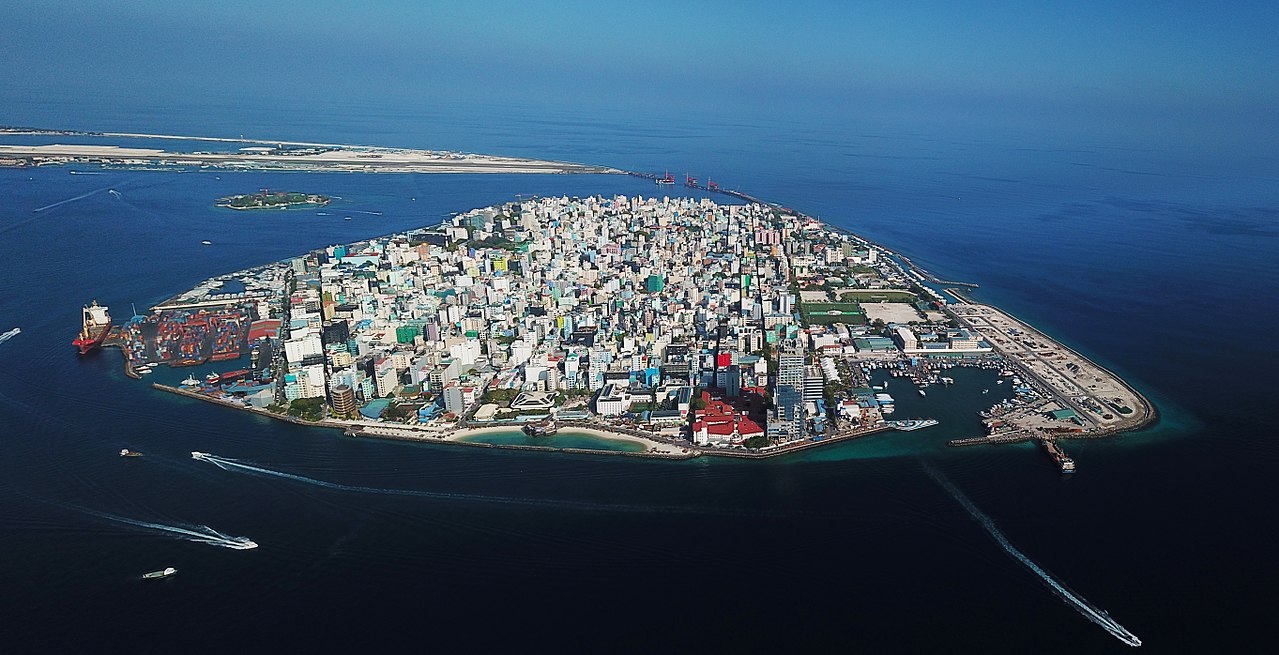
- Capital: Male (one of the world's most densely populated cities)
- Religion: Islam (100%)
- Sea Level Rise Threat: Could be uninhabitable by 2100
Maldivian culture has been shaped by its maritime environment. The Dhivehi language, related to Sinhalese, is the national language, and Islam has been the state religion since the 12th century. Fishing, particularly tuna, has been the traditional livelihood for centuries, and the pole-and-line method used by Maldivian fishers is considered one of the most sustainable fishing practices in the world.
Climate change poses an existential threat to the Maldives. With average elevations of just 1.5 meters, even modest sea level rise could render much of the country uninhabitable. The government has been one of the most vocal advocates for climate action on the world stage, and in 2009 held a cabinet meeting underwater to dramatize the threat.
Key Facts
- The Maldives is the world's lowest country, with no point exceeding 2.4 meters above sea level.
- The archipelago consists of 1,192 islands spread across 26 natural atolls over 800 km.
- Total land area is only 298 km², though the atolls span roughly 90,000 km² of ocean.
- Male, the capital, is one of the most densely populated cities in the world, with over 200,000 people on a 6 km² island.
- The Maldives could become uninhabitable within this century if sea levels rise as projected.
Fun Facts
- The Maldives held the world's first underwater cabinet meeting in 2009 to highlight the threat of sea level rise.
- Male is so densely populated that the government created an artificial island, Hulhumale, to provide more housing.
- The bioluminescent "sea of stars" caused by phytoplankton on Vaadhoo Island is one of the most photographed natural phenomena in the Maldives.
- Despite being 99.7% water by territory, the Maldives has no rivers, streams, or lakes.
Final Thoughts
The Maldives represents both paradise and peril. Its stunning coral atolls and marine biodiversity make it one of Earth's most beautiful places, while its extreme vulnerability to rising seas makes it a powerful symbol of the stakes of climate change for island nations worldwide.
