
The Matterhorn rises to 4,478 metres on the border between Switzerland and Italy, above Zermatt and Breuil-Cervinia. Its first ascent in July 1865 killed four of the seven men who made it, and the resulting scandal is generally taken to mark the end of the golden age of alpinism.
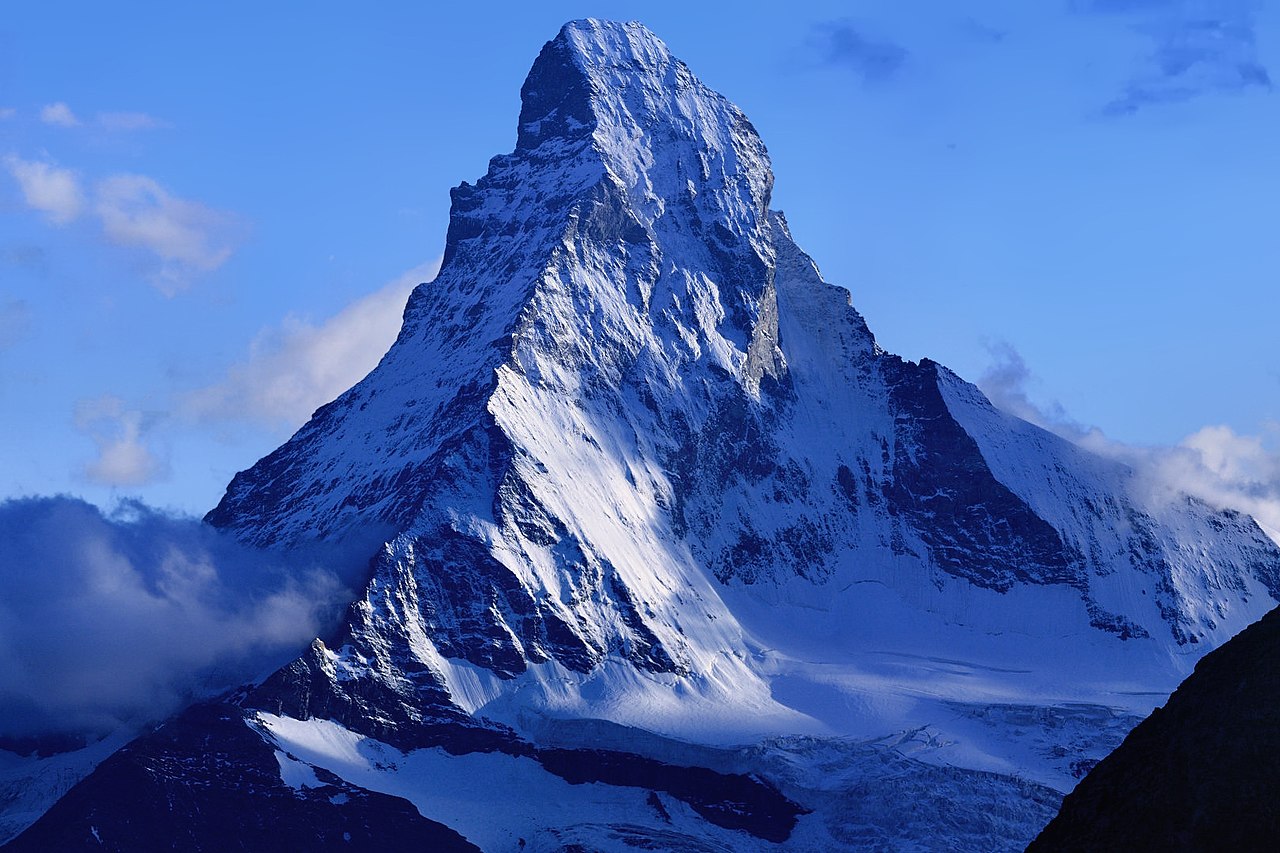
Where exactly it stands
The Matterhorn sits at the head of the Mattertal, on the watershed between the Rhône valley to the north and the Aosta valley to the south — and therefore on the divide between water reaching the Mediterranean via the Rhône and water reaching it via the Po.
It is not the highest peak even in its immediate neighbourhood. Monte Rosa, a few kilometres east, reaches 4,634 metres at the Dufourspitze, the highest point in Switzerland and the second-highest in the Alps, and the Weisshorn and Dom both exceed the Matterhorn. All of them are visited by a fraction of the attention, because none of them is shaped like that.
Four faces to the compass
The Matterhorn's shape is what makes it the most recognisable mountain in Europe and one of the most recognisable anywhere: a near-symmetrical pyramid with four faces oriented roughly to the four cardinal directions, and four ridges dividing them.
That form is glacial. During the ice ages, separate glaciers occupied cirques on each flank of the peak, and each cut backward into the mountain. Where several cirques erode toward one another, the rock between them is reduced to sharp ridges — arêtes — and where three or more meet, the result is a steep isolated pyramid known as a horn. The Matterhorn is the type example, and the German word for the shape is taken directly from its name.
The rock is not uniform. Geologically the summit belongs to the African plate: a slice of continental crust pushed over European rock during the Alpine collision, so the top of the Matterhorn is African material sitting on European material — one of the more striking illustrations of Alpine tectonics visible from a valley floor.
1865: the race and the accident
By the mid-1860s the Matterhorn was among the last major Alpine summits unclimbed, and it had a reputation for being impossible. Edward Whymper had attempted it repeatedly from the Italian side.
In July 1865, learning that an Italian party under Jean-Antoine Carrel was making an attempt, Whymper crossed to Zermatt and assembled a party at short notice: himself, Lord Francis Douglas, Charles Hudson, the nineteen-year-old Douglas Hadow, the guides Michel Croz and Peter Taugwalder with his son. They took the Hörnli ridge and reached the summit on 14 July, ahead of the Italians who were still on the other side.
The descent went wrong almost immediately. Hadow, the least experienced, slipped and knocked Croz off; Hudson and Douglas were pulled with them. The rope between Douglas and Taugwalder broke, and the four fell to the Matterhorn glacier some 1,200 metres below. Whymper and the two Taugwalders survived.
The broken rope became the centre of the controversy. It was an older, weaker line than the others the party carried, and an inquiry examined whether it had been used deliberately. No finding against the survivors was made, but suspicion attached to the Taugwalders for years, and Whymper carried the accident for the rest of his life. Three bodies were recovered; Lord Francis Douglas was never found.
The reaction, and the end of an era
The deaths caused a public sensation in Britain. Queen Victoria is said to have enquired whether mountaineering could be banned, and The Times ran editorials questioning what the entire pursuit was for.
The golden age of alpinism — the period from roughly 1854, with Alfred Wills on the Wetterhorn, to 1865 — had seen most of the major Alpine peaks climbed for the first time, largely by British climbers with Swiss and French guides. The Matterhorn was the last great prize, and its ascent both completed the project and discredited it in the public mind simultaneously.
What followed was a shift in emphasis. With the summits taken, attention moved to harder routes on peaks already climbed — the silver age, and then the pursuit of the great north faces in the twentieth century. The Matterhorn's own north face was not climbed until 1931, by the brothers Franz and Toni Schmid, who cycled from Munich to do it.
A very busy mountain
The Matterhorn is now one of the most climbed high peaks in the Alps, with a few thousand ascents in a good season, almost all by the Hörnli ridge from the Hörnli hut at 3,260 metres.
It is not a technically extreme route by modern standards — sustained scrambling and moderate climbing with fixed ropes on some sections — but it is long, loose in places, and busy. Parties start before dawn to avoid afternoon storms and to get down before the queues, and guides typically move fast with a single client.
The mountain has killed a large number of people, with estimates commonly cited above 500 since 1865, which makes it among the deadliest mountains in the world in absolute terms — a function of sheer traffic more than of extreme difficulty. Rockfall, storms, and parties moving too slowly account for most of it.
Climate change has begun to alter the climb directly: permafrost that cements the rock is thawing, and rockfall has increased, including a major collapse on the Hörnli ridge in 2003 that stranded climbers and prompted a mass helicopter evacuation.
Carrel, and the Italian ridge
Jean-Antoine Carrel, the Italian guide from Valtournenche whom Whymper beat to the summit, reached the top himself three days later by the Lion ridge from the Italian side — a harder line, and the one he had believed in for years.
Carrel's role in the story is often reduced to that of the loser in a race, which understates him. He had made repeated attempts over a decade, frequently with Whymper, and he had held to the conviction that the Italian ridge was the way when Whymper eventually abandoned it for the Hörnli. He was killed in 1890 on the mountain, having guided a party to safety through a storm and collapsed at the foot of the rocks.
The Italian ridge remains the harder of the two normal routes, fitted with fixed ropes and ladders in its steeper sections, and it is served by the Carrel hut. Far fewer parties use it than the Hörnli.
The hut, and the modern mountain
The Hörnli hut at 3,260 metres is the base for almost all ascents, and it was substantially rebuilt for the 150th anniversary of the first ascent in 2015. Places are limited and generally booked out well in advance for the short summer season, which functions as a de facto cap on how many people are on the ridge each day.
Guides typically leave around 4 a.m. and aim to be back at the hut by early afternoon, ahead of the thunderstorms that build over the Alps on summer days. A guided ascent is one of the more expensive single-day mountaineering engagements in Europe, and guides commonly turn clients back at a fixed time regardless of progress.
The mountain is also part of a working landscape. The Gornergrat railway, the Klein Matterhorn cable car — the highest in Europe at 3,883 metres — and an extensive lift system make the massif accessible to enormous numbers of people who never leave a marked path, and the tourism economy that supports Zermatt depends far more on them than on climbers. For the range as a whole, see our Alps guide.
Zermatt, and a mountain as an economy
Zermatt sits at 1,608 metres at the head of the Mattertal and is closed to internal-combustion cars — visitors arrive by train from Täsch, and local transport is electric. The village grew from a farming community to a resort almost entirely on the back of the mountain above it, beginning with the British climbers of the 1850s and 60s.
The Matterhorn's silhouette has become a commercial asset well beyond Switzerland. It is widely believed to have inspired the Toblerone packaging, it appears on Swiss branding of every kind, and its shape is one of the most reproduced natural forms in advertising.
On the Italian side, Breuil-Cervinia offers the other approach, and the mountain is Monte Cervino in Italian and Mont Cervin in French. Ski areas on both sides are linked across the border at altitude, making it possible to ski between two countries around the base of the peak.
Against Mont Blanc, the Alps' two famous mountains
The Matterhorn and Mont Blanc are the two most famous mountains in the Alps and they are not alike:
- Height: Mont Blanc is higher at 4,808 metres, and is the highest in western Europe. The Matterhorn is not even in the top ten Alpine summits by altitude.
- Shape: Mont Blanc is a broad snow dome; the Matterhorn is a sharp rock pyramid. The Matterhorn is far more photogenic and consequently far more famous.
- Difficulty: the standard route on Mont Blanc is easier technically but longer and higher; the Matterhorn's is shorter, steeper and more exposed.
- History: Mont Blanc's 1786 ascent began mountaineering; the Matterhorn's 1865 ascent closed its first chapter.