
Novarupta is a volcanic vent on the Alaska Peninsula that produced the largest volcanic eruption of the 20th century from June 6-8, 1912. The eruption ejected approximately 13 km³ of magma (30 km³ of tephra), making it roughly 30 times more powerful than the 1980 eruption of Mount St. Helens.
Introduction
Despite its enormous scale, the eruption occurred in one of the most remote inhabited regions of North America. No one was killed, though the nearest village of Kodiak, 160 km away, was buried under 30 cm of ash and plunged into darkness for three days. The eruption created the Valley of Ten Thousand Smokes, a vast ash-filled landscape.
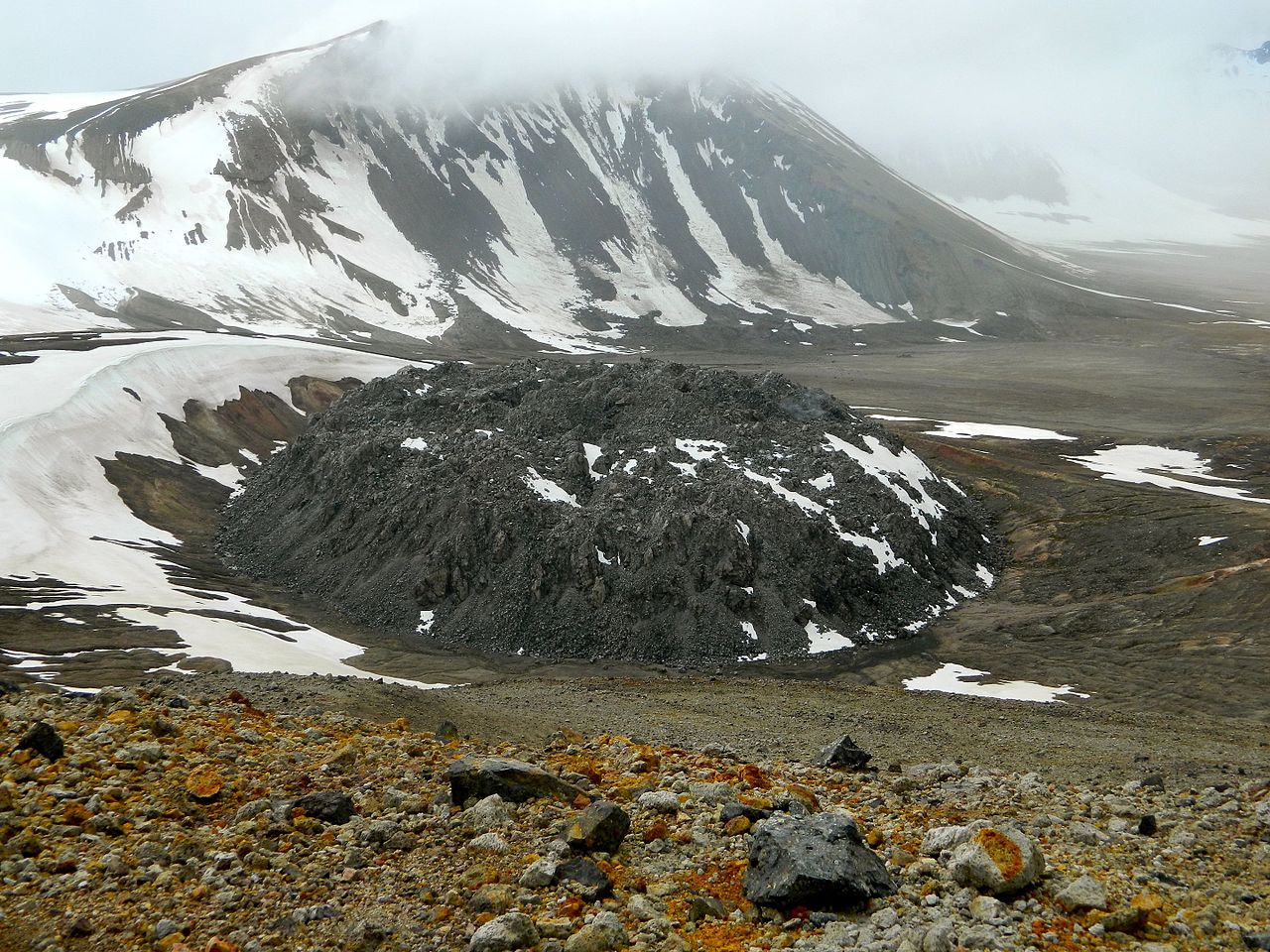
Geography & Location
- Location: Alaska Peninsula, USA (58.27°N, 155.16°W)
- Height: 841 m (2,759 ft)
- Type: Volcanic vent / rhyolitic dome
Novarupta is located within Katmai National Park and Preserve on the Alaska Peninsula, approximately 460 km southwest of Anchorage. It sits at the base of Mount Katmai, a larger stratovolcano whose summit collapsed during the 1912 eruption.
The name "Novarupta" means "new eruption" in Latin, given because the vent did not exist before 1912. It is a small, dome-capped vent only about 65 meters across — remarkably compact for the source of such a massive eruption.
Volcanic Activity
- 1912 Eruption: VEI 6, ~13 km³ of magma erupted
- Eruption Column: 32+ km into stratosphere
- Current Status: Quiet, no eruptions since 1912
The three-day eruption began with an explosive phase that sent an ash column over 32 km into the stratosphere. Pyroclastic flows raced down valleys, filling a wide glacial valley with over 200 meters of incandescent volcanic material that became the Valley of Ten Thousand Smokes.
The eruption was heard in Juneau, 1,200 km away, and ash fell on Seattle, 2,500 km distant. Acid rain damaged clothing hung to dry as far away as Vancouver, Canada. Global temperatures dropped approximately 1°C for the following year.
Eruption History
- 1912 Event: June 6-8, 60 hours of eruption
- Tephra Volume: ~30 km³ (dense rock equivalent ~13 km³)
- Katmai Collapse: Summit of Mount Katmai collapsed forming a caldera
For decades, the eruption was attributed to Mount Katmai, whose summit collapsed into a 4-km-wide caldera during the event. However, geological investigations in the 1950s and 1960s by volcanologist Garniss Curtis revealed that the actual eruption vent was Novarupta, 10 km west of Katmai.
The magma that fed Novarupta likely drained from beneath Mount Katmai through a subsurface conduit, causing Katmai's summit to collapse from loss of structural support. This discovery was one of the most important revisions in volcanological history.
Surrounding Ecosystem
- Valley of Ten Thousand Smokes: Vast pyroclastic flow deposit
- Katmai National Park: 16,564 km²
- Wildlife: Brown bears, salmon, eagles
The Valley of Ten Thousand Smokes was named by botanist Robert Griggs, who led a National Geographic expedition in 1916 and found thousands of steam vents rising from the still-hot pyroclastic deposits. By the 1950s, the fumaroles had cooled and ceased.
Katmai National Park is now famous for its brown bear population — the Brooks Falls bear-viewing area, where bears catch leaping salmon, is one of the most iconic wildlife-watching locations on Earth. The landscape around Novarupta remains largely barren volcanic terrain.
Cultural Significance
- National Park: Katmai established partly due to the eruption
- Scientific Legacy: Changed understanding of volcanic plumbing systems
- Remoteness: One of the least visited US national parks
The 1912 eruption prompted the National Geographic Society-funded expeditions of 1915-1919, led by Robert Griggs. His reports on the Valley of Ten Thousand Smokes led to the creation of Katmai National Monument in 1918, later expanded to a national park.
The discovery that Novarupta — not Katmai — was the true eruption source revolutionized understanding of how magma can move laterally underground. This concept is now recognized at many volcanic systems worldwide and has implications for hazard assessment.
Key Facts
- Novarupta's 1912 eruption was the largest of the 20th century at VEI 6.
- It ejected ~13 km³ of magma, roughly 30 times more than Mount St. Helens in 1980.
- The eruption created the Valley of Ten Thousand Smokes from massive pyroclastic flows.
- Ash fell as far as 2,500 km away in Seattle and acid rain reached Vancouver.
- The discovery that Novarupta (not Katmai) was the source changed volcanological understanding.
Fun Facts
- No one was killed because the area was so remote — the nearest village was 160 km away.
- The eruption was heard 1,200 km away in Juneau, Alaska.
- Robert Griggs named the Valley of Ten Thousand Smokes after seeing thousands of steam vents rising from the ash — none are active today.
- Novarupta's vent is only 65 meters across — remarkably small for the source of such a massive eruption.
Final Thoughts
Novarupta is a humbling reminder that the largest eruptions do not always make the biggest headlines. Occurring in one of the most remote corners of North America, this colossal event went largely unnoticed at the time. Its scientific legacy, however, has been enormous, reshaping our understanding of how volcanoes work beneath the surface.
Test Your Volcano Knowledge!
Think you know the world's most powerful volcanoes? Try our interactive quiz!
Play Geographic Features Quiz →