
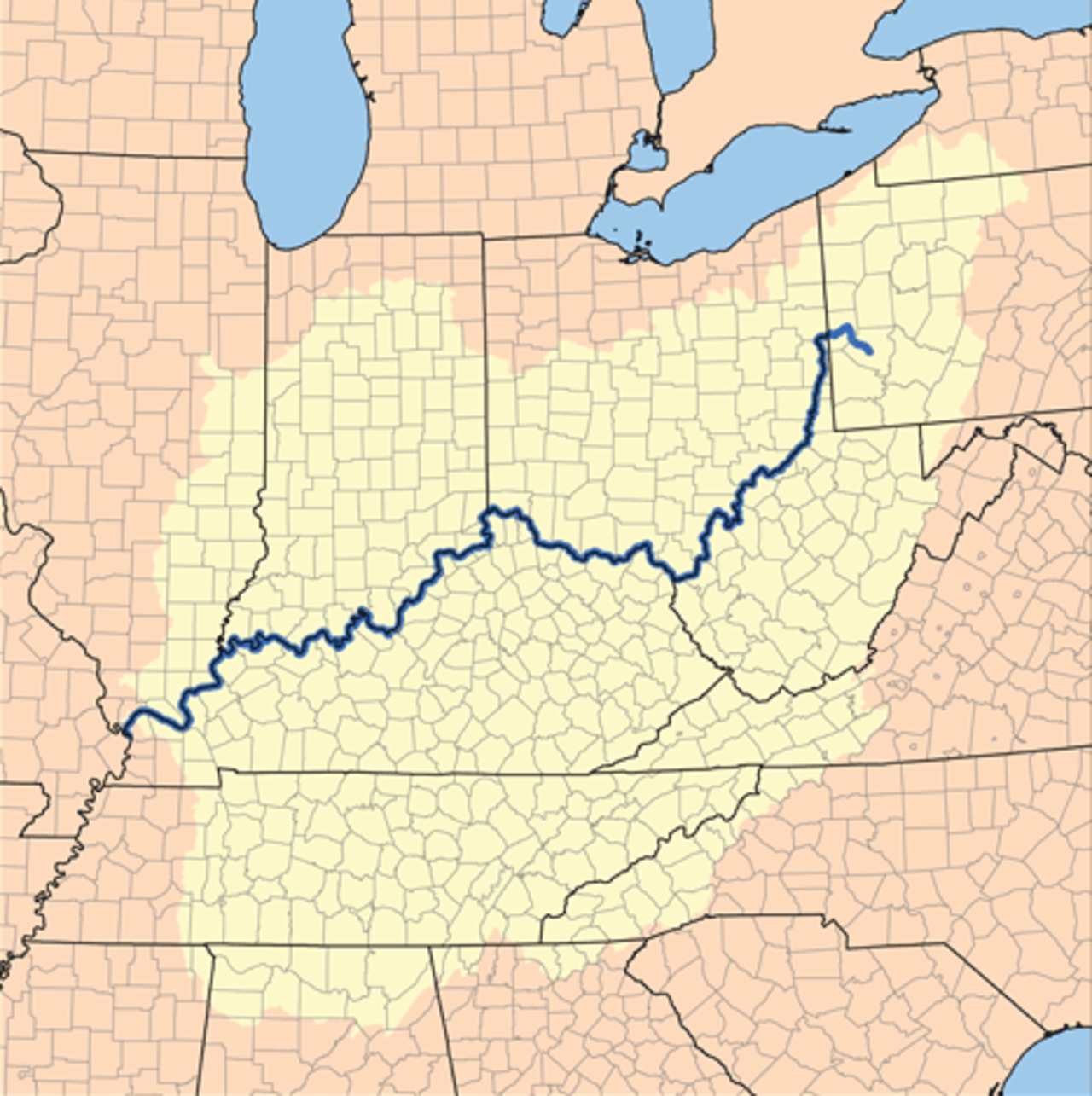
The Ohio River begins at the confluence of the Allegheny and Monongahela Rivers in downtown Pittsburgh, Pennsylvania, and flows 981 miles west and southwest to join the Mississippi River at Cairo, Illinois. Despite being shorter than the Mississippi above their junction, the Ohio actually contributes more water — its average discharge of 281,000 cubic feet per second exceeds the upper Mississippi's flow.
Introduction
The Ohio was the original gateway to the American West. For thousands of settlers in the 18th and 19th centuries, the river was the primary route from the Appalachian Mountains to the vast interior of the continent. Its valley became one of the nation's first industrial heartlands, and its waters have been both exploited and abused for over two centuries.

Geography & Dimensions
- Length: 981 miles (1,579 km)
- Drainage Basin: 204,000 sq miles (parts of 15 states)
- Average Discharge: 281,000 cu ft/s at mouth
- Source: Pittsburgh, PA (Allegheny + Monongahela confluence)
The Ohio River drains 204,000 square miles across parts of 15 states, from New York to Alabama. It forms the border between West Virginia and Ohio, then between Ohio and Kentucky, Indiana and Kentucky, and Illinois and Kentucky. Major tributaries include the Kanawha, Scioto, Miami, Wabash, Cumberland, and Tennessee Rivers.
The river drops only 429 feet over its 981-mile course, an extremely gentle gradient that made it navigable long before modern engineering. A system of 20 locks and dams maintains a minimum 9-foot navigation channel, allowing barges to carry over 230 million tons of cargo annually — more tonnage than passes through the Panama Canal.
History & Settlement
- Indigenous Peoples: Shawnee, Cherokee, Iroquois, Lenape
- Northwest Ordinance: 1787 — Ohio River as boundary for new territories
- Steamboat Era: First steamboat, New Orleans, 1811
- Underground Railroad: River served as boundary between slave and free states
The Ohio River valley was densely inhabited by Indigenous peoples for millennia. The Adena and Hopewell cultures built elaborate earthworks and mound complexes, including the Great Serpent Mound in southern Ohio. European-American settlement surged after the Revolutionary War, with the Northwest Ordinance of 1787 establishing the Ohio as the boundary between slave states to the south and free territories to the north.
This boundary gave the Ohio River a unique role in American history as a dividing line during the era of slavery. The river was a critical passage on the Underground Railroad, with freedom seekers crossing from Kentucky to Ohio under cover of darkness. Harriet Beecher Stowe set key scenes of Uncle Tom's Cabin along the Ohio, and the river remains a powerful symbol of the nation's struggle with slavery.
Industry & Commerce
- Cargo Volume: Over 230 million tons annually
- Power Plants: Numerous coal and natural gas plants along the river
- Major Cities: Pittsburgh, Cincinnati, Louisville, Evansville
- Locks & Dams: 20 locks and dams maintain navigation channel
The Ohio River valley was the cradle of American heavy industry. Pittsburgh's steel mills, Cincinnati's meatpacking plants, and Louisville's manufacturing facilities all relied on the river for transportation, water supply, and waste disposal. At its peak in the mid-20th century, the Ohio was one of the most polluted rivers in the United States, with stretches devoid of aquatic life.
Today, the Ohio remains one of the nation's busiest commercial waterways. Coal, petroleum, chemicals, grain, and aggregates move on barges that are far more fuel-efficient than trucks or trains. A single 15-barge tow on the Ohio carries the equivalent of 870 tractor-trailers. The river generates billions of dollars in economic activity annually.
Ecology & Recovery
- Fish Species: Over 160 species
- Mussels: Over 70 freshwater mussel species
- Clean Water Act: 1972 — triggered major cleanup
- Recovery: Fish populations rebounded significantly since 1970s
The passage of the Clean Water Act in 1972 began a dramatic transformation of the Ohio River. Cities and industries that had dumped raw sewage and industrial waste directly into the river were required to treat their discharges. Water quality improved steadily, and fish populations rebounded from near-zero in some stretches to over 160 species today.
The Ohio River supports one of the most diverse freshwater mussel communities in the world, with over 70 species documented. Freshwater mussels are among the most endangered groups of organisms in North America, and the Ohio's populations are critical for the survival of several species. The river also supports important recreational fisheries for bass, catfish, sauger, and walleye.
Challenges & Future
- Toxic Algae Blooms: Increasing frequency due to nutrient pollution
- Chemical Spills: 2014 Elk River spill contaminated water for 300,000
- Climate Change: More intense rainfall and flooding events
Despite decades of improvement, the Ohio River faces persistent challenges. Toxic algal blooms, fueled by agricultural runoff and warming temperatures, have become more frequent. The 2014 chemical spill on the Elk River in Charleston, West Virginia, contaminated the drinking water supply for 300,000 people and exposed the vulnerability of communities that depend on the river for water.
Climate change is increasing the intensity of rainfall events in the Ohio Valley, leading to more severe flooding. The river's system of locks and dams, many of which are over 50 years old, faces a maintenance backlog estimated at billions of dollars. Keeping the river navigable, clean, and resilient in the face of aging infrastructure and a changing climate is a major challenge for the coming decades.
Key Facts
- The Ohio River is 981 miles long and drains parts of 15 states.
- It contributes more water to the Mississippi than the Upper Mississippi itself.
- Over 230 million tons of cargo move on the Ohio annually — more than the Panama Canal.
- The river served as the boundary between slave and free states before the Civil War.
- Fish populations have rebounded from near-zero to over 160 species since the Clean Water Act.
Fun Facts
- The Ohio River technically begins at the exact spot where the Allegheny and Monongahela Rivers meet at Point State Park in downtown Pittsburgh.
- At Cairo, Illinois, the Ohio is actually wider than the Mississippi — the "smaller" river swallows the "bigger" one.
- The word "Ohio" comes from the Seneca (Iroquois) word "ohi-yo," meaning "great river" or "large creek."
- A paddlewheel steamboat race between the Robert E. Lee and the Natchez in 1870 was one of the most famous sporting events of the 19th century.
Final Thoughts
The Ohio River is a microcosm of American industrial history — from Indigenous civilizations to steel mills to environmental recovery. Its story is one of exploitation and renewal, and its future depends on continued investment in clean water, modern infrastructure, and ecological restoration.
Test Your Knowledge!
Think you know America's rivers? Try our interactive quiz!
Play Geography Games →