
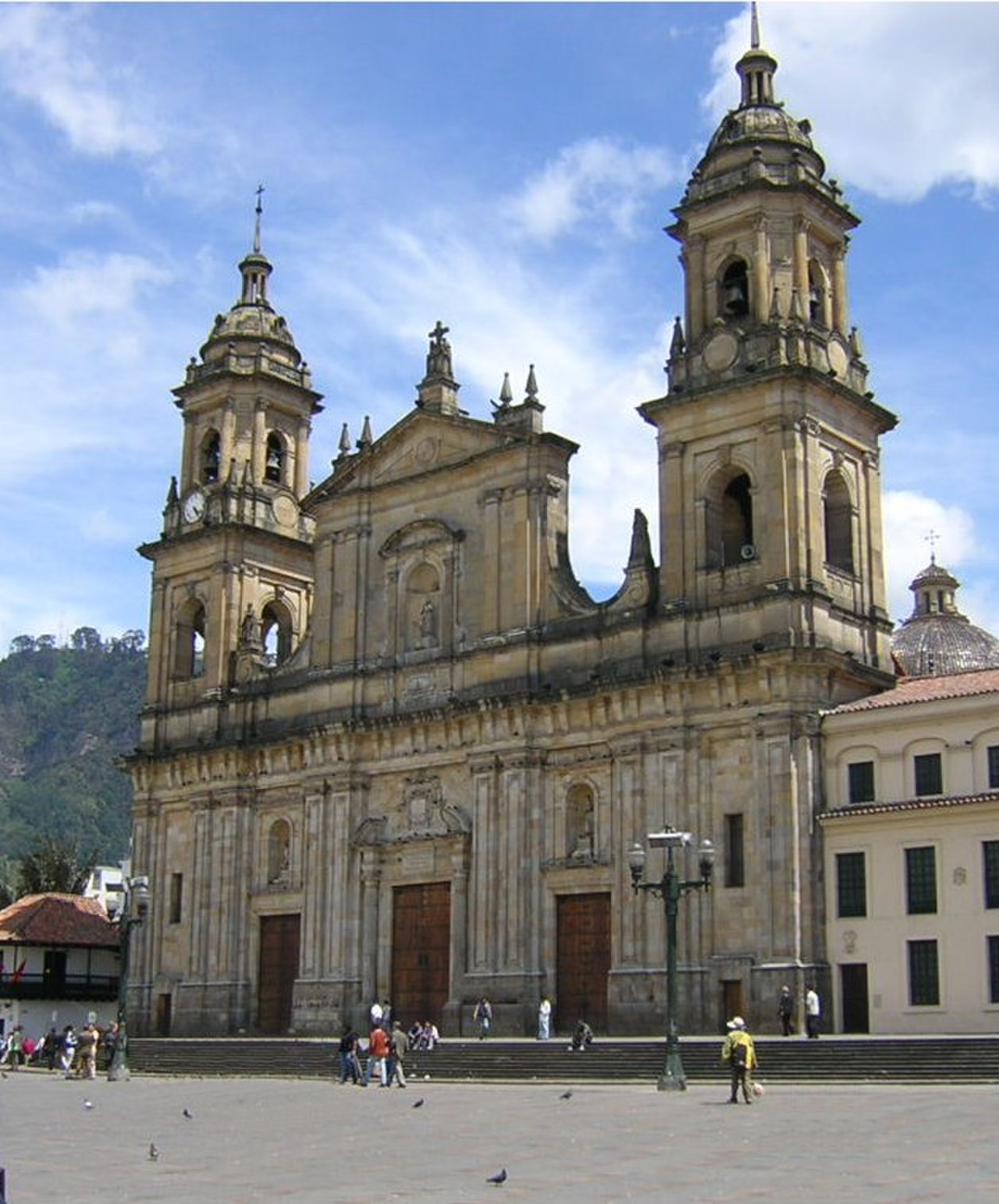
Colombia is a predominantly Catholic country. Most surveys put Roman Catholics at between about 60 and 80 per cent of the population, depending on the survey and the year. The Pew Research Center found 79 per cent in 2014, and more recent polls report lower figures as the share declines. Protestants, mostly evangelical and Pentecostal, make up around 13 to 20 per cent and are the fastest-growing group, and a growing minority say they have no religion. Since the 1991 constitution Colombia has had no official religion and guarantees freedom of worship, but Catholicism still shapes its calendar, its pilgrimages and much of its public life.
Gold at Guatavita: Before the Spanish
Colombia's most famous legend is religious. The Muisca people of the high plateau around today's Bogotá worshipped the sun and moon and held rituals at sacred lakes. According to Spanish chroniclers, when a new Muisca ruler took office he was covered in gold dust and rowed out onto Lake Guatavita on a raft, where he and his priests threw gold and emeralds into the water as offerings. That ceremony became the legend of El Dorado, "the gilded one", and it drew Spanish expeditions deep into South America. In 1969, farmers near Pasca found a small gold model of a raft carrying a ruler and attendants, apparently depicting the ritual. It is now one of the treasures of the Gold Museum in Bogotá.
Indigenous religions survive today, above all in the Sierra Nevada de Santa Marta, the isolated mountain range on the Caribbean coast. There the Kogi, Arhuaco and Wiwa peoples call themselves the "Elder Brothers", responsible for keeping the balance of the world. Their spiritual leaders, the mamos, are trained for years from childhood.
Cartagena and the Colonial Church
The Spanish founded Bogotá in 1538, and the Catholic Church became central to the colony. Cartagena, the main Caribbean port for the slave trade, was one of only three seats of the Spanish Inquisition in the Americas, established in 1610. Its Palace of the Inquisition is now a museum. The same city produced Colombia's best-loved saint, the Spanish Jesuit Peter Claver, who spent nearly forty years in the seventeenth century meeting slave ships and caring for enslaved Africans. He called himself "the slave of the slaves forever" and was canonised in 1888.
After independence the Church's place in the state was the main dividing line between Colombia's two parties, the Conservatives, who defended the Church's privileges, and the Liberals, who tried to limit them. The Conservative constitution of 1886 made Catholicism the religion of the nation, and a concordat with the Vatican in 1887 gave the Church control over much of education and marriage. In 1902 Colombia was formally consecrated to the Sacred Heart of Jesus. During La Violencia, the civil conflict of 1948 to 1958, some clergy openly took the Conservative side, and religious differences were part of the violence.
Freedom of Worship Since 1991
The constitution adopted in 1991, written by an assembly that included former guerrillas and Indigenous representatives, ended Catholicism's status as the national religion. It declared the equality of all religions before the law, and a 1994 law on religious freedom let Protestant churches and other faiths register and conclude agreements with the state. Civil marriage, divorce and secular education were confirmed. Colombia's Constitutional Court has since become one of the most liberal in Latin America, and it has legalised same-sex marriage (2016) and decriminalised abortion up to 24 weeks (2022) against the opposition of the Catholic hierarchy and evangelical leaders.
Pilgrimage Sites Across the Country
Colombian Catholicism is most visible at its great pilgrimage sites. The patroness of the country is Our Lady of the Rosary of Chiquinquirá, a sixteenth-century painting in Boyacá that, according to tradition, restored itself miraculously in 1586 after years of fading. In Bogotá, a cable car and a steep footpath climb to the church of Monserrate, about 3,150 m above sea level, where pilgrims visit the statue of the Fallen Lord, El Señor Caído. In the Valle del Cauca, the Basilica of the Lord of Miracles in Buga draws millions of visitors a year.
Two sites have become national landmarks. Near the Ecuadorian border, the neo-Gothic Sanctuary of Las Lajas, completed in 1949, stands on a bridge across the gorge of the Guáitara River, built around a rock where the Virgin is said to have appeared in the eighteenth century. North of Bogotá, the Salt Cathedral of Zipaquirá is carved inside a working salt mine about 180 m underground, with a nave, Stations of the Cross and a large cross cut into the rock salt. The present cathedral opened in 1995. For how Colombia's faith compares with its neighbours', see our overview of religion in Peru.
Holy Week in Popayán
The most elaborate religious festival in Colombia is Holy Week in Popayán, the white-painted colonial city in the south-west. Its night processions have been held since the sixteenth century. Carriers in purple robes bear heavy wooden platforms with colonial religious sculptures through the streets, stopping at every corner in a fixed choreography. UNESCO recognised the processions as intangible cultural heritage in 2009. The river town of Mompox, on the Magdalena, holds equally old Holy Week ceremonies.
Popes, Saints and the Peace Process
Colombia has welcomed three popes. Paul VI's visit to Bogotá in 1968 was the first by a pope to Latin America. John Paul II came in 1986, and Francis in September 2017, when he supported the peace agreement with the FARC guerrillas and beatified two priests killed during the conflict. Colombia also has its own native saint, Laura Montoya, a teacher who founded a missionary order to work among Indigenous communities and was canonised in 2013.
Faith and the Armed Conflict
Religion ran through Colombia's long armed conflict. In the 1960s some Catholic priests were drawn to liberation theology. The best known, Camilo Torres Restrepo, a sociologist and priest from a prominent Bogotá family, joined the ELN guerrillas and was killed in his first combat in February 1966, becoming a symbol for the revolutionary left. The Church later became one of the main mediators between governments and armed groups, and priests and nuns in remote regions were often the only outside presence in communities caught between guerrillas, paramilitaries and the army.
Churches were not always sanctuaries. On 2 May 2002, in the Chocó village of Bojayá, a gas-cylinder bomb fired by FARC guerrillas during fighting with paramilitaries crashed through the roof of the church where residents had taken shelter, killing scores of people, many of them children. A crucifix from the church, which lost its arms and legs in the blast, became known as the Black Christ of Bojayá. Pope Francis prayed before it in Villavicencio in 2017.
The Rise of the Evangelicals
Protestant missions arrived in the nineteenth century, but for most of the twentieth century Protestants faced hostility, and during La Violencia some were attacked. Since the 1980s, evangelical and Pentecostal churches have grown rapidly, especially in poorer city neighbourhoods and regions affected by the conflict, and many large churches now run television channels and social programmes. Evangelicals have also become a political force. They have founded parties such as MIRA and Colombia Justa Libres, and in the 2016 referendum on the peace agreement with the FARC, many evangelical leaders campaigned against the deal, objecting to what they called "gender ideology" in its text. The "No" side won by less than half a percentage point, and the agreement was renegotiated before being approved by Congress.
A Catholic Calendar
The religious calendar shapes national life. Christmas begins on the night of 7 December with the Día de las Velitas, when families light candles and paper lanterns in windows, on balconies and along streets for the Feast of the Immaculate Conception. From 16 to 24 December, families gather each evening to pray the novena de aguinaldos, sing carols and eat traditional foods such as buñuelos and natilla. Colombia has one of the highest numbers of public holidays in the world, about eighteen a year, and many are Catholic feasts. Under the Emiliani Law of 1983, several of them are moved to the following Monday, creating long weekends known as puentes, or bridges.
Afro-Colombian and Other Traditions
Colombia's Afro-Colombian communities, concentrated on the Pacific and Caribbean coasts, have kept distinctive religious traditions. In San Basilio de Palenque, a village founded by escaped slaves in the seventeenth century and recognised by UNESCO for its cultural traditions, the lumbalú funeral rites combine African music and dance with Catholic practice. The village also keeps its own language, Palenquero, one of the few Spanish-based creole languages in the world, with many words of Central African Bantu origin. On the Pacific coast, communities sing alabaos, sung prayers for the dead. Small Muslim communities, many descended from Lebanese and Syrian traders, live in Maicao on the Venezuelan border, whose large mosque opened in 1997, and on the Caribbean island of San Andrés. There are also Jewish communities in Bogotá, Barranquilla and Cali. The rest of the country is described in our guide to Colombia.