
Nigeria is one of the most religiously balanced large nations on Earth, split almost evenly between Islam and Christianity. Roughly 53% of Nigerians are Muslim, concentrated in the northern states, while about 46% are Christian, dominant in the south. Traditional African religions account for around 1%, though their influence runs far deeper than the figure suggests. With a population of about 220 million, Nigeria is Africa's most populous country, and this near-perfect religious divide makes faith a defining force in its politics, culture, and daily life.

The Religious Makeup of Nigeria
No single faith holds a clear majority in Nigeria, which is precisely what makes its religious landscape so distinctive. The two great world religions exist here in almost equal measure, divided not only by belief but by geography, ethnicity, and history. The result is a country that contains within its borders one of the largest Muslim populations in the world and one of the largest Christian populations as well.
| Religion | Percentage |
|---|---|
| Islam | 53% |
| Christianity | 46% |
| Traditional religions | 1% |
This balance is more than a statistic. Because Nigeria is so populous, even the 1% figure for traditional religions represents over two million people, and indigenous beliefs quietly shape the practices of millions more who also identify as Muslim or Christian. Religious affiliation in Nigeria is rarely a private matter; it is interwoven with regional identity, language, and political loyalty.
Islam in the North
Islam is the faith of the majority across northern Nigeria, spanning the Hausa, Fulani, and Kanuri peoples among others. Nigerian Muslims are predominantly Sunni and follow the Maliki school of jurisprudence, the dominant legal tradition across much of West Africa. Sufi brotherhoods, especially the Qadiriyya and Tijaniyya orders, have long shaped religious devotion in the region, while reformist and Salafi movements have grown in recent decades.
The Sultan of Sokoto is regarded as the spiritual leader of Nigerian Muslims, a position rooted in the legacy of the Sokoto Caliphate. In twelve northern states, Sharia law operates alongside the secular legal system, governing criminal and personal matters for Muslim citizens. The rhythm of life in the north is shaped by the five daily calls to prayer, Friday congregational worship, and the month of Ramadan, during which public life slows as millions observe the fast.
Christianity in the South
Christianity dominates the southern and much of the central belt of Nigeria, embraced widely by the Igbo, Yoruba, and many smaller ethnic groups. Nigerian Christianity is strikingly diverse. Roman Catholics and Anglicans form long-established communities dating to the missionary era, while the Pentecostal and Charismatic movement has exploded in size and influence since the late twentieth century.
Mega-churches such as the Redeemed Christian Church of God, Winners' Chapel, and the Mountain of Fire and Miracles Ministries now count members in the millions and have planted congregations across Africa, Europe, and the Americas. Nigerian pastors are among the most globally recognised religious figures of their generation. In the Christian south, Sunday worship is central to community life, and churches run extensive networks of schools, universities, and hospitals.
Traditional African Religions
Long before Islam or Christianity arrived, the peoples of what is now Nigeria practised rich indigenous religions. The Yoruba tradition, with its pantheon of orisha deities such as Ogun, Sango, and Osun, is among the most influential, having travelled across the Atlantic to shape faiths like Santería and Candomblé in the Americas. The Igbo honoured a supreme creator, Chukwu, alongside ancestral spirits, while many northern communities held their own pre-Islamic beliefs.
Although only about 1% of Nigerians formally identify with traditional religion today, these beliefs rarely disappeared entirely. Many Nigerians blend ancestral practices, festivals, and spiritual ideas with their Muslim or Christian faith. The ancient Nok terracotta sculptures, dating back more than 2,000 years, hint at sophisticated spiritual and artistic traditions that long predate the world religions now dominant in the country.
A History of Two Faiths
Islam reached northern Nigeria through trans-Saharan trade routes from around the 11th century, becoming firmly rooted through the Kanem-Bornu Empire and the Hausa city-states. The Sokoto Caliphate, founded by the scholar and reformer Usman dan Fodio in 1804, became one of the largest and most influential Islamic states in Africa, unifying much of the north under a single religious authority.
Christianity arrived later. Portuguese traders brought it to the coast in the 15th century, but it spread in earnest only through 19th-century British and other European missionaries working in the south. Colonial rule then hardened the religious geography: the British practised indirect rule in the north, preserving Islamic authority, while in the south missionary schools spread Christianity and Western education. Since independence in 1960, this inherited divide has remained deeply entangled with ethnic and regional politics.
Religious Sites and Landmarks
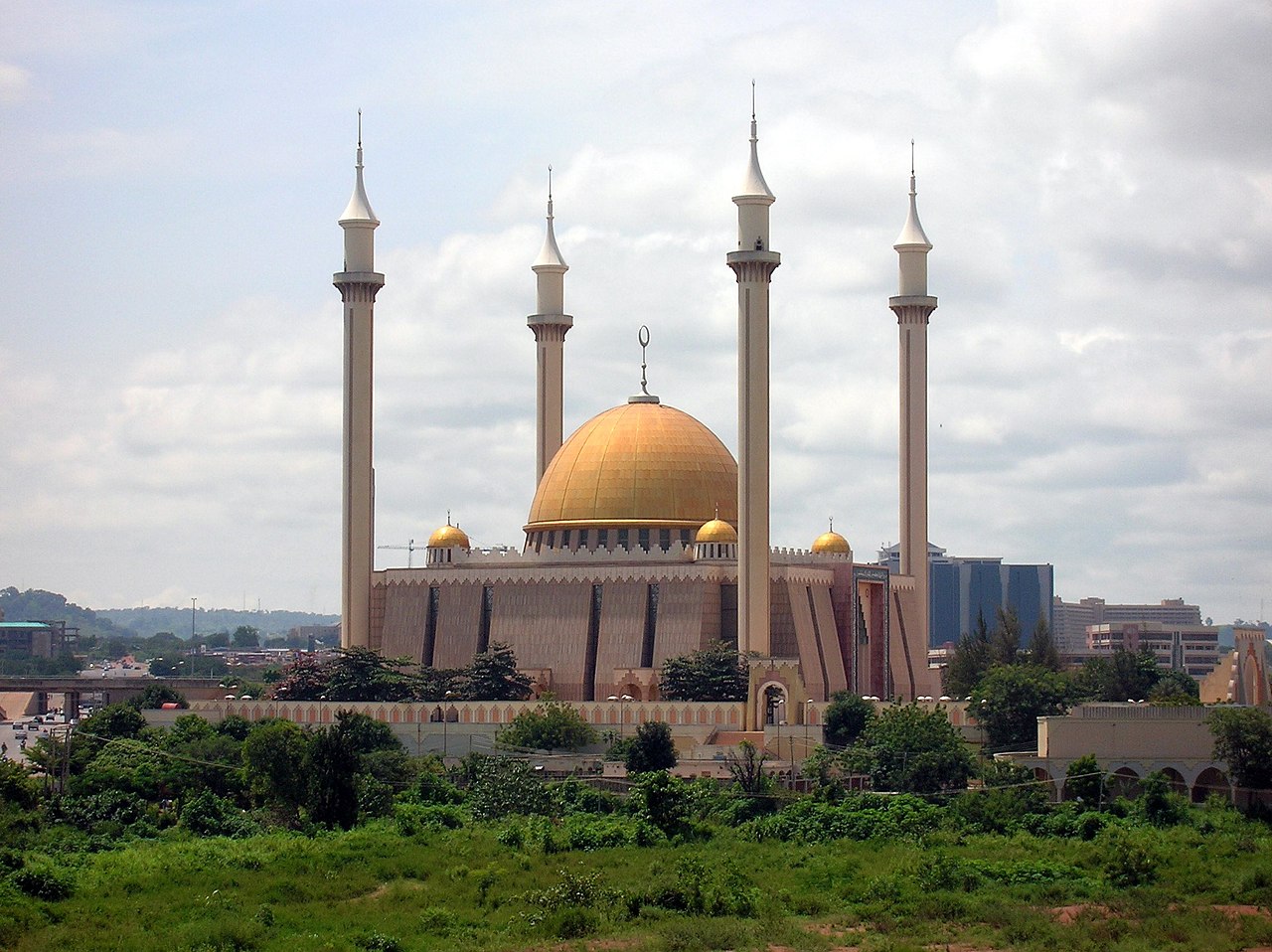
Nigeria's religious duality is written into its architecture. In the capital, the Abuja National Mosque and the Abuja National Christian Centre stand near one another, deliberate symbols of a nation balanced between two faiths. The Sultan of Sokoto's mosque remains the spiritual heart of Nigerian Islam.
In the south, the Cathedral Church of Christ in Lagos is one of West Africa's most significant Anglican churches, while the Redeemed Christian Church of God's Redemption Camp along the Lagos-Ibadan expressway hosts the monthly "Holy Ghost Service," among the largest religious gatherings in the world. You can explore more about the country's capital in our Abuja city guide.
Religion, Society, and Politics
Faith touches nearly every aspect of Nigerian public life. Religious identity influences marriage, business partnerships, schooling, and voting patterns. An informal political convention often sees presidential tickets balanced between a Muslim and a Christian to reflect the national divide. Inter-faith relations are mostly peaceful in daily life, with Muslims and Christians living and working side by side across much of the country.
Yet the north-south religious boundary remains Nigeria's most sensitive social fault line, and tensions over land, resources, and politics have at times erupted into violence in the central "Middle Belt" region. Managing this delicate equilibrium between two great faiths is among the central challenges of governing Africa's largest nation.
Key Facts
- Largest religion: Islam, around 53% of the population
- Second largest: Christianity, around 46%
- Traditional religions: roughly 1%, with wider underlying influence
- Geographic split: Muslim-majority north, Christian-majority south
- Dominant Islamic tradition: Sunni, Maliki school of law
- Sharia states: 12 northern states apply Sharia for Muslims
- Spiritual leader of Muslims: the Sultan of Sokoto
Frequently Asked Questions
Is Nigeria a Muslim or Christian country?
Nigeria is officially a secular state with no national religion. In practice it is divided almost evenly, with a Muslim majority of around 53% in the north and a Christian population of around 46% in the south, making it both a major Muslim and a major Christian nation.
What is the most practised religion in Nigeria?
Islam is the most widely practised religion overall, followed by about 53% of Nigerians, mainly in the northern states. Christianity follows closely at around 46% and dominates the southern and central regions.
Are there other religions in Nigeria besides Islam and Christianity?
Yes. Traditional African religions, such as Yoruba orisha worship and Igbo ancestral beliefs, account for roughly 1% of the population formally. Their influence is far broader, however, as many Nigerians blend indigenous customs with Islam or Christianity. Smaller communities of other faiths also exist.
Why is Nigeria split between Islam and Christianity?
The divide reflects history. Islam spread south across the Sahara into northern Nigeria from the 11th century, while Christianity arrived later through European missionaries along the southern coast. British colonial policy then reinforced this geographic split, leaving a Muslim north and a Christian south.
Test Your Geography Knowledge!
Think you know your world geography? Try our interactive quizzes!
Play Geography Games →