
Somalia is close to 100 per cent Sunni Muslim, following the Shafi'i school of law, with non-Muslims numbering at most a few hundred people in a population above 20 million. Islam is the state religion, the constitution requires that no law contradict sharia, and proselytising any other faith is prohibited. The country's religious conflict is therefore not between faiths but within one: between the Sufi practice that has defined Somali Islam for centuries and the Salafi-jihadist movement that has spent nearly two decades trying to eradicate it.
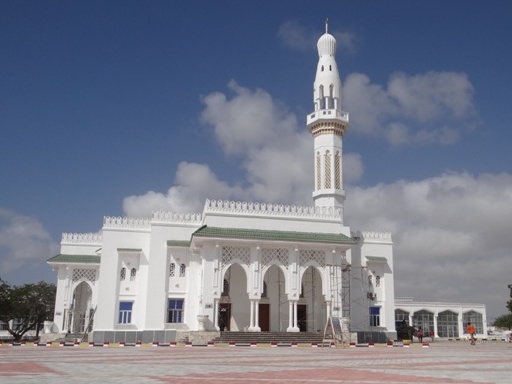
Islam Arrived Early, and by Sea
The Somali coast faces Arabia across a narrow strait, and Islam reached it within the first century of the faith through trade rather than conquest. The port towns — Zeila, Berbera, Mogadishu, Merca, Barawa — were commercial and cosmopolitan, connected to Yemen, the Gulf and the Indian Ocean routes, and they were Muslim long before the interior.
Conversion inland proceeded through the same mechanisms that worked elsewhere in the Horn: itinerant teachers, marriage into pastoral lineages, and the attachment of Muslim genealogies to existing clan structures. Most Somali clans trace descent to Arab ancestors associated with the spread of Islam, a claim that is genealogically doubtful and socially foundational.
Three Legal Systems at the Same Time
Somalis have historically governed themselves through the interaction of three bodies of law, and the arrangement still operates where the state does not.
- Xeer, Somali customary law, an oral system of contracts between clans administered by elders, centred on compensation — diya paid in camels for injury or death — and on collective responsibility of the lineage group.
- Sharia, applied principally to matters of family, inheritance and personal conduct, administered by qadis.
- Statutory law, inherited from Italian and British colonial codes and from the Barre state, functional in some places and nominal in others.
The boundaries are negotiated case by case. A killing may be settled by xeer compensation between clans even where sharia would prescribe otherwise, because the clan system supplies the enforcement that no court does. Understanding Somali religious life means recognising that clan and faith are not competing loyalties but interlocking ones.
The Sufi Orders That Shaped Somali Islam
Somali Islam has been overwhelmingly Sufi in character. The Qadiriyya, the oldest order in the country, was carried and reshaped in the nineteenth century by scholars such as Uways al-Barawi of Barawa, who preached in Somali, composed devotional poetry in the vernacular and built a following across the south before being killed in 1909.
The Ahmadiyya order — a Sufi tariqa founded by Ahmad ibn Idris, and unconnected to the separate Ahmadi movement of South Asia — and its offshoot the Salihiyya arrived later and were more reformist in temper, sceptical of saint veneration and of the use of tobacco and khat.
The orders established agricultural settlements, known as jamaat, along the Shabelle and Juba rivers, which functioned as religious communities, farms and refuges from clan conflict. Many of the sedentary communities of southern Somalia formed around them.
The Sayyid and the Dervish State
The towering figure of modern Somali history is a religious one. Sayyid Mohammed Abdullah Hassan, a Salihiyya shaykh and an accomplished poet, launched a rebellion in 1899 against British, Italian and Ethiopian encroachment and built the Dervish state, which held territory in the north for two decades.
He fortified Taleh with stone forts, fought British columns to a standstill repeatedly, and was finally broken in 1920 when Britain used aircraft against him — among the earliest uses of air power in colonial warfare. British writers called him the Mad Mullah; Somalis regard him as the founder of the national resistance, and his poetry is still recited.
His movement was religious and nationalist at once, and it set a template: in Somalia, Islamic authority has repeatedly been the vehicle through which political authority is claimed, because it is the one identity that crosses clan lines.
Saints, Tombs and the Mawlid
Traditional Somali practice includes veneration of awliya, saints, whose tombs are visited for blessing and intercession. Aw-Barkhadle, near Hargeisa, is associated with a thirteenth-century shaykh credited with devising a Somali method for teaching the Arabic alphabet and with converting the region.
Saints' days, or siyaaro, and the mawlid commemorating the Prophet's birth, are observed with recitation, drumming and communal meals. Somali devotional poetry and song developed into a substantial literature, much of it composed in Somali rather than Arabic, which made the tradition accessible to people who did not read.
Al-Shabaab's Break With All of It
Al-Shabaab emerged from the youth wing of the Islamic Courts Union after Ethiopian forces removed the Courts from Mogadishu in 2006, and it has controlled substantial rural territory in southern Somalia for much of the period since.
Its interpretation of Islam is Salafi-jihadist and imported, and it is explicitly hostile to Somali religious tradition. Between 2008 and 2010 its fighters destroyed Sufi shrines and exhumed the graves of revered shaykhs, on the doctrine that veneration of the dead is idolatry. It banned the mawlid, music, cinema and — in a measure aimed at a near-universal Somali habit — the chewing of khat. It has imposed amputations and stonings, and has barred aid agencies from areas facing famine.
None of this had precedent in Somali practice, and the destruction of the shrines in particular was experienced as an attack on Somali identity rather than a theological correction.
When the Sufis Took Up Arms
The response was unusual. Ahlu Sunna Waljama'a had existed since the early 1990s as a Sufi organisation defending traditional practice by argument. After the desecration of the tombs, it formed militias, took territory in the central regions, and fought Al-Shabaab directly, at points in alliance with the federal government and with Ethiopian forces.
A Sufi movement raising an army to protect graves is not a common event in modern Islamic history, and it indicates how far the shrine destruction cut. Ahlu Sunna has since been drawn into the fractious politics of federal member states, but its formation remains the clearest evidence that Somalia's religious division is real and is felt at village level.
A Cathedral Left as a Ruin
Mogadishu Cathedral, built in 1928 in Norman Gothic style by the Italian colonial administration, was among the largest churches in Africa at the time. It was sacked in 1989, when the bishop of Mogadishu was assassinated, and wrecked in the civil war that followed. Al-Shabaab destroyed what remained of the structure in 2008.
Its shell still stands in the centre of the capital. Christianity in Somalia today consists of a handful of individuals, almost all of them converts who conceal the fact, plus a small foreign presence. Conversion from Islam carries severe social consequences and, in areas under Al-Shabaab, death. A 2020 announcement that Mass might be celebrated again in Mogadishu drew enough hostile reaction that it did not proceed.
Somaliland, Puntland and the Same Question
Somaliland, which declared independence in 1991 and is not internationally recognised, has a religious composition indistinguishable from the rest of the Somali territories: Sunni Shafi'i, Sufi-inflected, with Islam as the state religion and a constitutional bar on any other faith being propagated.
What differs is the security situation, which has allowed traditional religious authority and clan elders to function without the pressure applied further south. The elders' council institutionalised in Somaliland's upper house, the Guurti, is an example of exactly the fusion of customary and religious authority that Al-Shabaab rejects.
The Dugsi, and How Children Learn
Religious education begins early and almost universally at the dugsi, the Quranic school, where children memorise the text from wooden boards under a teacher, usually before or alongside any secular schooling. In much of rural Somalia the dugsi has been the only education available for decades, and a boy who completes memorisation acquires the title of hafiz and real standing in his community.
This system survived the collapse of the state in 1991 intact, because it requires nothing more than a teacher, a board and ink. Where ministries, universities and schools disappeared, the dugsi continued, which is a large part of why religious literacy in Somalia is high while general literacy is low.
Women's Religious Life, and a Contested Practice
Somali women's religious practice has historically run through separate channels — women's dhikr circles, saints' day gatherings, and the recitation of devotional poetry — and women were prominent in the Sufi devotional tradition without holding formal clerical office.
The most difficult issue in contemporary Somali religious debate is female genital cutting, which is near-universal in Somalia and is frequently justified in religious terms. It is not an Islamic requirement and predates Islam in the Horn, and Somali religious scholars are publicly divided: some have issued rulings against the most severe form, others defend the practice. Campaigns against it inside the country have generally worked by seeking religious rulings rather than by appealing to international norms, because the latter carry little weight and the former can.
Ramadan, Remittances and the Diaspora
Ramadan reorganises Somali life comprehensively, and it also reorganises money: remittances from the diaspora spike sharply during the month and again before Eid, sent through the hawala networks that have substituted for a banking system for decades and that operate on trust relationships with a strong religious framing.
Diaspora communities in Minneapolis, London, Toronto, Nairobi and the Gulf have built mosques that serve as the organising centres of Somali life abroad, and they are also where arguments about Somali Islam now partly take place — between older Sufi-oriented generations and younger Somalis exposed to Salafi currents online. A fuller picture is in our Somalia country guide, the neighbourhood in our Horn of Africa guide, and the placement question in which continent Somalia is part of.
